Documentary collection

Archives of the House of Rapontchombo

Engravings, watercolours, museum objects, deeds, reports: the world’s public collections keep the trace of King Denis, his lineage and the Mpongwe of the estuary.

Le Tour du Monde, 1865

The king, in his lifetime

The estuary shore, 1862: the photographer Auguste Houzé de l’Aulnoit captured the features of King Denis. Three years later, Le Tour du Monde published Dr Griffon du Bellay’s account, illustrated with engravings by Émile Bayard and Thérond after these photographs. The original is at the musée du quai Branly; the engravings, in the public domain, come from Gallica.
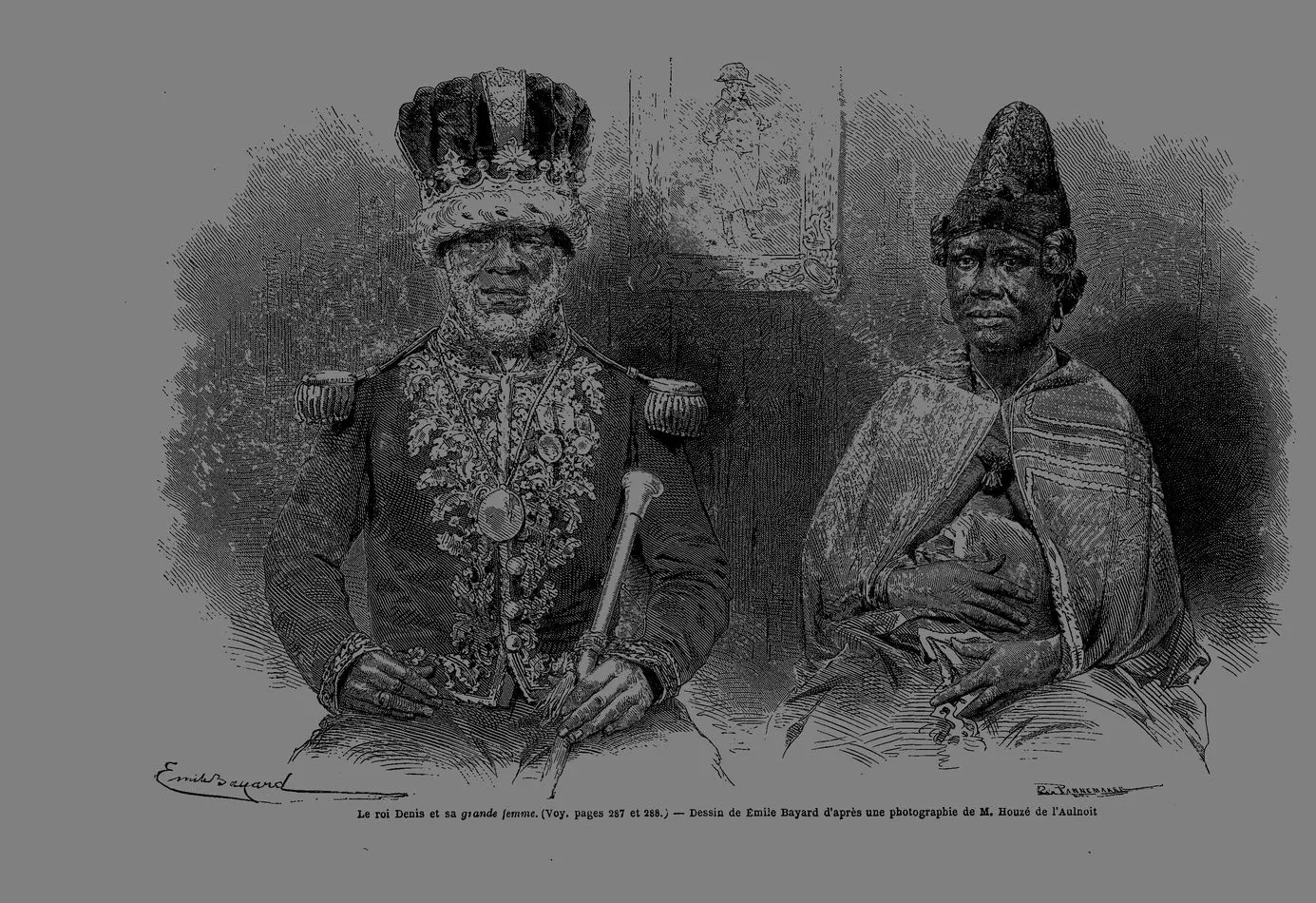
Engraving: King Denis in a uniform with epaulettes and, above, the portrait of his great wife
King Denis and his great wifePlate on p. 277: drawing by Émile Bayard after a photograph by M. Houzé de l’Aulnoit, taken in Gabon around 1862, in the king’s lifetime.Le Tour du Monde, 1865 · Source gallica.bnf.fr / BnF · public domain
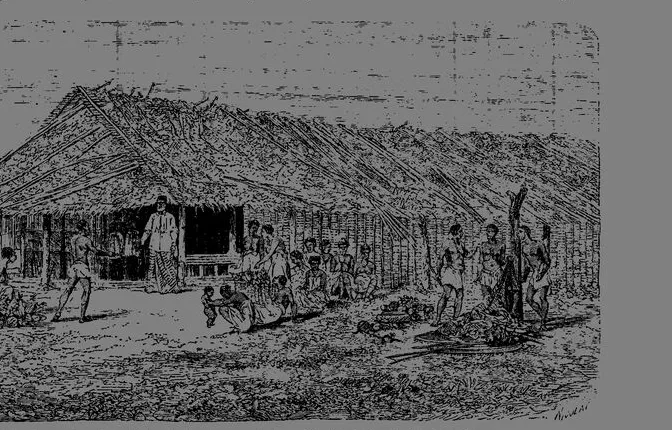
Engraving: King Denis’s Bwiti temple, a large hut with a leaf roof, surrounded by figures
King Denis’s Bwiti temple at Pointe-DenisGabon, 1865 · p. 288, captioned « La case du roi Denis » (King Denis’s hut): drawing by Thérond after a photograph by M. Houzé de l’Aulnoit.Le Tour du Monde, 1865 · Source gallica.bnf.fr / BnF · public domain
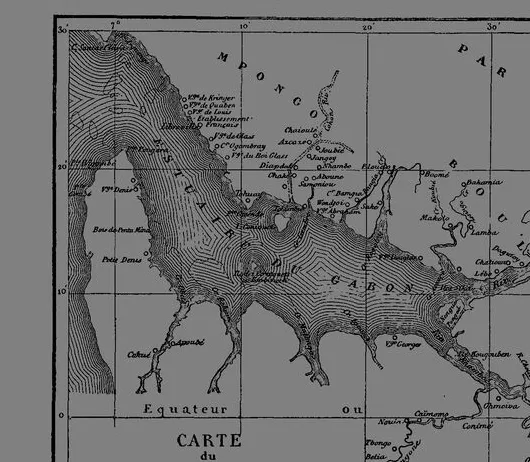
Engraved map of the Gabon estuary in 1865
Map of Gabonp. 279: after the most recent publications of the Ministry of the Navy: the estuary, its clans and its trading posts.Le Tour du Monde, 1865 · Source gallica.bnf.fr / BnF · public domain
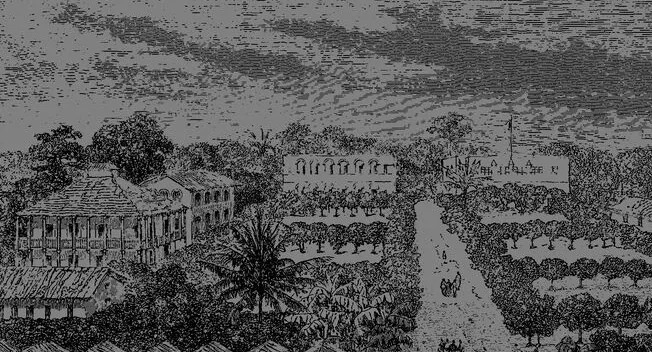
Panoramic engraving of the French trading post in Gabon in 1865
Bird’s-eye view of the Gabon trading postp. 273: drawing by Thérond after a watercolour by M. Vallon, commander: the French trading post facing the lands of King Denis.Le Tour du Monde, 1865 · Source gallica.bnf.fr / BnF · public domain
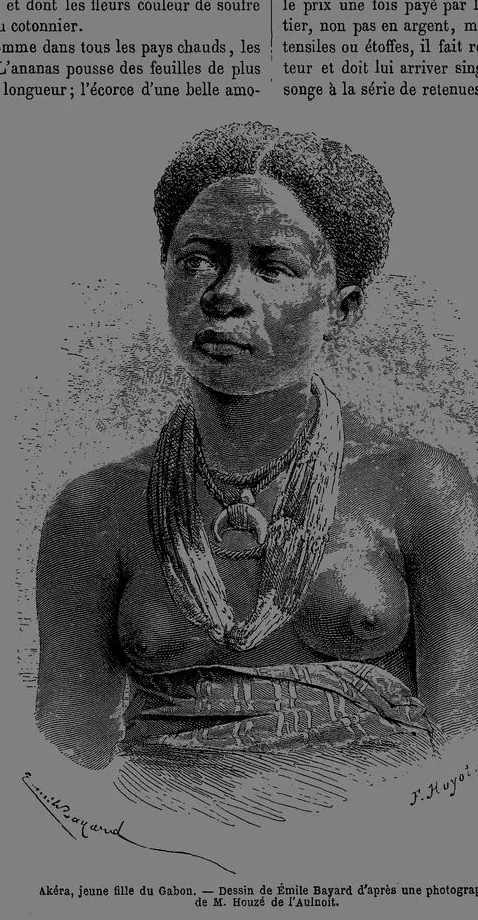
Engraving: head-and-shoulders portrait of Akéra, a young Mpongwe girl with bead necklaces
Akéra, a young girl of Gabonp. 285: drawing by Émile Bayard after a photograph by M. Houzé de l’Aulnoit: a young Mpongwe woman of the estuary, adorned with necklaces.Le Tour du Monde, 1865 · Source gallica.bnf.fr / BnF · public domain

Musée du quai Branly · Jacques Chirac, Paris

The Houzé de l’Aulnoit album, 1861-1862

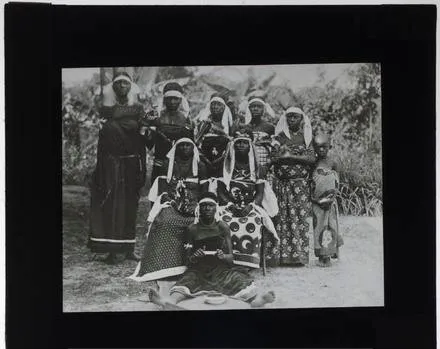
The earliest photographic record of Gabon. Stationed on the estuary from 1861 to 1863, the naval lieutenant Auguste Houzé de l’Aulnoit photographed King Denis, his wives and his hut. Albumen prints, bound in the album « Côtes occidentales d’Afrique, Gabon », held at the musée du quai Branly · Jacques Chirac. Reproductions follow the museum’s official records; the author died in 1895, and his photographs are in the public domain. Added to these, a lantern slide from the musée de l’Homme: the Ivenga dance, photographed between 1900 and 1933.
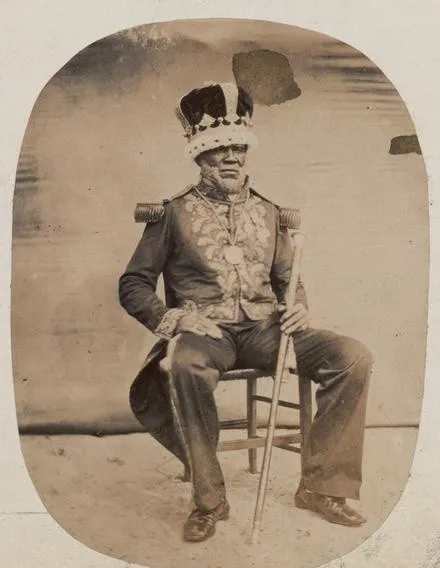
Photograph of 1862: King Denis seated, feathered crown, embroidered uniform with epaulettes, sceptre in hand
King Denis, 1862King Denis Rapontchombo (1780-1876), chief of the left bank of the Gabon, seated and wearing the royal regalia: crown and sceptre. Albumen print captioned in pencil « Roi Denis ».Musée du quai Branly - Jacques Chirac, inv. 70.2008.16.1.82 · photograph by Houzé de l’Aulnoit, public domain
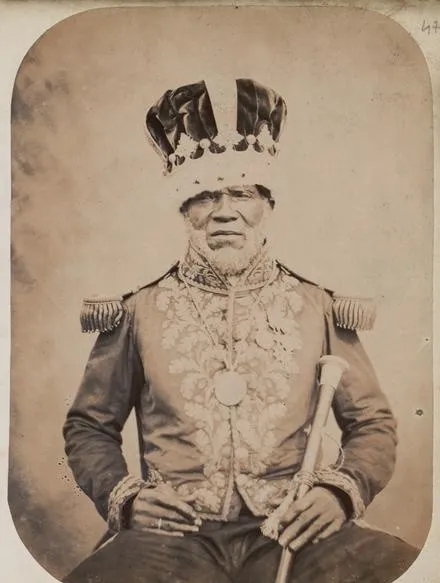
Half-length portrait of King Denis crowned, the medal on his chest, the sceptre against his shoulder
King Denis, 1862Half-length portrait of the king wearing crown and sceptre. Handwritten pencil caption beneath the print: « Le roi Denis 1862 ».Musée du quai Branly - Jacques Chirac, inv. 70.2008.16.1.115 · photograph by Houzé de l’Aulnoit, public domain
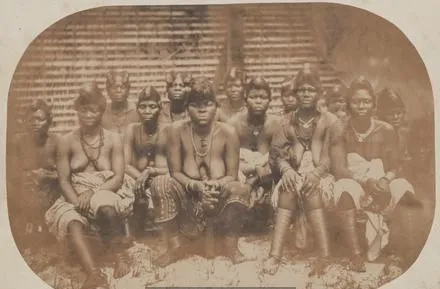
Photograph of January 1862: some twenty seated women, tall hairstyles and bead necklaces
Wives of King Denis, January 1862The king’s wives gathered before a wall of mats, showing off their hairstyles and jewellery. Caption in ink: « Femmes du Roi Denis, Rivière du Gabon, Côtes occid. d’Afrique ».Musée du quai Branly - Jacques Chirac, inv. 70.2008.16.1.181 · photograph by Houzé de l’Aulnoit, public domain
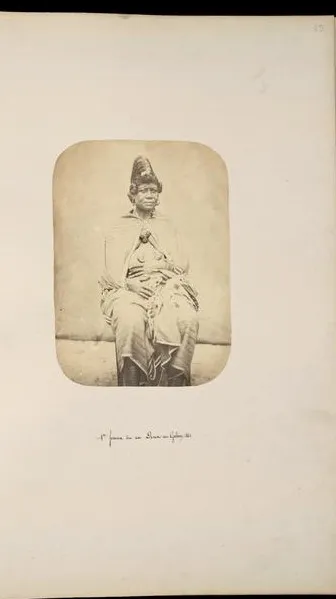
Album plate: the first wife of King Denis seated, draped, with a tall chignon
First wife of King DenisThe king’s first wife, seated, in ceremonial dress with her hair in a chignon, 1861-1862. Album plate, captioned in ink « 1ère femme du roi Denis au Gabon 1861 ».Musée du quai Branly - Jacques Chirac, inv. 70.2008.16.2.25 · photograph by Houzé de l’Aulnoit, public domain
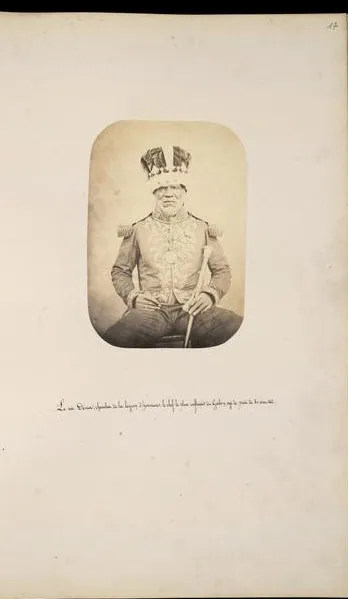
Album plate: portrait of King Denis crowned, a calligraphed ink caption beneath the print
King Denis I in royal insignia, 1862Half-length portrait of the king in royal regalia, 1862. The handwritten caption calls him “Knight of the Legion of Honour, the most influential chief in Gabon” (« chevalier de la Légion d’honneur, le chef le plus influent du Gabon »). The family corrects this: the Legion of Honour belongs to King Denis II, Louis Denis Marie Félix Adandé Rapontchombo, the king’s son.Musée du quai Branly - Jacques Chirac, inv. 70.2008.16.2.17 · photograph by Houzé de l’Aulnoit, public domain
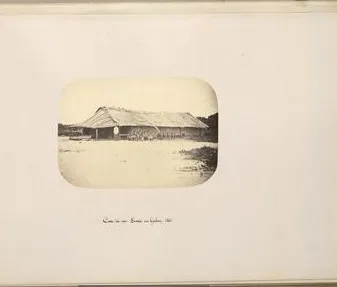
Album plate: King Denis’s hut, a long building with a leaf roof, figures before the entrance
King Denis’s hut in Gabon, 1861The king standing before his dwelling, a group of seated women and four crouching men to his left: the temple of Pointe-Denis photographed as early as 1861.Musée du quai Branly - Jacques Chirac, inv. 70.2008.16.2.8 · photograph by Houzé de l’Aulnoit, public domain
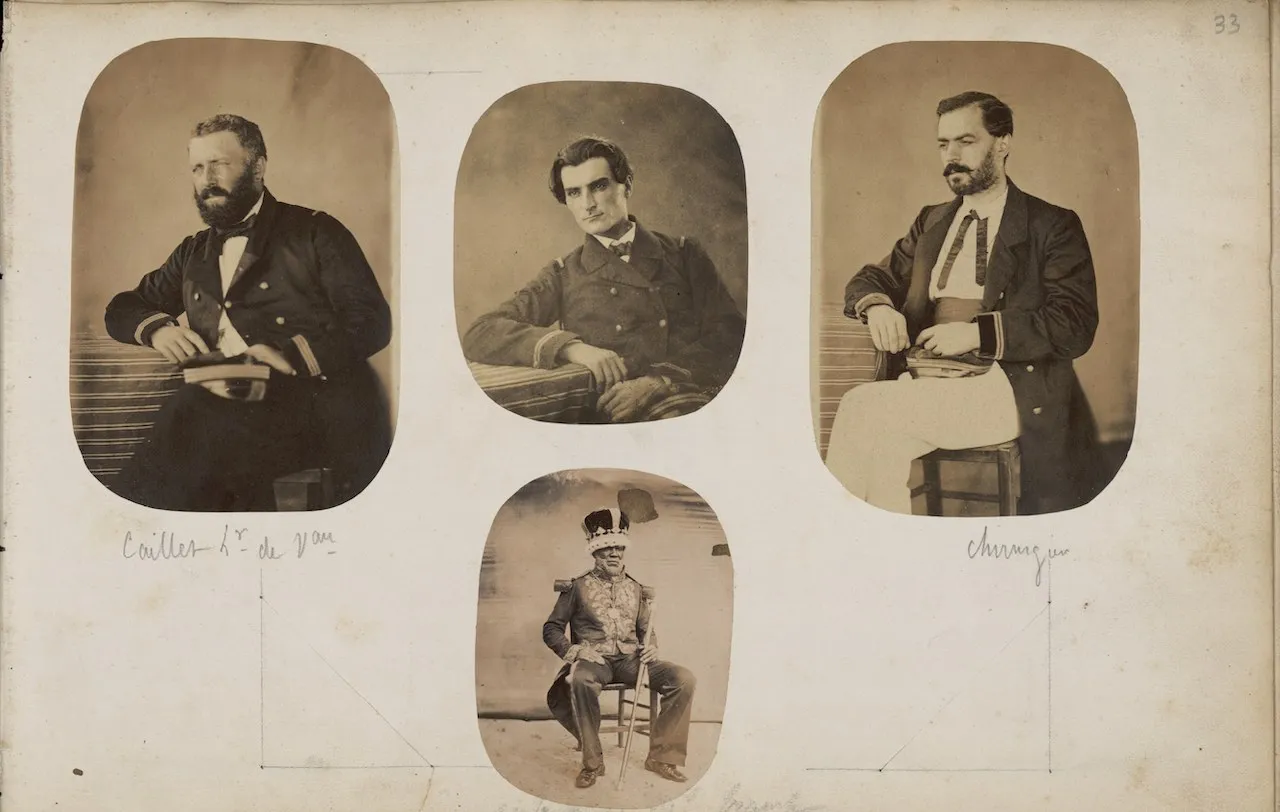
Album plate: three portraits of French officers and, at the bottom centre, King Denis seated in royal regalia
The king among the officers, plate 33Plate from Houzé de l’Aulnoit’s personal album, “mixing different kinds of images”: the portrait of King Denis in royal regalia sits beside those of the station’s officers, “Caillet, lieutenant de vaisseau” and the surgeon.Musée du quai Branly - Jacques Chirac, inv. 70.2008.16.1.82 · photographs by Houzé de l’Aulnoit, 1862, public domain
Lantern slide: a dozen Mpongwe women in ceremonial costume posing as a group
The Ivenga dance, 1900-1933Lantern slide from the photographic library of the musée de l’Homme: « Gabon. Mpongwé. Danse de l’Ivenga », a group posing in ceremonial costume, headscarves and wrappers printed with crescents and stars.Musée du quai Branly - Jacques Chirac, photothèque du musée de l’Homme · anonymous photograph, 1900-1933, public domain

Around the treaty of 1839

The watercolours of Darondeau

A painter aboard ship with the French Navy, Stanislas Darondeau (1807-1841) painted “King Denys”, whom the family identifies as King Denis II, and his circle at the very time of the treaty: the oldest known portraits of the family, published by Colonel Frey in 1890.

Watercolour: King Denis II, Louis Denis Marie Félix Adandé Rapontchombo, seated in an embroidered uniform, a wife beside him
Denys, king of the left bank of the GabonWatercolour by Stanislas Darondeau, contemporary with the treaty of 1839. According to the family, this “King Denys” is King Denis II, Louis Denis Marie Félix Adandé Rapontchombo, son of King Denis I: in uniform, seated beside one of his wives.Frey, Côte occidentale d’Afrique (1890), p. 368 · New York Public Library / Wikimedia Commons · public domain
Watercolour: Petit Denys seated, in a frogged jacket
Petit Denys, nephew of King DenysWatercolour by Darondeau, from the same voyage: a nephew of the king, in a frogged military jacket.Frey, Côte occidentale d’Afrique (1890), p. 371 · NYPL / Wikimedia Commons · public domain
Engraving: King Louis standing, sabre in hand
Anguilè Ré-Dowé, known as King LouisMpongwe chief of the right bank, contemporary and rival of King Denis, to set the estuary of the period in context.Wikimedia Commons · public domain

Family archives

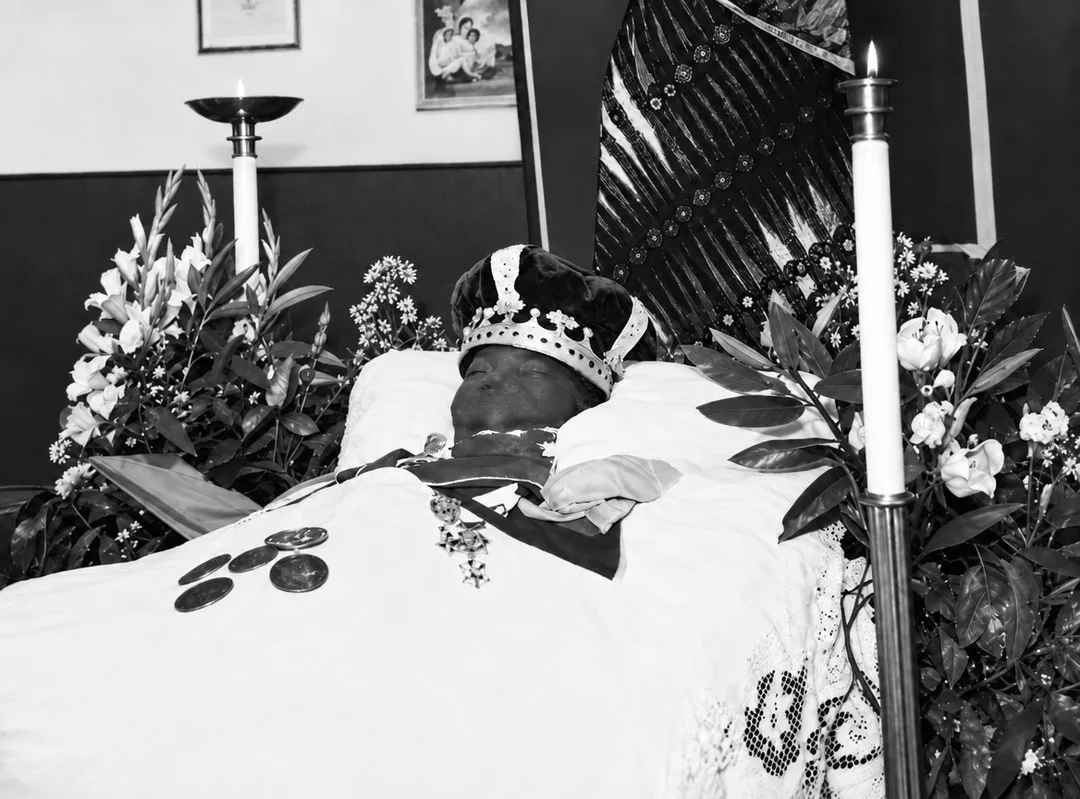
A lying in state

Old black and white photograph: a crowned chief lies on a bier draped in white, a decoration on his chest and medals laid on the sheet, between tall candles and bouquets of white flowers
A lying in state in the family: the deceased rests on a bier draped in white, wearing his crown, his decorations on his chest and his medals laid beside him, among candles and flowers.Collection of the Rapontchombo family

In the museums of the world

Mpongwe objects

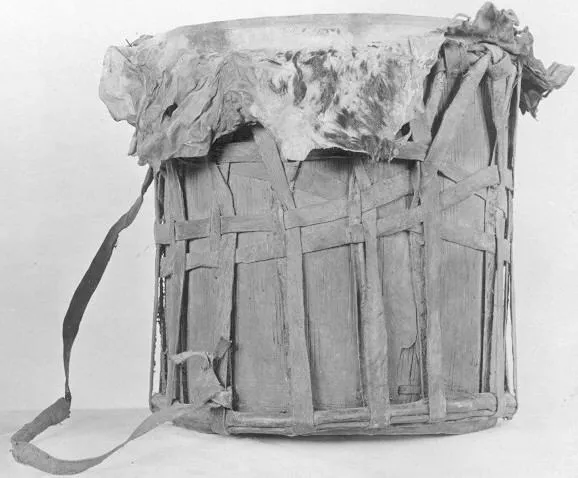
Cylindrical Mpongwe drum of wood stretched with hide
Mpongwe drum, 19th centuryWood and hide, 32 × 38 cm. Collected before 1889 (Crosby Brown collection of musical instruments).The Metropolitan Museum of Art, New York, inv. 89.4.557 · Open Access CC0
Black and white face mask with headdress, Galwa or Mpongwe
Face mask, Galwa or MpongweWood, pigments and metal, northern and central coast of Gabon. The white masks of the Ogooué are cousins of the traditions of the estuary.De Young Museum, San Francisco · photo Daderot, CC0
White mukudj mask with a forehead scarified in lozenges
Mukudj mask, before 1896Attributed “Punu or Mpongwe”, entered the Berlin museum before 1896.Ethnologisches Museum, Berlin · photo Sailko, CC BY 3.0
Forge bellows with two hide bags and a wooden nozzle
Mpongwe forge bellowsWood, hide and iron, 19th century: ironwork, the art of the blacksmiths of the estuary.British Museum, London · photo Ji-Elle, CC BY-SA 4.0
Galwa mask with flat areas of white kaolin, red ochre and black
Galwa mask, collected before 1820Anthropomorphic dance mask, Galwa people (Myènè group, like the Mpongwe), Ogooué region. Wood, black and red pigments, kaolin, 30 × 19 cm: one of the oldest Gabonese pieces preserved, entering the collection in King Denis’s lifetime.Musée du quai Branly - Jacques Chirac, inv. 71.1930.29.343 · photo Ji-Elle, CC BY-SA 3.0
Okuyi mask with a white kaolin face and a tall striated headdress
White okuyi Mpongwe mask, 19th centuryPainted wood and kaolin, 33 cm, gift of Marguerite Bluysen. Entered the musée de l’Homme in 1942 under the label « Masque en bois peint Mpongwe » (M.H. 42.1.1), photographed in 1954 under the title « Masque Mpongwé », now catalogued as Punu; shown in the exhibition « Rois et reines ».Musée du quai Branly - Jacques Chirac, inv. 71.1942.1.1 · photo Ismoon, CC BY-SA 4.0
Dark wooden spoon with a handle carved as a figure
Carved ceremonial spoonSpoon with a figurative handle, attributed Punu. Spoons, paddles and carved ivories are among the most renowned arts of the Gabonese coast, where the Mpongwe ivory carvers excelled.Musée de Troyes · photo G. Garitan, CC BY-SA 4.0
Gabonese harp with a hide sound box, topped with a carved figure
Harp with a figurative peg boxWood, hide and plant fibres, 19th or early 20th century, Punu or Lumbu culture: the sacred harp that accompanies the rites of the Bwiti.Château-musée de Boulogne-sur-Mer · photo Patrick (Compiègne), CC BY-SA 2.0
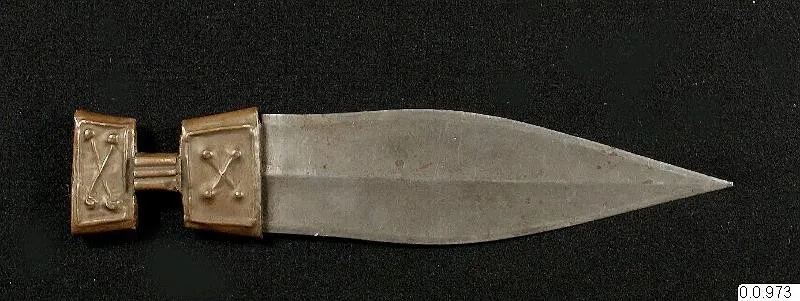
Leaf-bladed dagger, hilt with metal plates engraved with crosses
Leaf-bladed dagger and its sheathGabon or Ogooué, brought back at the end of the 19th century: leaf-shaped blade and hilt plated with engraved metal, attributed to Mpongwe or Lumbu blacksmiths (assessment by L. Siroto).Världskulturmuseet, Göteborg, inv. 0000.00.0973 · image CC0
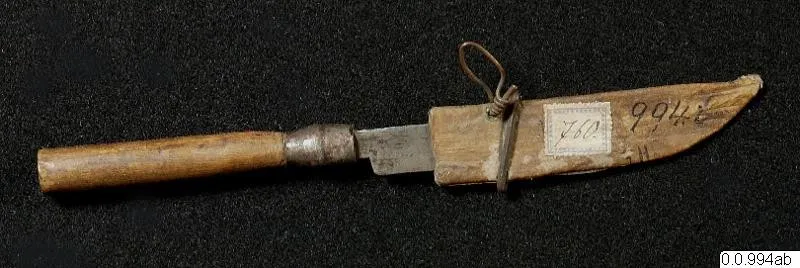
Knife with a pale wooden handle and its bound wooden sheath
Mpongwe knife and wooden sheathGabon or Ogooué, late 19th century. Its European-inspired workmanship led to the piece being attributed to the Mpongwe, in close contact with the trading posts of the estuary.Världskulturmuseet, Göteborg, inv. 0000.00.0994a-b · image CC0
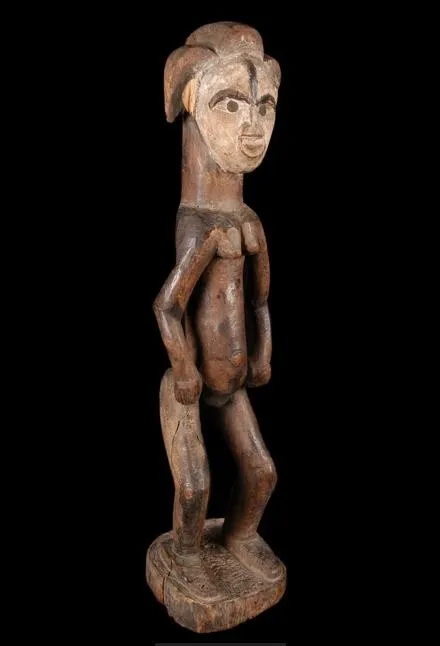
Mpongwe funerary statuette in profile, standing, with striped hairstyle and whitened face
Mpongwe funerary statuetteFemale funerary statuette: painted wood, whitened face, eyes of copper plates, 45 cm. Gift of Marguerite Bluysen, entered in 1942 with the okuyi mask; the photographic library of the musée de l’Homme photographed it as early as 1952.© musée du quai Branly - Jacques Chirac, inv. 71.1942.1.8
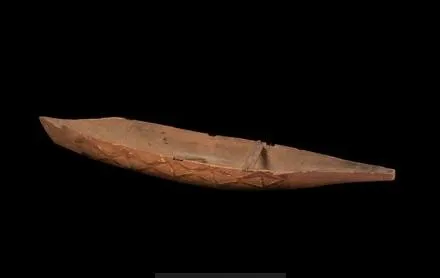
Scale model of a Mpongwe dugout canoe in pale wood, slender, flat-bottomed
Mpongwe dugout canoe, gift of Victor SchoelcherScale model of an estuary dugout canoe: wood, 88 cm, two paddlers’ benches and geometric relief decoration. Given before 1886 by Victor Schoelcher, the man behind the abolition of slavery in 1848.© musée du quai Branly - Jacques Chirac, inv. 71.1886.140.1 · gift of Victor Schoelcher
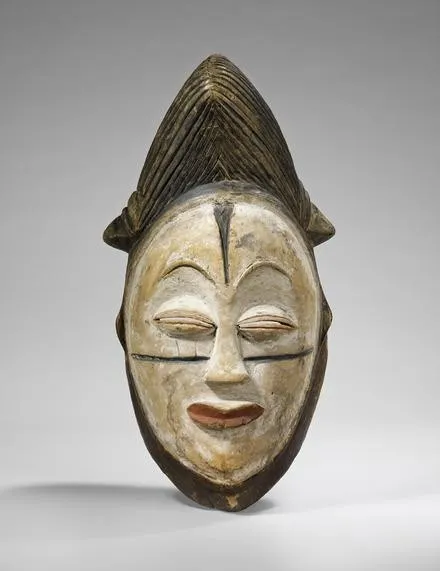
Mpongwe mask with a whitened face, black striated crest and red lips
Mpongwe mask from the coastal regionWood and pigments, 34 cm, early 20th century: striated crested hairstyle painted black, face whitened with lime, reddened lips, black median lines on the forehead and cheeks.© musée du quai Branly - Jacques Chirac, inv. 71.1948.64.1
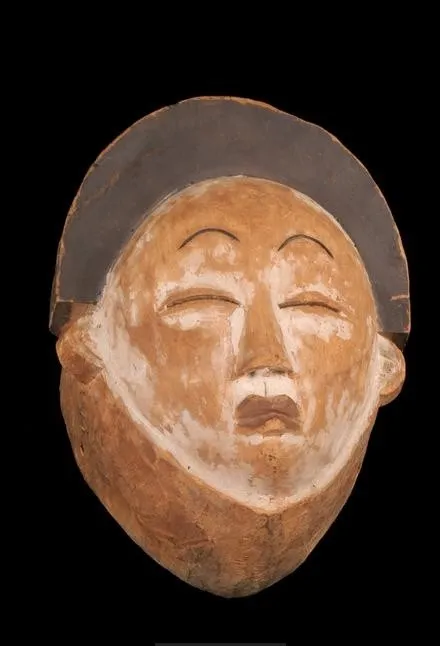
Round Mpongwe mask with a kaolin face framed by a dark hairstyle
Mask with a kaolin faceWood, 25 cm, gift of Adolphe Le Blanc, entered before 1951. Face whitened with kaolin, rounded upper part and V-shaped chin, arched incised eyebrows, black semicircular hairstyle.© musée du quai Branly - Jacques Chirac, inv. 71.1951.49.12
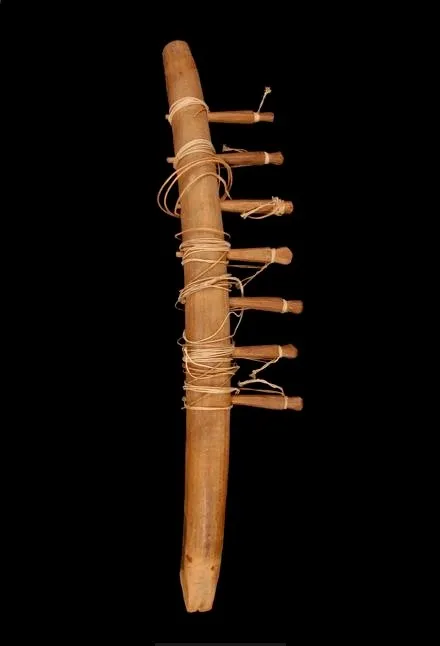
Arched neck of a ngombi harp, eight wooden pegs and fibre strings
Eight-stringed ngombi harpArched neck and eight wooden pegs, 44 cm: the ngombi, harp of the rites of the Bwiti. Gift of Professor Jacques Millot, entered before 1961.© musée du quai Branly - Jacques Chirac, inv. 71.1961.120.136
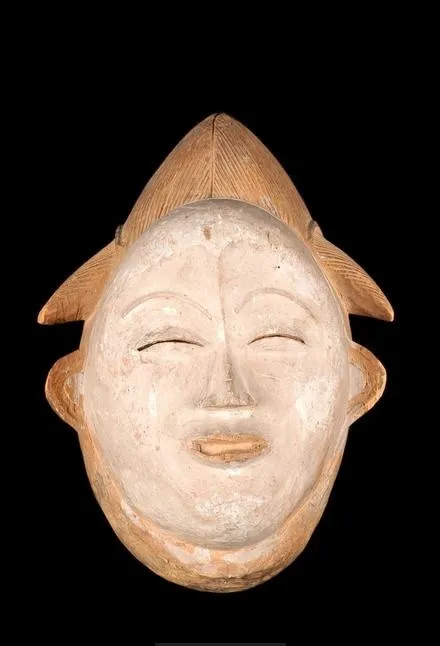
Mpongwe dance mask with a face entirely covered in pale kaolin
Kaolin dance maskWood and kaolin, 32 cm; bequest of Édouard-Victor Saint-Paul, entered the collections in 1977. The kaolin-covered face of the dances of the estuary.© musée du quai Branly - Jacques Chirac, inv. 71.1977.52.2
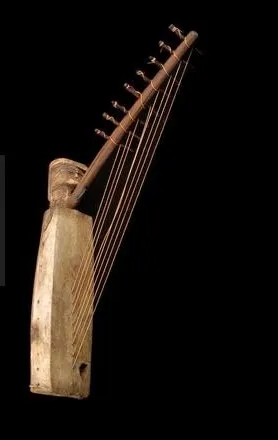
Eight-stringed Mpongwe harp, hide-covered sound box and peg box with a carved head
Harp with a carved headLeather, wood, iron and plant fibres, 68 cm, entered before 1937: half-cylindrical sound box covered with nailed hide, extended by a carved human head.© musée du quai Branly - Jacques Chirac, inv. 71.1937.0.179.1
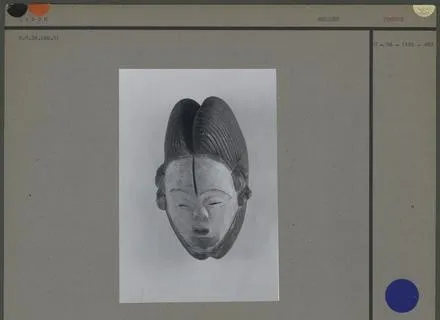
Photographic library card: black and white print of a white Mpongwe mask with a lobed headdress, mounted on grey card
« Masque mpongwe », record card of 1956Record card from the photographic library of the musée de l’Homme: a 1956 silver print mounted on card, labelled simply « Masque mpongwe ». The object, which entered the collection in 1938, bears the number 71.1938.166.51.© musée du quai Branly - Jacques Chirac, inv. 71.1938.166.51 · photothèque du musée de l’Homme, 1956
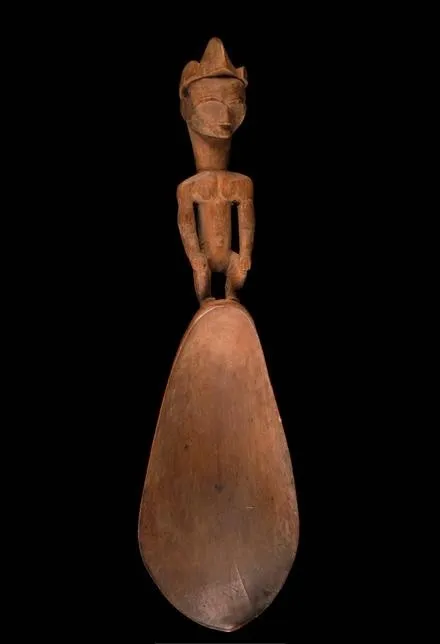
Red-brown wooden spoon whose handle is a carved standing figure
Wooden spoon topped with a figureWood, 15.2 cm, gift of Charles Pobéguin, entered the national collections in 1951. The hairstyle recalls the Punu or Mpongwe style, the face is treated in the Fang manner: an object born of the meeting of Gabonese styles.© musée du quai Branly - Jacques Chirac, inv. 71.1951.73.67
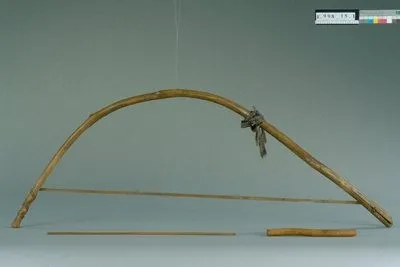
Mungongo musical bow: a bent branch strung with a cord, with its beating stick
Mungongo musical bowThe mouth bow of Gabon: a bent branch, a single string struck with a stick, the mouth as sound box. Brought back from Gabon, acquired by Jean Landré in 1968.Musée de la musique, Philharmonie de Paris · photo CC BY-NC-SA 4.0
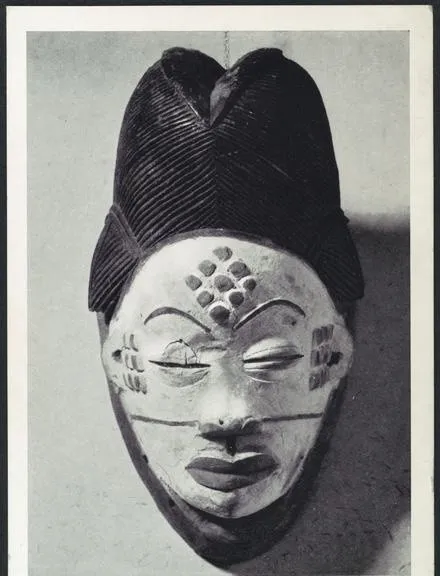
Old photograph: white Mpongwe mask with a tall striated headdress, painted lips and tattoos
Mpongwe mask, Geneva museumPhoto card from the first half of the 20th century: « Masque en bois sculpté. Lèvres et tatouages peints en rouge. Mpongwe. Afrique Équatoriale française. » (Carved wooden mask. Lips and tattoos painted red.) The object is held at the Musée d’ethnographie de la Ville de Genève.Photothèque du musée de l’Homme / musée du quai Branly - Jacques Chirac · anonymous photograph, 1900-1950

Royal Museums Greenwich · Tour du Monde

Found while verifying the story of Queen Victoria’s gifts: the Admiralty sea chart showing the towns of the estuary kings, the brig that brought the medal in May 1840, the anti-slavery squadron of the day, and the 1865 page in which Dr Griffon du Bellay records England’s gifts. All in the public domain.
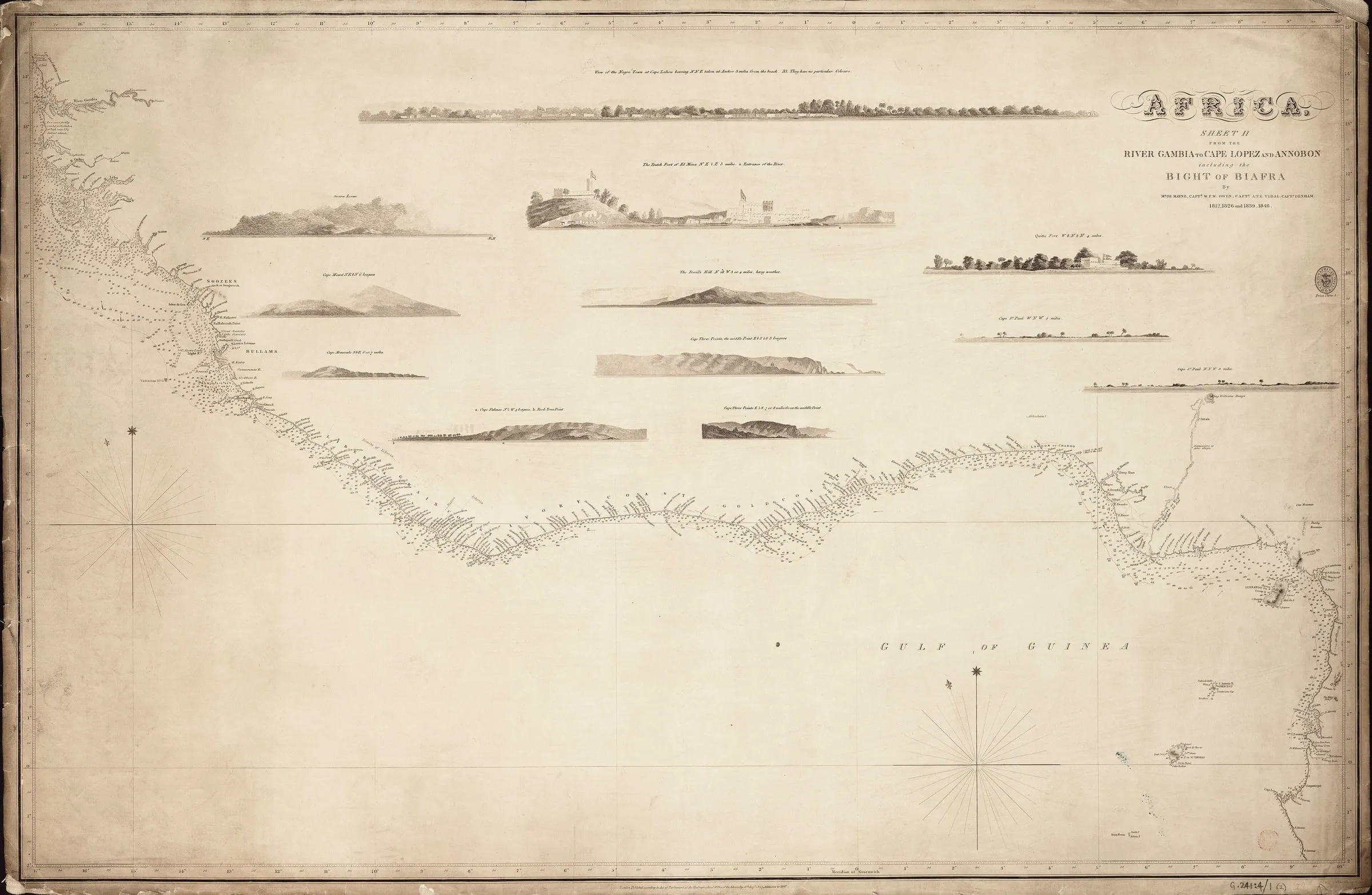
Admiralty sea chart: the coast of Africa from the Gambia to Cape Lopez, with soundings and coastal views
Admiralty Chart No. 594, Africa Sheet IIThe Royal Navy sea chart from the Gambia to Cape Lopez, surveyed by Captains Owen, Vidal and Denham (1812, 1826, 1839-1846): on the estuary one reads “R. Gaboon”, “K. Glass Town”, “K. Qua Ben Town” and “K. George Town”.Hydrographic Office, 1847 edition · Royal Museums Greenwich, F0133 · public domain
Watercolour: the brig HMS Wolverene under full sail, ahead of the squadron
“H.M. Brig Wolverene, beating the Squadron”The brig HMS Wolverene, which arrived in the Gabon river on 15 May 1840: the next day Commander William Tucker hung Queen Victoria’s gold medal and chain round King Denis’s neck.Anonymous watercolour, 19th century · Royal Museums Greenwich, PU6064 · public domain
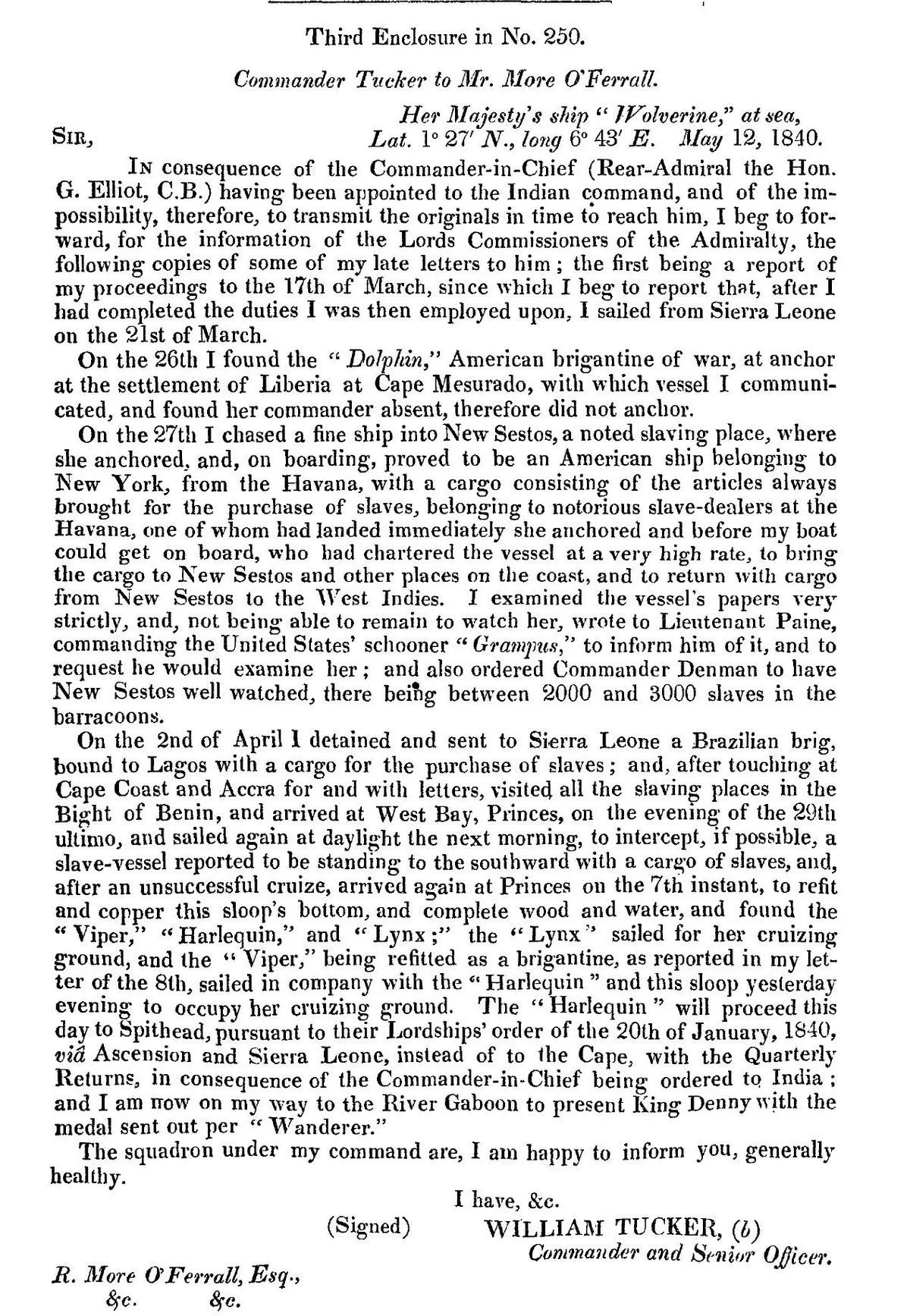
Printed page of 1841: Commander Tucker’s letter dated HMS Wolverine at sea, 12 May 1840
Commander Tucker’s letter, 12 May 1840Written at sea aboard HMS Wolverene: “and I am now on my way to the River Gaboon to present King Denny with the medal sent out per ‘Wanderer’”. Printed in the slave trade correspondence presented to the British Parliament in 1841.Parliamentary Papers, 1841, Class D, p. 187 · Internet Archive · public domain
Painting: the brig HMS Acorn overhauling the slave ship Gabriel on the open sea
The capture of the slaver Gabriel by HMS Acorn, 6 July 1841The Royal Navy’s anti-slavery squadron in action off the coast of Africa, in the years when its sailors, those of HMS Lynx in 1839, owed their freedom to King Denis.Nicholas Matthews Condy, oil, 1841 · Royal Museums Greenwich, BHC0628 · public domain
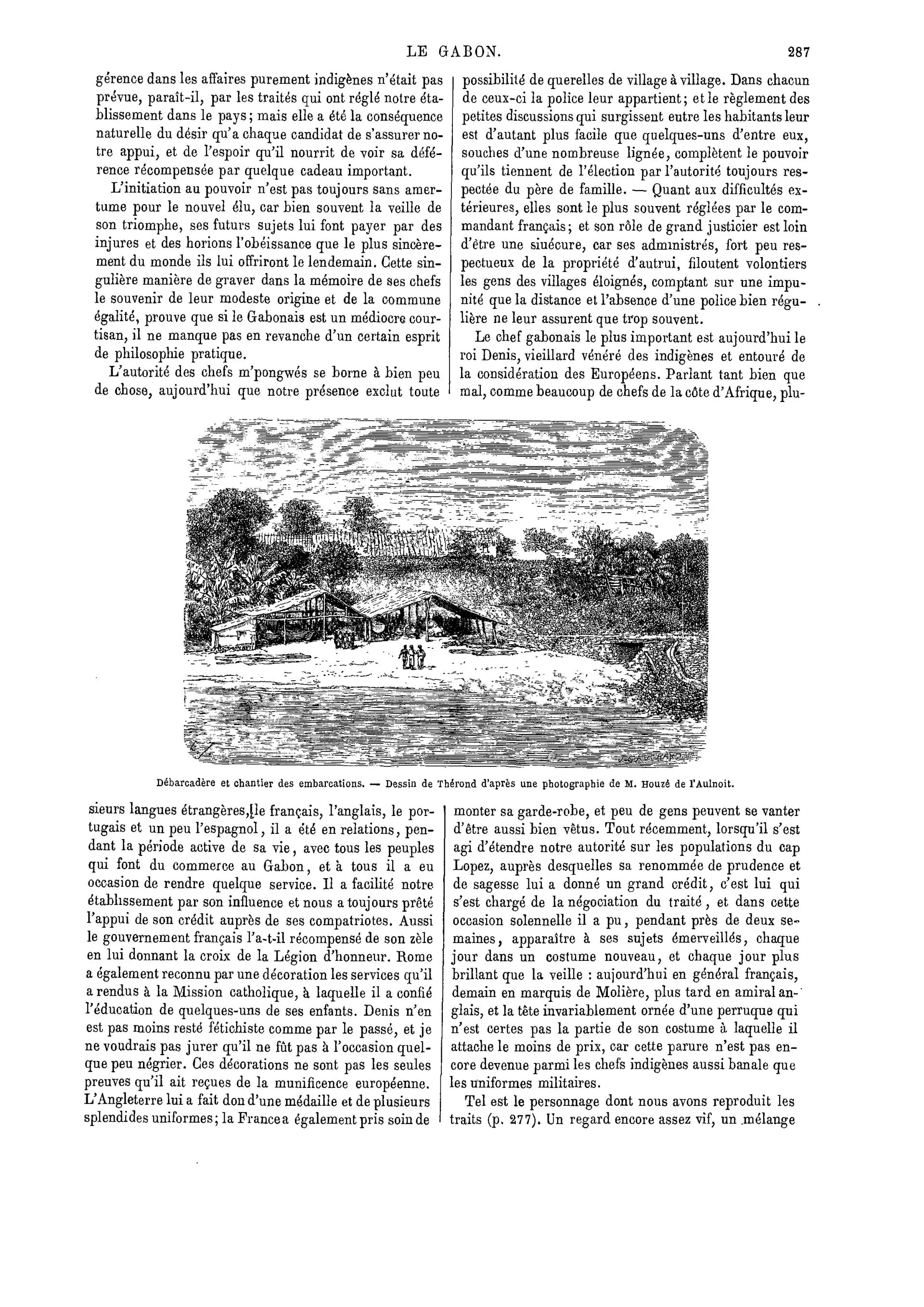
Printed page of Le Tour du Monde, 1865, with the engraving of the landing stage and the text on King Denis
Le Tour du Monde, 1865, page 287Dr Griffon du Bellay’s account: “England gave him a medal and several splendid uniforms; France likewise took care to furnish his wardrobe” (« L’Angleterre lui a fait don d’une médaille et de plusieurs splendides uniformes »).Le Tour du Monde, vol. 12, 1865 · Wikisource · public domain

Archives nationales d’outre-mer · 40 COL 436

The treaty of 9 February 1839

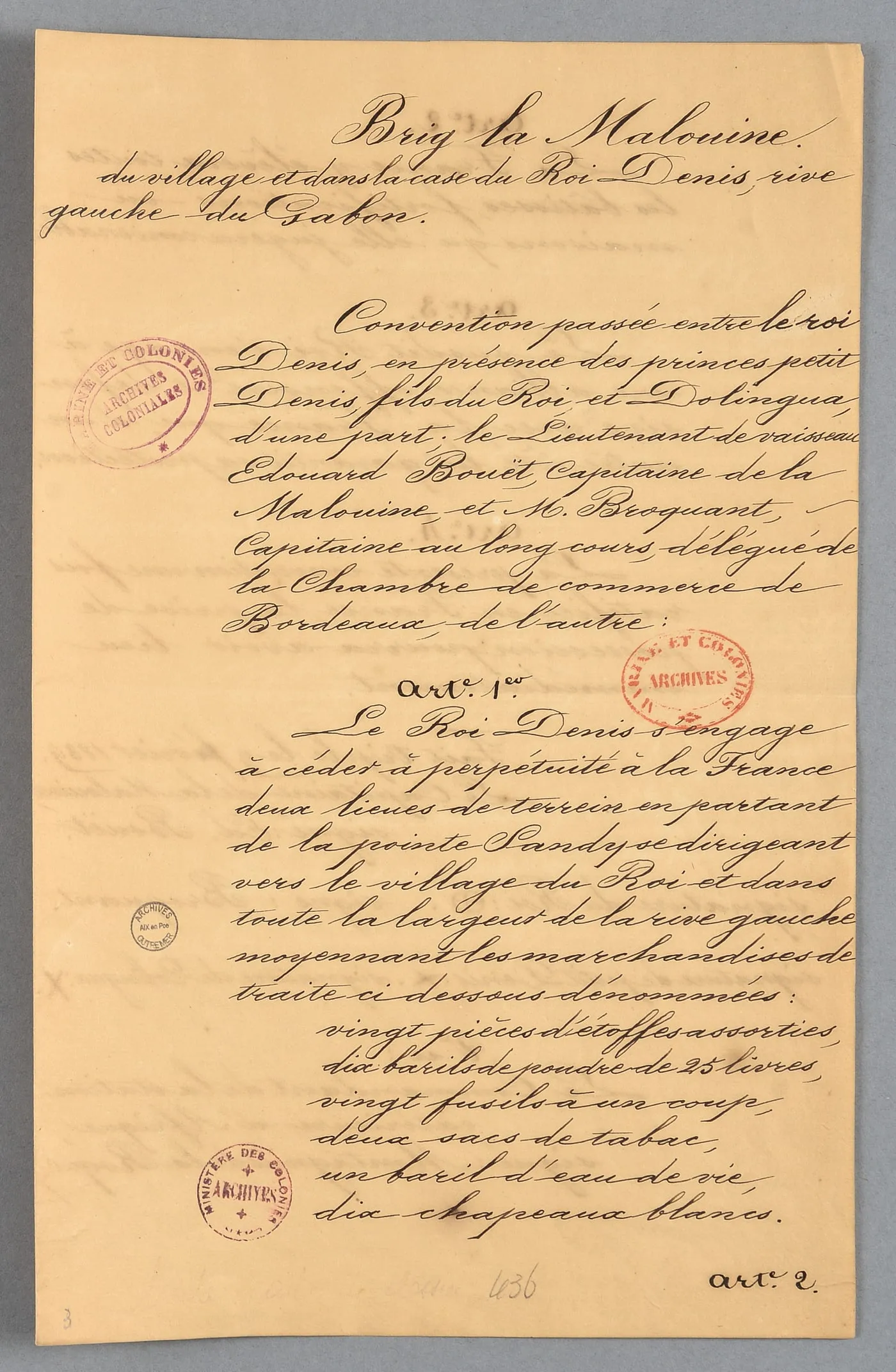
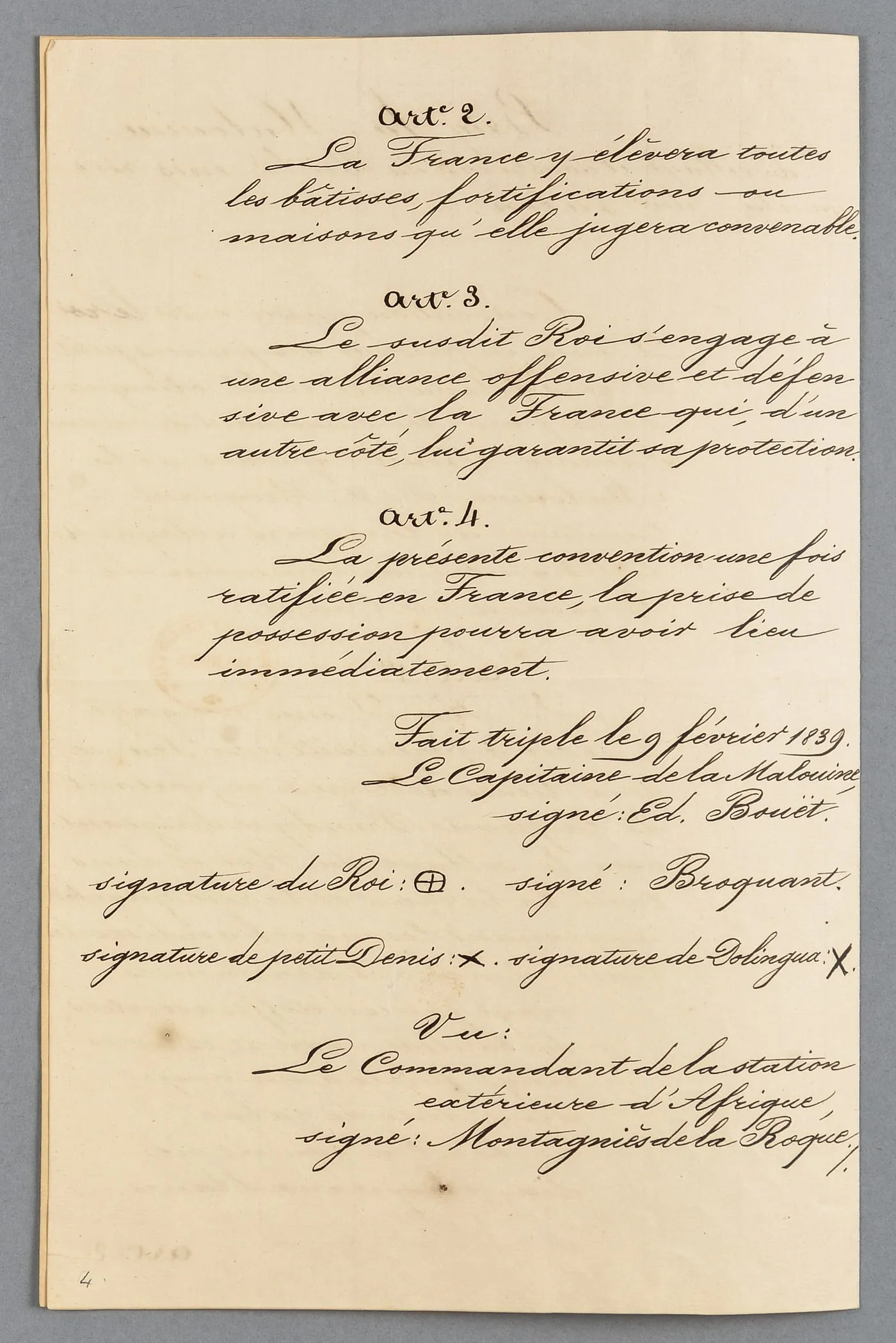
The founding deed as kept at the Archives nationales d’outre-mer: the original signed aboard La Malouine, where the king sets his circled cross and Petit Denis his cross, and the fair copy. “Made in triplicate”: two other copies remain to be found.
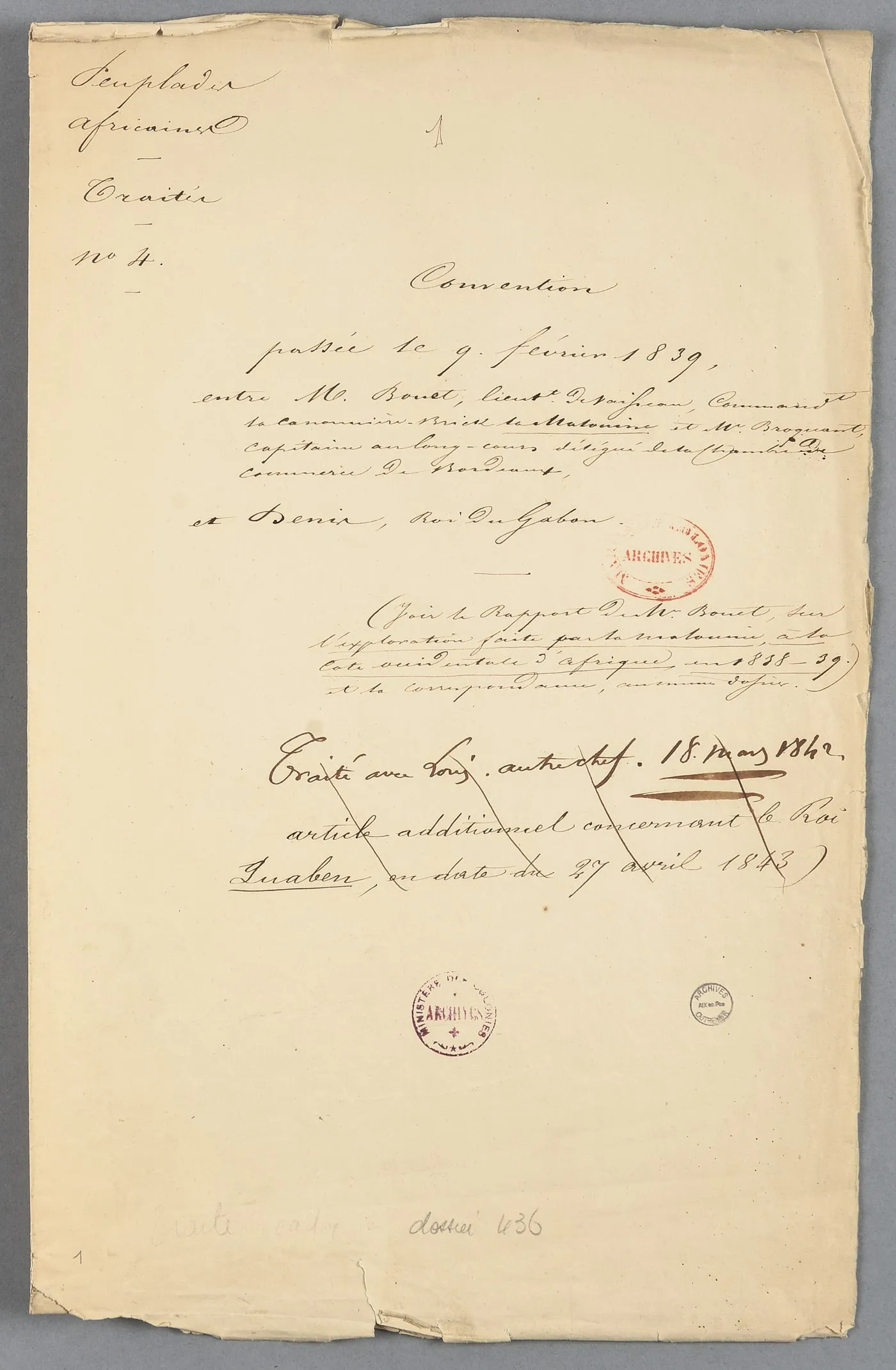
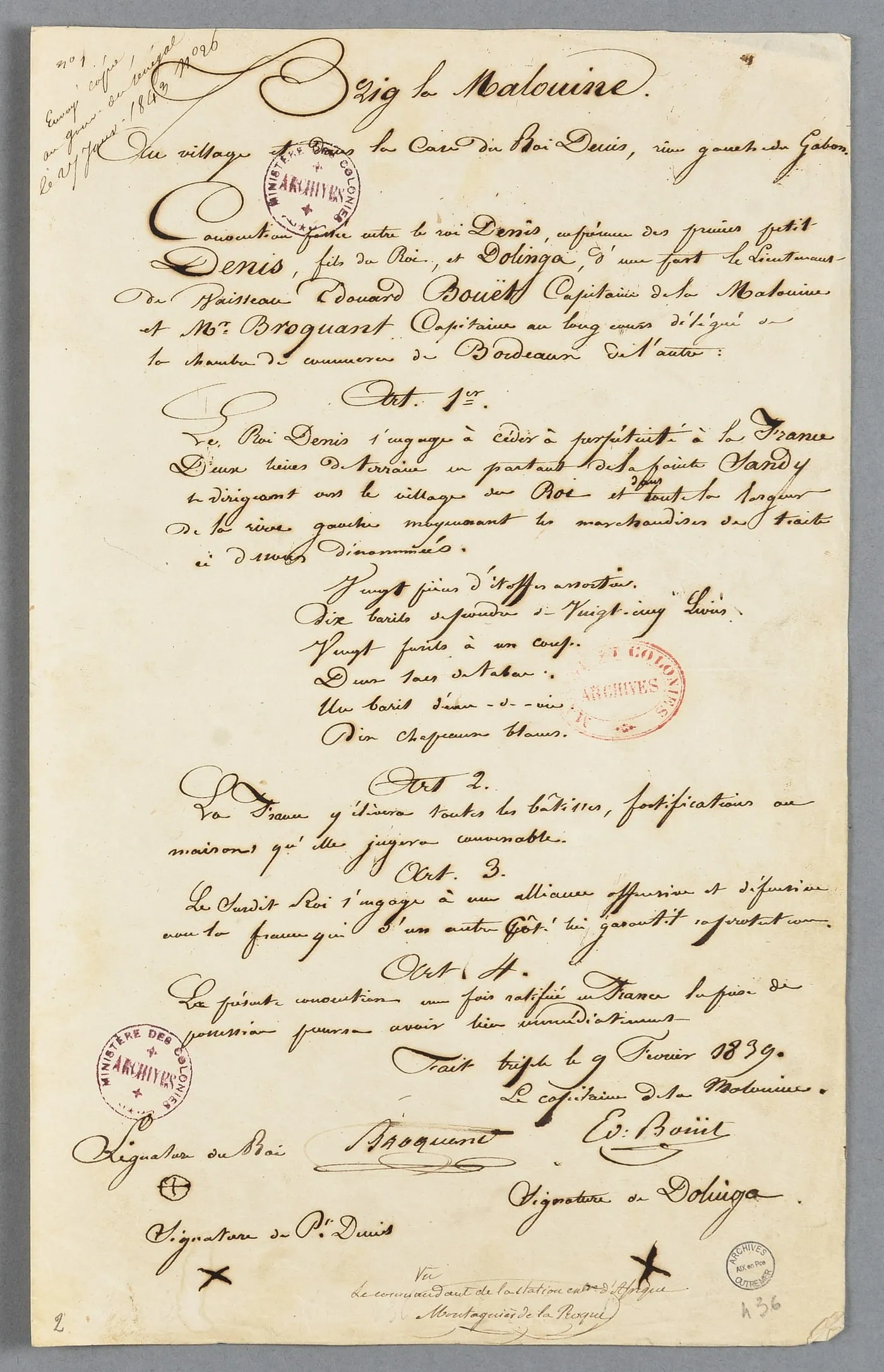
The archive file cover: African peoples, Treaties no. 4, convention of 9 February 1839
The handwritten original of the convention of 9 February 1839, with the king’s circled cross and the signatures
Calligraphed copy of the convention, first page
Calligraphed copy of the convention, second page, with the words Fait triple and the signatures
The archive file cover: African peoples, Treaties no. 4, convention of 9 February 1839
The handwritten original of the convention of 9 February 1839, with the king’s circled cross and the signatures
Calligraphed copy of the convention, first page
Calligraphed copy of the convention, second page, with the words Fait triple and the signatures

Click a page or use the arrows to turn it

See the file at the Archives nationales d’outre-mer, FR ANOM 40 COL 436 ↗

Gallica · Bibliothèque nationale de France

The press of July 1939

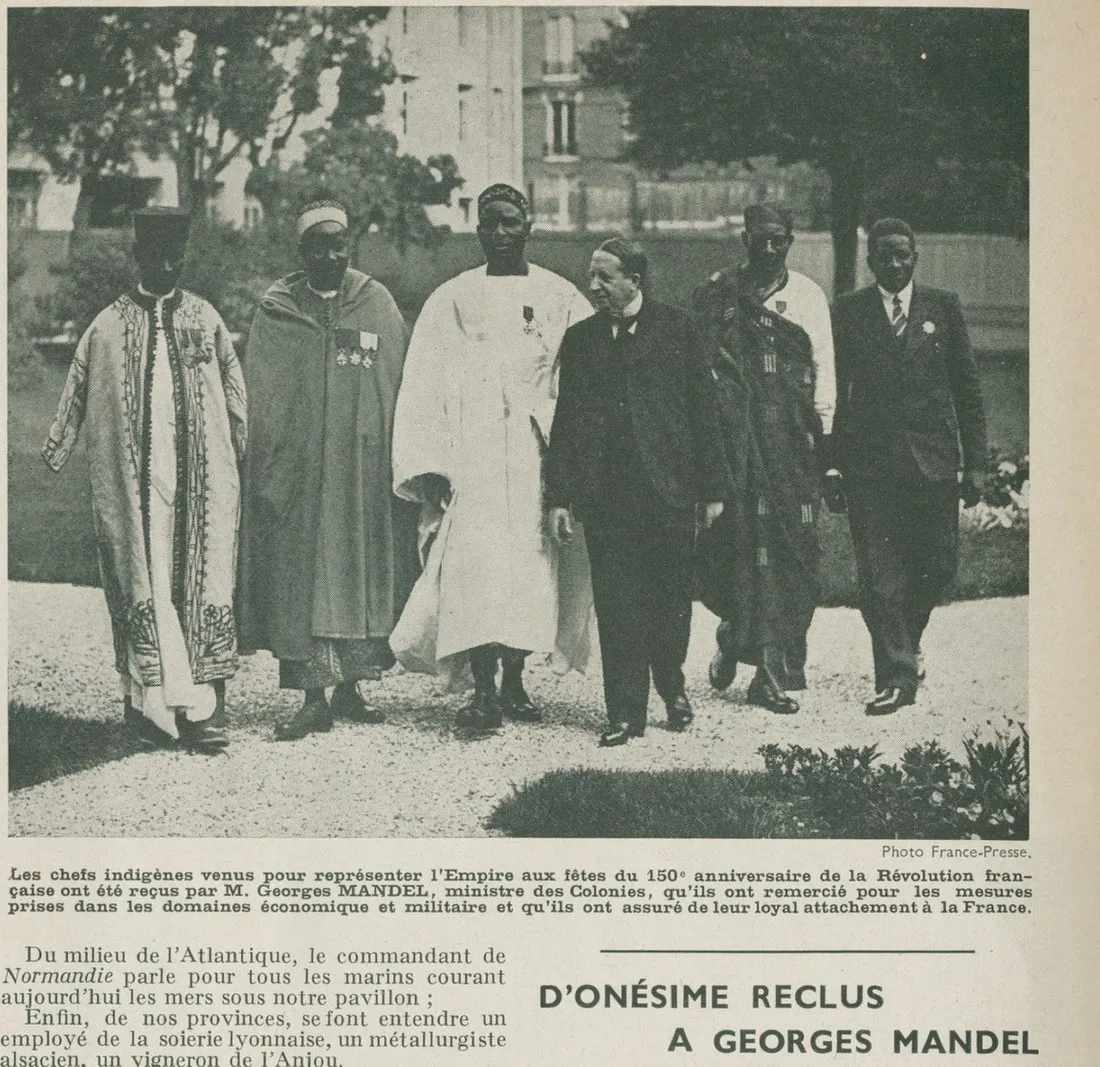
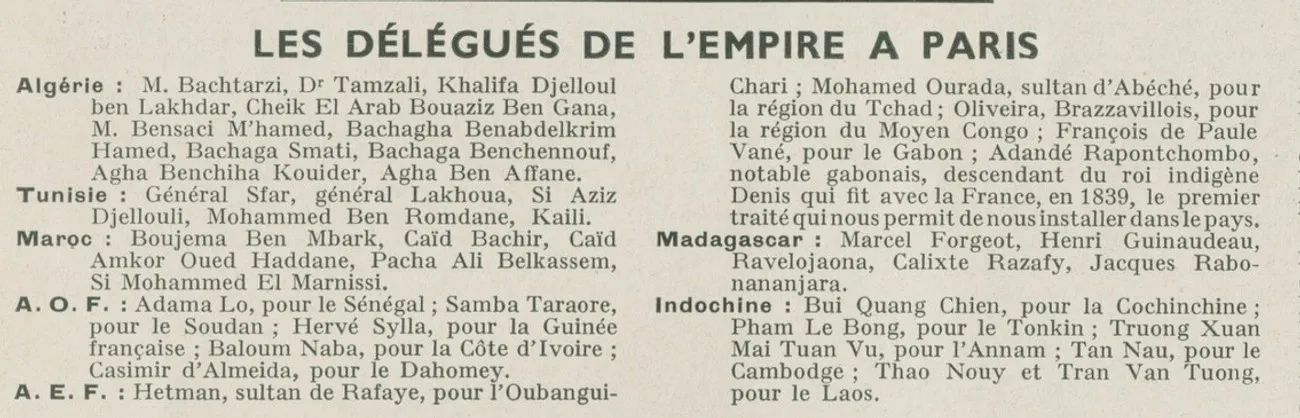
July 1939: the delegates of the Empire come to Paris for the 14 July celebrations and the 150th anniversary of the Revolution. Prince Félix Adandé Rapontchombo lands at Bordeaux with them; Ce soir names him, and Le Monde colonial illustré lists him among the delegates of French Equatorial Africa.
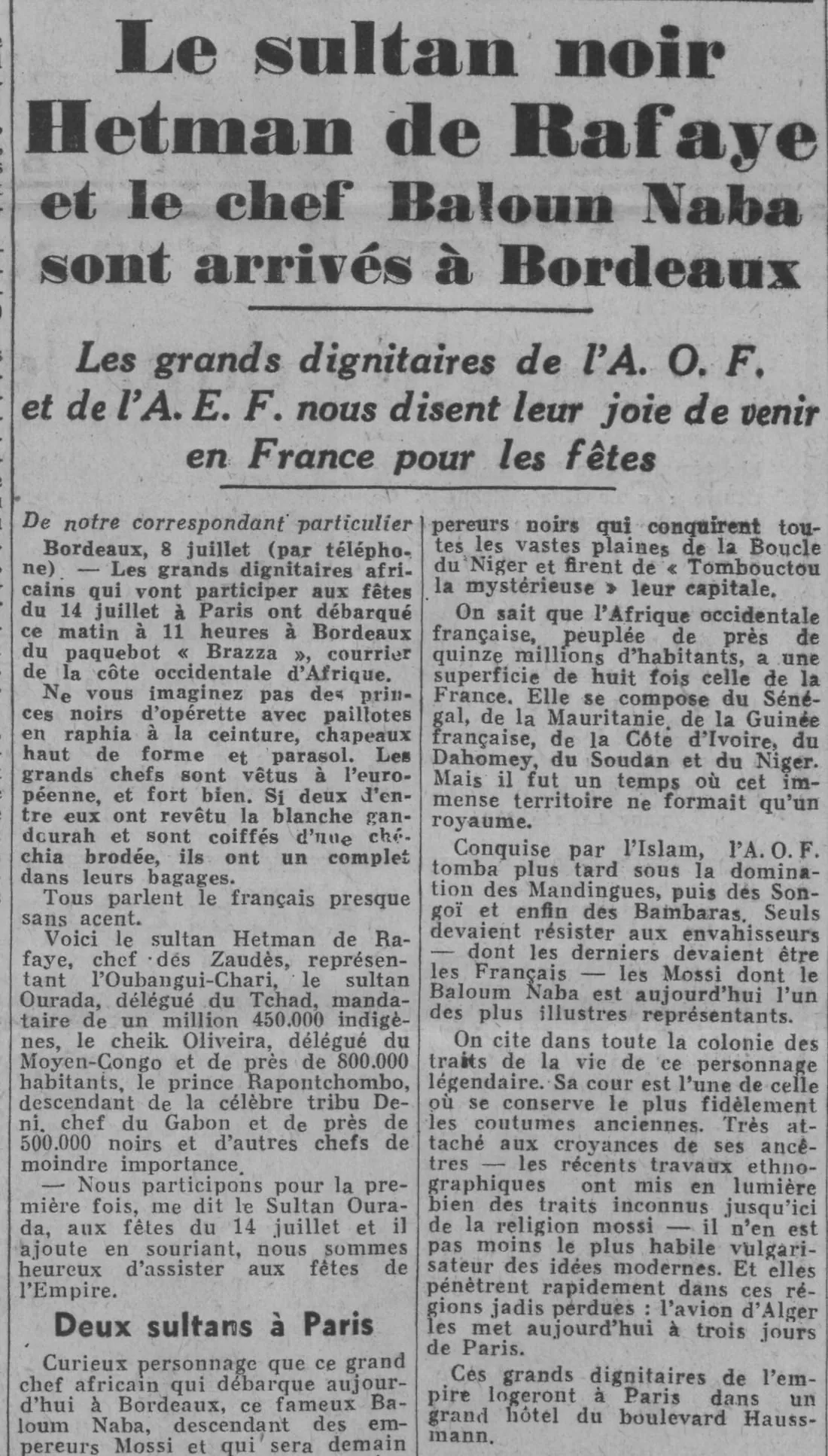
Clipping from the newspaper Ce soir of 9 July 1939: the great African dignitaries have arrived at Bordeaux
Ce soir, 9 July 1939« Le sultan noir Hetman de Rafaye et le chef Baloum Naba sont arrivés à Bordeaux »: among the delegates landed from the liner Brazza, « le prince Rapontchombo, descendant de la célèbre tribu Déni, chef du Gabon » (Prince Rapontchombo, descendant of the famous Déni tribe, chief of Gabon).From our special correspondent, p. 5 · Gallica, Bibliothèque nationale de France
Clipping from Le Monde colonial illustré, 1939: « Les délégués de l’Empire à Paris », a list by territory including Adandé Rapontchombo for French Equatorial Africa
Le Monde colonial illustré, 1939« Les délégués de l’Empire à Paris »: under French Equatorial Africa, « Adandé Rapontchombo, notable gabonais, descendant du roi indigène Denis » (Gabonese notable, descendant of King Denis).p. 172 · Gallica, Bibliothèque nationale de France
Photograph from 1939: chiefs from the Empire walking in a garden alongside the minister Georges Mandel
Received by Georges Mandel, July 1939The delegates of the Empire received by the Minister for the Colonies for the 150th anniversary of the Revolution; the caption does not name the people photographed.France-Presse photo, Le Monde colonial illustré, p. 172 · Gallica/BnF

Gallica · family archives

Le Figaro at the centenary of Gabon, August 1950

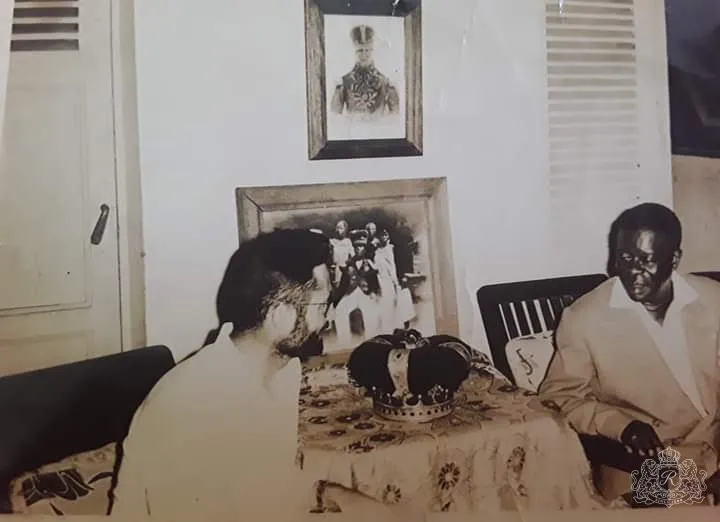
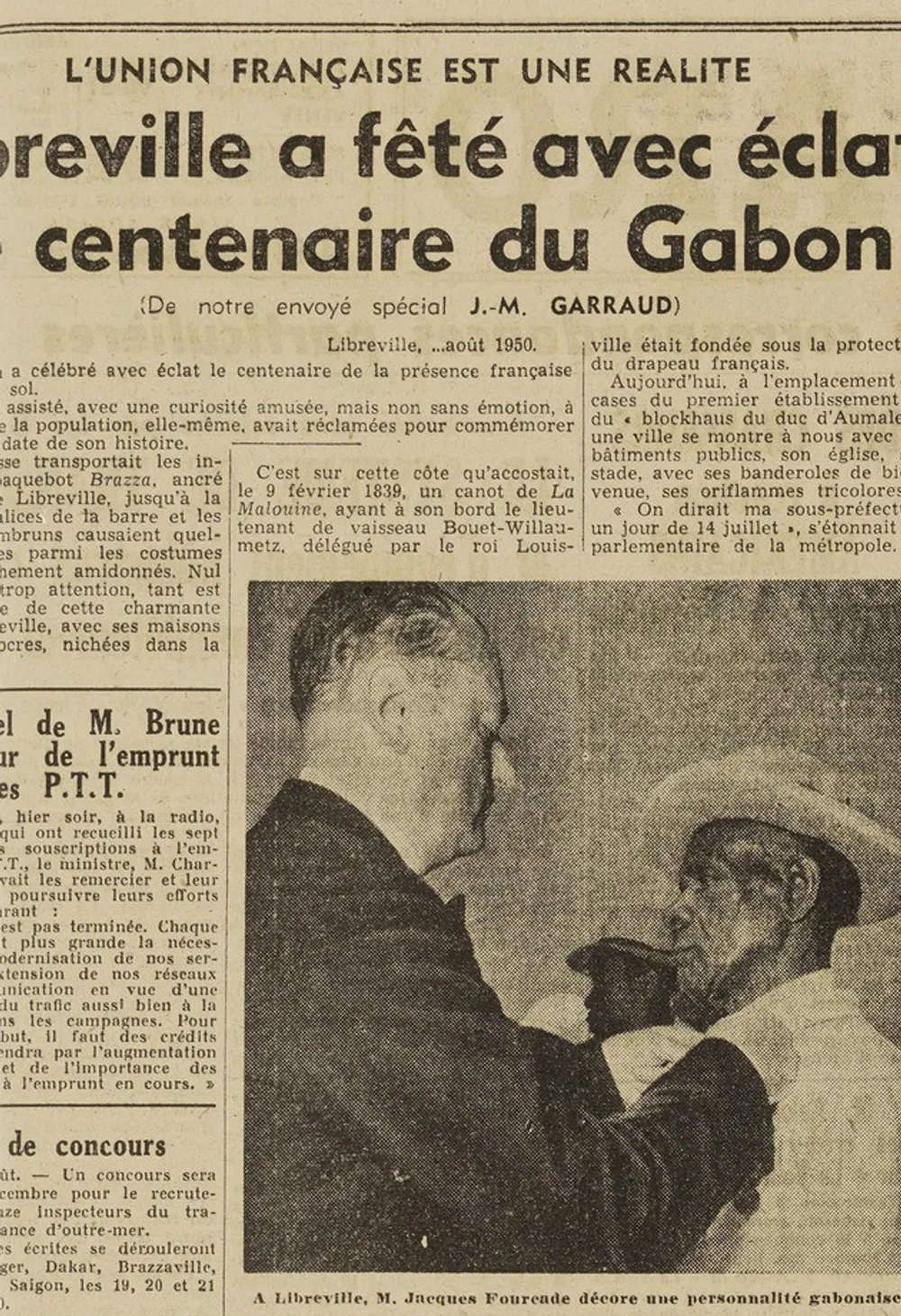
Libreville, 1 August 1950: the centenary of the French presence in Gabon, and Le Figaro sent Jean-Marie Garraud. His two articles open with King Denis. The family keeps the photograph of the interview at which the crown was shown to the journalist.
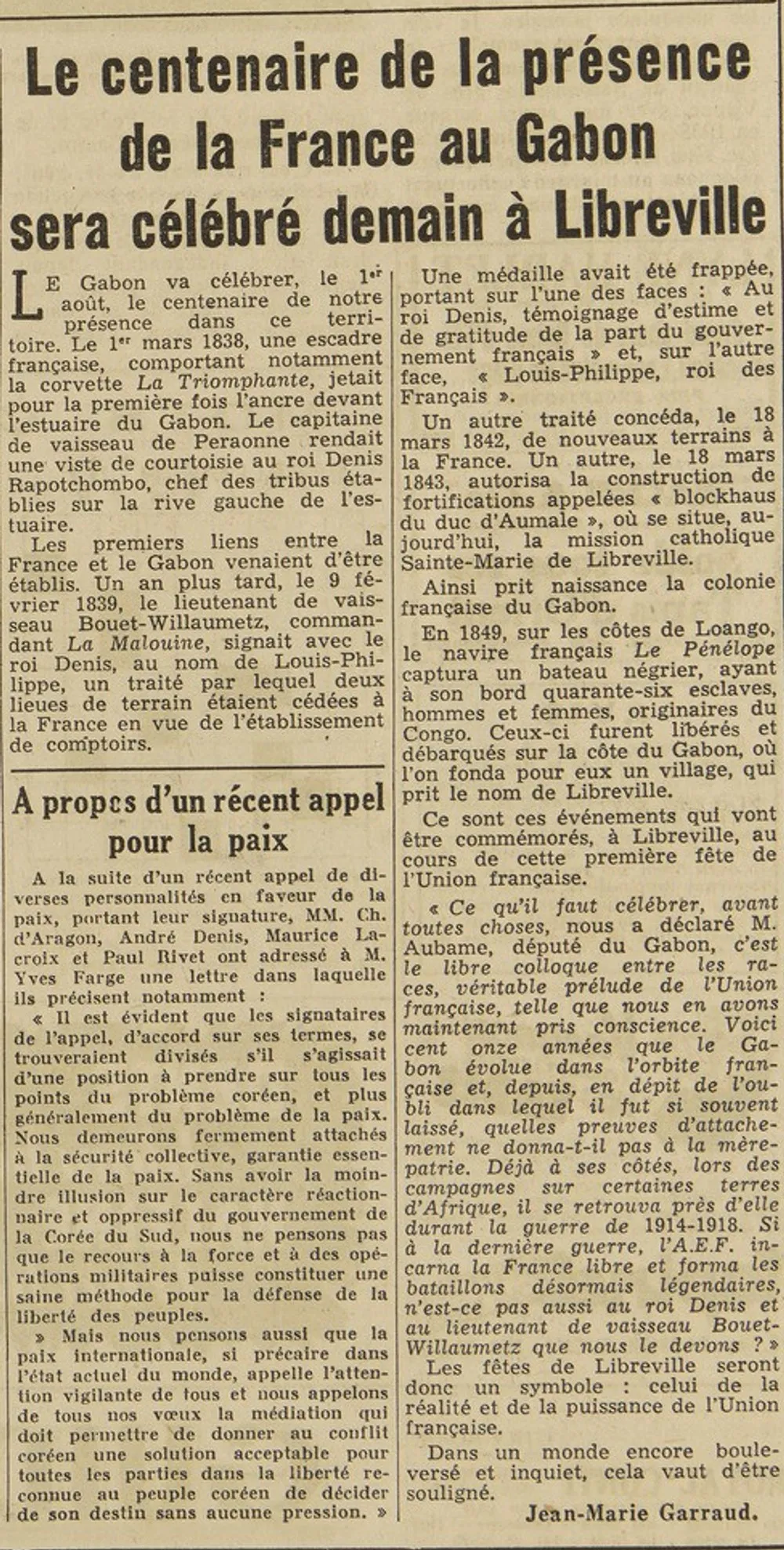
Clipping from Le Figaro of 31 July 1950 on the centenary of the French presence in Gabon
Le Figaro, 31 July 1950« Le centenaire de la présence de la France au Gabon sera célébré demain à Libreville »: King Denis opens the story, the inscription on his medal is quoted, and the député Aubame pays him tribute.Jean-Marie Garraud, p. 6 · Gallica, Bibliothèque nationale de France
Clipping from Le Figaro of 5-6 August 1950: Libreville celebrated the centenary of Gabon in style
Le Figaro, 5-6 August 1950« Libreville a fêté avec éclat le centenaire du Gabon »: the special correspondent’s report; in the photograph, Jacques Fourcade decorates Prince Félix Adandé Rapontchombo.J.-M. Garraud, p. 7 · Gallica, Bibliothèque nationale de France
Prince Félix Adandé Rapontchombo facing a journalist, the crown on the table between them
The crown shown to Le Figaro, August 1950Prince Félix Adandé Rapontchombo receives a journalist from Le Figaro; on the table, the crown; on the wall, the portrait of King Denis.Photograph from the family archives

Under rights · to consult

In the institutions

Held in public collections, these pieces remain under rights: we point to them without reproducing them.

  • Musée du quai Branly - Jacques Chirac, Paris

    « Le roi Denis », photograph by Auguste Houzé de l’Aulnoit, 1862

    The original photograph from which the 1865 engraving derives: King Denis photographed in his lifetime. Listed as « Le roi Denis, 1862 » at the GrandPalaisRmn photo agency; reproduction subject to rights (© musée du quai Branly). Search the collections database for “Houzé de l’Aulnoit”.

  • Archives nationales d’outre-mer (ANOM), Aix-en-Provence

    Treaty of 9 February 1839

    « Convention passée entre le roi Denis [et] le lieutenant de vaisseau Édouard Bouët », the founding act of the French presence in Gabon, digitised under the reference FR ANOM 40 COL 436.

  • Royal Museums Greenwich (National Maritime Museum), London

    Letters of Cornelius Thomas Augustus Noddall, 1840 (AGC/N/33)

    Letters from a Royal Navy sailor to his mother, with “a description of a medal presentation to King Denny, an African chief”: a first-hand account of the delivery of Queen Victoria’s gifts in 1840.

  • UK Parliament, London

    Parliamentary Papers, 1841: correspondence on the slave trade, West Coast of Africa

    Commander Tucker’s report (HMS Wolverene, Fernando Po, 31 May 1840), King Denis’s letter to the Queen of 16 May 1840 thanking her for the medal and asking for a uniform, and Lord John Russell’s reply of 30 January 1841: the official British record of the gifts.

  • University of Lille

    Mélanie Soiron, doctoral thesis in anthropology, 2009 (NNT 2009LIL12006)

    Vol. 1, pp. 82-83, note 207: in 1848 the Queen of England is said to have sent King Denis “sixty pieces of luxurious fabric, the dress of a senior officer and a king’s crown”, and the king was buried in the full dress of an English general. The original document is not cited.

  • Musée d’Orsay, Paris

    « Roi Denis (Gabon) », by L. Pâris

    A second period photographic portrait of the king, distinct from those by Houzé de l’Aulnoit: a 32.4 × 24 cm print, given in 1992 through the Société des Amis du musée d’Orsay; distributed by the RMN-Grand Palais agency (record no. 265759).

  • ECPAD / ImagesDéfense, Ivry-sur-Seine

    Photograph « Gabon. Le roi Denis »

    Picture collection of the Ministry of the Colonies: “Antyouwé Kowé Rapontyombo, king of the Pongoués, died 9 May 1876… who in 1839 signed the convention giving France the right to found an establishment in Gabon”.

  • The Metropolitan Museum of Art, New York

    Mpongwe musical instruments, 19th century (Crosby Brown collection)

    Besides the drum reproduced above, the Met holds three other Mpongwe instruments collected in the 19th century: the eleke (inv. 89.4.3529), the nkonjo (inv. 89.4.2862) and the ikabo (inv. 10.50.9a-c), not yet photographed.

  • British Museum, London

    Mpongwe ivory spoons and combs

    Collected in Gabon by R. B. N. Walker (1851-1874), father of the Gabonese historian André Raponda-Walker (inv. Af1960,20.102 ff.).

  • Smithsonian Institution, National Museum of Natural History, Washington

    Mpongwe dagger and its lizard-skin sheath

    Entered the collections on 19 February 1883 (accession 83A00011); the attribution to the Mpongwe of the Gabonese coast follows the assessment of Leon Siroto. Record freely accessible, with no photograph published to date.

  • Library of Congress, Washington

    « Denis, King of the Mpongwe, approximately 1780-1876 »: authority record

    The king has his own authority record in the catalogue of the Library of Congress, the largest library in the world: the international reference that links together every work concerning him.

  • Hulton Archive / Getty Images, London

    Period photograph of King Denis

    A period print of the king is held in the Hulton Archive in London, one of the largest private photographic collections in the world, and distributed by the Getty Images agency.

  • Bridgeman Images, London

    « King Denis Rapontchombo of Gabon and his Wife », engraving of 1865

    The major agency for European art collections distributes the Tour du Monde engraving of the king and his great wife, listed as « French School, 19th century ».

  • Pitt Rivers Museum, Oxford

    356 objects from Gabon, 143 of them collected by R. B. N. Walker

    Weapons and ornaments from the estuary, including a Mpongwe woman’s belt.

Gabonese television

Audiovisual

Watch on YouTube:
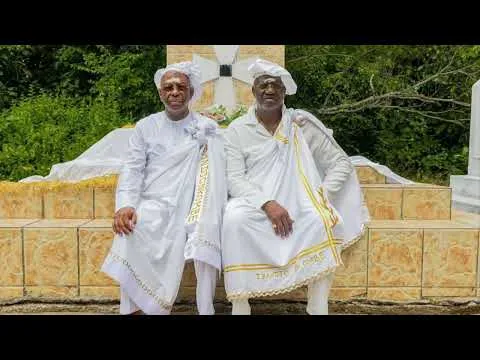
Le Roi Denis Rapontchombo et ses prédécesseurs honorésRTG (Journal télévisé), via aLibrevilleTV · 3 November 2015National television report: tribute paid at Pointe-Denis to King Denis and his predecessors by their descendants.
Watch on YouTube:
Alexandre Barro Chambrier s'inclina sur la tombe de Denis RapontchomboMvt Patriotique Daction Pour 1 Gabon meilleur (YouTube) · 29 July 2024Short video (33 s): the Gabonese politician Alexandre Barro Chambrier, dressed in white, bows at the tomb of King Denis at Pointe-Denis.
Watch on YouTube:
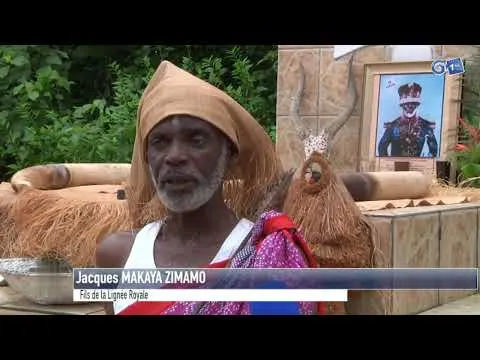
Fête des défunts : cérémonial sur la tombe du Roi Denis RapontchomboGroupe Gabon Télévisions (Gabon 1ère / Canal 1) · 4 November 2024Jacques Makaya Zimamo, in traditional dress, leads the annual ceremony at the king’s tomb in Iwounwé.
Oligui Nguema salue la mémoire du roi Denis RapontchomboGabon 24 · Société / Nécrologie · March 2025Full report (2 min 34): the President of the Republic of Gabon, Brice Clotaire Oligui Nguema, lays a wreath on the king’s tomb at Pointe-Denis; interview with Gérard Michel Aimé Adande Avili at the King Denis museum.Reportage : Fabienne Okome, Alban Mboumba, Sydonie Kiiya · © Gabon 24

2008 - 2026

In the press

  1. 31 July 1950

    Le centenaire de la présence de la France au Gabon sera célébré demain à Libreville · Le Figaro

    Jean-Marie Garraud opens his article with the 1838 visit to “King Denis Rapotchombo” and the treaty of 1839; he quotes the inscription on Louis-Philippe’s medal and the tribute of the député Aubame.

  2. 5-6 August 1950

    Libreville a fêté avec éclat le centenaire du Gabon · Le Figaro

    Report from the special correspondent in Libreville: the treaty “with the local chief, King Denis”, the official ceremony, and the photograph of Prince Félix Adandé Rapontchombo decorated by Jacques Fourcade.

  3. 27 October 2008

    Un site éco-touristique en hommage au Roi Dénis Rapontchombo · Gabonews (via allAfrica)

    Achille Ogoula, great-grandson of King Denis, opens an ecotourism complex at Pointe-Denis and plans a museum holding the sovereign’s relics, beside his burial place.

  4. 16 January 2014

    Libreville : les enfants du roi Denis · Jeune Afriquerestricted access

    A portrait of the descendants; Prince Félix Adandé Rapontchombo, great-grandson of the king, was part of the 1960 delegation negotiating independence in Paris.

  5. 30 July 2015

    Dans le secret des grandes familles du Gabon · Jeune Afriquerestricted access

    Recalls the handover of 1876: before his death, King Denis gives his gold ring to his son Félix Adandé, designated to succeed him (reigned 1876-1911). The family specifies: this son is King Denis II, Louis Denis Marie Félix Adandé Rapontchombo.

  6. 17 January 2017

    Avis de décès de Denis Marie Félix Adandé Rapuntchombo · L'Union (avis officiels)

    Death in Libreville, on 10 January 2017, of the former mayor of the 4th arrondissement of Libreville, son of Prince Félix Adandé-Rapontchombo (archived PDF).

  7. February 2020

    Rituel pour cérémonie d'offrandes à la Pointe Denis : les directives · 7joursinfo

    Princess Marie-Anne Ankombie Rapontchombo, curator of the heritage and royal attributes, suspends activities at sea by circular for the rites of February 2020.

  8. 22 March 2021

    Virginie Ambougou, l'une des deux premières femmes députées du Gabon · Info241restricted access

    Born on 27 August 1902 at Pointe-Denis, daughter of Princess Marie-Anne Rapontchombo; Oga of the clan Assiga, member of parliament from 1961 to 1964, died on 6 May 1992.

  9. 1 July 2023

    La Pointe-Denis, paradis gabonais de Mohammed VI et Ali Bongo Ondimba · Jeune Afriquerestricted access

    King Denis’s peninsula, a retreat for heads of state.

  10. 10 April 2025

    Destination Gabon : la Pointe-Denis mise sur l'écotourisme · AFP (Afriquinfos, Le Quotidien…)

    Gérard Adande Avili, a descendant of King Rapontchombo, guides the “royal hike” and runs the small round-hut museum dedicated to his ancestor.

  11. 5 April 2026

    Pointe Denis : suspension des activités maritimes pour des cérémonies traditionnelles · Gabonactu

    Circular from Princess Marie-Anne Ankombie Rapontchombo: the sea closed from 8 to 12 April 2026, offerings on the 12th, fishing suspended until the 17th.

  12. 5 April 2026

    Estuaire du Komo : la chefferie mpongwè interdit toute activité maritime au nom de la tradition · Gabon Review

    The princess acts “in the name of the throne of King Denis Rapontchombo” (« au nom du trône du roi Denis Rapontchombo »); Pointe-Denis, spiritual heart of the Mpongwe kingdom.

  13. 16 April 2026

    Une tradition animiste pluriséculaire pour protéger le littoral (rite Mpago) · Africanews / AFP

    Report from Pointe-Denis: Gérard-Aimé Adande, grandson of Prince Félix Adande Rapontchombo, presented as chief of the Mpongwe clans of the estuary; the clan Assiga, guardian of the rhythms of the Mpago.

  14. 28 August 2026

    Nchantonwin · Gabon Review (tribune)

    Historical essay by Imunga Ivanga on the former name of Pointe-Denis and the meaning of the name Rapontchombo; Antchoué Kowè, son of Ré-Mboko.

The reproductions shown here come from public-domain collections (Gallica/BnF, NYPL, Wikimedia Commons, the Houzé de l’Aulnoit album at the musée du quai Branly) or are under open licences (CC0, CC BY); each caption carries the exact credit. Pieces held under rights are indicated by a link to the institution.