

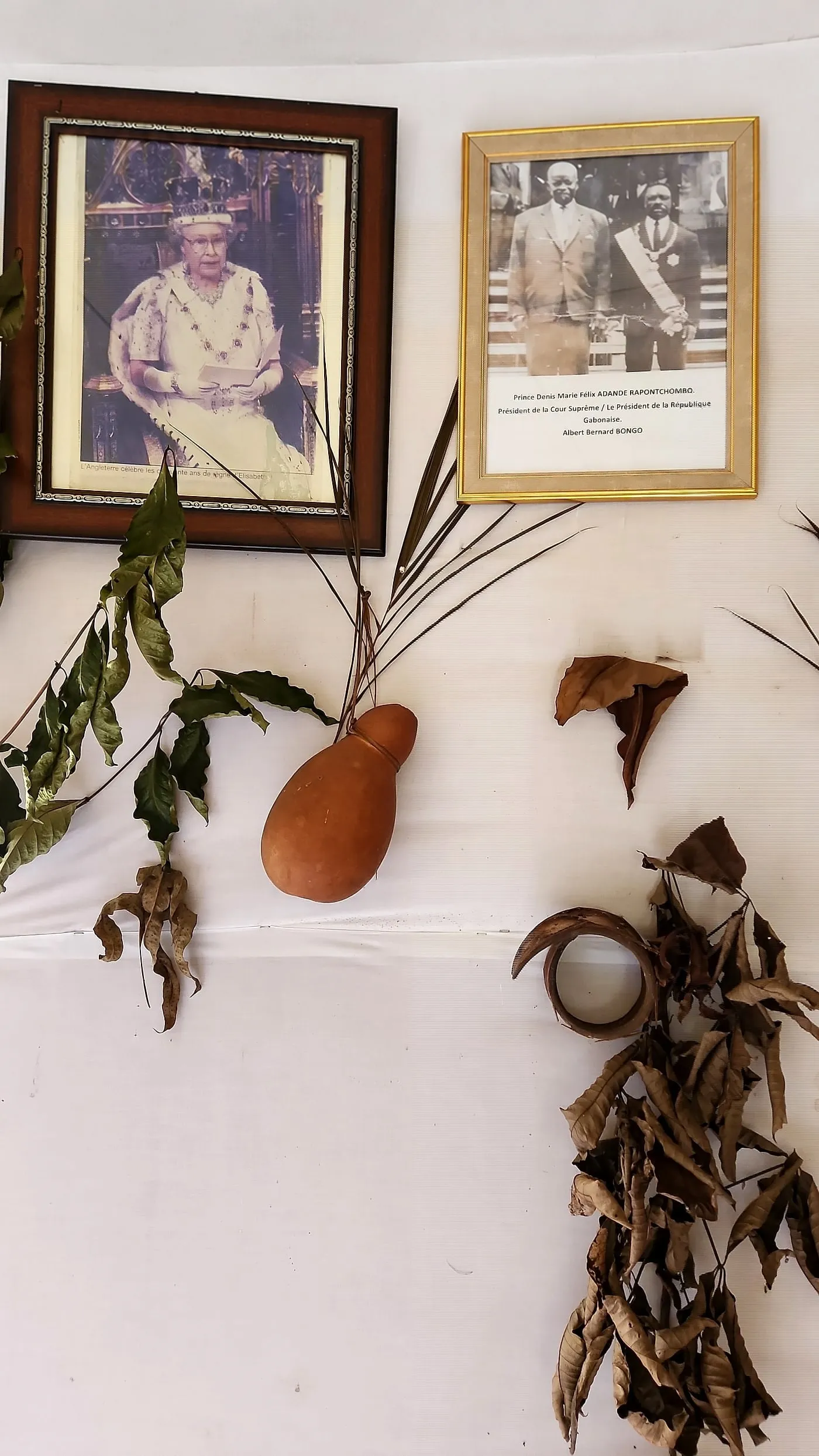
In the museum of the royal family, on the white wall where the calabash and the ritual leaves hang, a gilt frame shows two men side by side: Prince Denis Marie Félix Adande Rapontchombo, President of the Supreme Court, and the President of the Gabonese Republic, Albert-Bernard Bongo, whom the country would come to know as Omar Bongo. If the House keeps this portrait among its relics, it is because the statesman was also, according to the memory of the House, an initiate of the Bwiti, the great initiatory path of Gabon, faithful to its guardians.
Albert-Bernard, then Omar
Albert-Bernard Bongo was born on 30 December 1935 in Lewaï, in the Haut-Ogooué, the town that today bears the name Bongoville. Vice-President in November 1966, he succeeded Léon M'ba, the first president of independent Gabon, on 2 December 1967. In 1973 he embraced Islam and became El Hadj Omar Bongo; he later added to his name that of his father, Ondimba. He governed Gabon for more than forty-one years, until his death in Barcelona on 8 June 2009.
Two initiated presidents
The Bwiti has not always been accepted. Opposed by the missions and the colonial administration, it long lived apart from those in power. Independence changed matters: the first two presidents of Gabon, Léon M'ba and then Omar Bongo, were both initiates of the Bwiti. Their initiation contributed to the cult’s re-emergence into the open and to its growing acceptance in Gabonese society. The Bwiti ceased to be hunted down; it is still sometimes looked upon askance, but it is no longer a clandestine affair.
For Omar Bongo, initiation was in no way at odds with his conversion to Islam: in Gabon, the initiatory paths are not lived as a rival religion, but as a path of knowledge and a form of belonging, binding the initiate to his ancestors, to his land and to those who initiated him. In the memory of the House of Rapontchombo, Omar Bongo remains a great Bwitist, a man who knew the rites and respected their guardians. On what the Bwiti is, see What is the Bwiti?.
The president and the House of King Denis
The portrait in the museum recalls another bond: that of the Gabonese State with the descendants of King Denis. Prince Denis Marie Félix Adande Rapontchombo, who stands beside the president, presided over the Supreme Court of Gabon. That the House chose to place this photograph in its museum, among the ritual leaves and the calabash, says enough about how it remembers the man: as a head of State, and as an initiate who honoured the lineages that guard the tradition. The line of King Denis in the 20th century can be traced in the House’s family tree.
Sources
- Biographical landmarks: Omar Bongo, Wikipédia.
- The portrait of Prince Denis Adande Rapontchombo and President Bongo is kept in the museum of the royal family at Pointe-Denis (see the Gallery); Omar Bongo’s place among the great Bwitists also belongs to the memory of the House of Rapontchombo, and is presented as such.