

It is one of the oldest photographs taken on the family’s lands: a long building of woven leaves resting on the sand of Pointe-Denis, a man standing in pale clothing and, seated in the shade of the awning, a large gathering. The picture is the work of Auguste Houzé de l'Aulnoit, who photographed the Gabon estuary in 1862, in the lifetime of King Denis. The original print is held today at the musée du quai Branly - Jacques Chirac, in Paris.
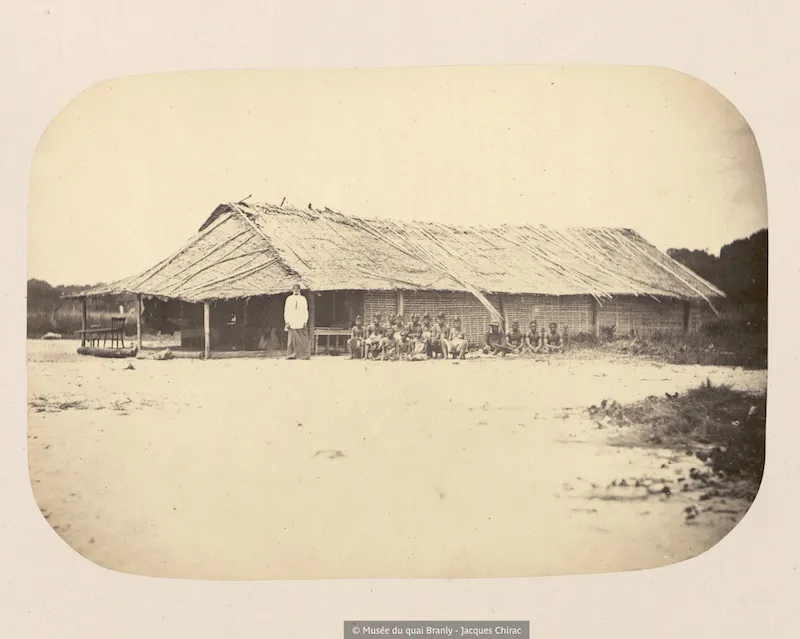
For the House of Rapontchombo, this building is the Bwiti temple of King Denis: the place where the sovereign of the Assiga clan held the rites of which his lineage has remained the guardian, and whose tradition continues on the peninsula to this day. The French sources of the period, for their part, describe the place in their own words, « la case du roi Denis » (King Denis’s house), without grasping its spiritual function.
1865: the engraving in Le Tour du Monde
Three years after the picture was taken, the magazine Le Tour du Monde published the account of Dr Griffon du Bellay, a naval doctor posted to Gabon from 1861 to 1864. On page 288, an engraving by Thérond faithfully reproduces the photograph by Houzé de l'Aulnoit: the same roof with long slopes of leaves, the same awning, the same gathering on the sand.
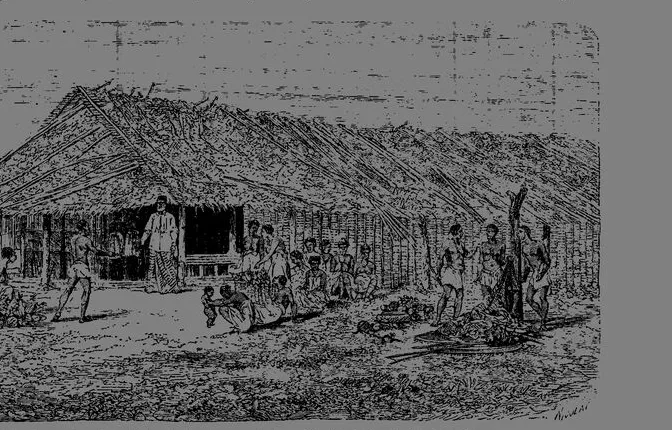
The text accompanying the engraving paints a respectful portrait of the old king. Griffon du Bellay describes him as a patriarch “of quite remarkable individuality”, combining “finesse and good nature” (« finesse et bonhomie ») with “an air of real dignity”:
“Long accustomed to European ways, he knows how to wear his magnificent costumes with propriety and without too much awkwardness. […] He has a taste for hospitality, and does the honours of his poor dwelling with cordiality.”
“He lives on the left bank of the bay and is its most influential chief.”
A detail in the same text sheds light on the photograph: the king, writes Griffon du Bellay, remained “attached by an old habit” to his former dwelling and “refus[ed] to live in the truly comfortable houses that his sons [had] built for him nearby”. The attachment that the French officer takes for nostalgia, family tradition reads otherwise: one does not move a temple.
What the photograph shows
The gathering seated beneath the awning, the space left open on the sand, the man standing in pale dress at the entrance: the scene is that of a place of assembly and of rite, not of a mere dwelling. It is on this same peninsula that the family still celebrates its ceremonies, from offerings to the sea to the tributes paid at the king’s tomb at Iwounwé, and it is this continuity, more than stone or wood, that makes the image a document of the first order for the history of the House.
Sources
- Auguste Houzé de l'Aulnoit, photographs of Gabon, 1862; prints held at the musée du quai Branly - Jacques Chirac (including « Le roi Denis », 1862).
- Dr Griffon du Bellay, « Le Gabon (1861-1864) », Le Tour du Monde, 1865, pp. 273-320; engravings by É. Bayard and Thérond after Houzé de l'Aulnoit; la case du roi Denis, p. 288 (Gallica/BnF, public domain).
- On the lineage and the keeping of the rites: André Raponda-Walker, Notes d'histoire du Gabon, Brazzaville, 1960, ch. II-III; and the Family tree page of this site.
- The identification of the building as a Bwiti temple belongs to the tradition of the House of Rapontchombo; the sources of 1865 refer to it as « la case du roi Denis ».