

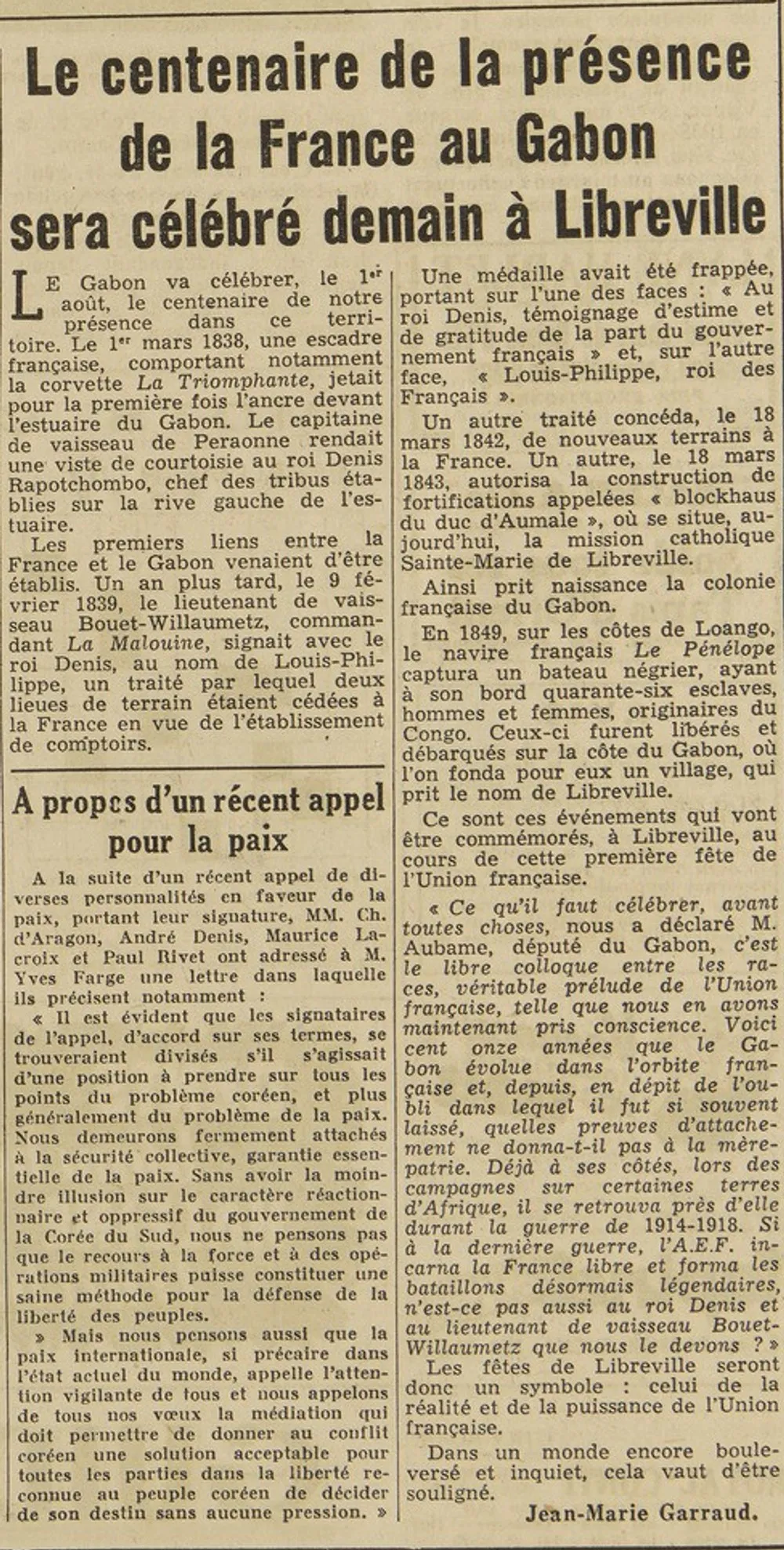
On 1 August 1950, Libreville celebrated the centenary of the French presence in Gabon and the “first festival of the French Union”. The day before, in Paris, Le Figaro announced the event on page 6, in an article by Jean-Marie Garraud: « Le centenaire de la présence de la France au Gabon sera célébré demain à Libreville » (The centenary of the French presence in Gabon will be celebrated tomorrow in Libreville). A hundred and eleven years after the treaty of 1839, King Denis’s name opens the article.
King Denis in the first chapter
The journalist goes back to the beginning: “On 1 March 1838 a French squadron, including the corvette La Triomphante, dropped anchor for the first time off the Gabon estuary. Captain de Peraonne paid a courtesy visit to King Denis Rapotchombo, chief of the tribes settled on the left bank of the estuary.” Then comes the treaty: “A year later, on 9 February 1839, Lieutenant Bouet-Willaumetz, commanding La Malouine, signed with King Denis, in the name of Louis-Philippe, a treaty by which two leagues of land were ceded to France for the establishment of trading posts.”
The article also records a detail rarely found elsewhere: the inscription on the medal France gave the king. “A medal had been struck, bearing on one face: ‘To King Denis, a token of esteem and gratitude from the French government’ and, on the other, ‘Louis-Philippe, King of the French’.” This is the silver-gilt medalthat accompanied the cross of the Legion of Honour, awarded, according to the family, to King Denis II, Louis Denis Marie Félix Adandé Rapontchombo, the king’s son.
“Do we not owe it also to King Denis…”
The journalist gives the floor to Jean-Hilaire Aubame, député for Gabon in the National Assembly. For him, the Libreville festival above all celebrates “the free dialogue between the races”; he recalls that Gabon stood beside France in the war of 1914-1918, and that French Equatorial Africa embodied Free France in 1940. He ends with a question that gives King Denis his place in that history:
“If in the last war French Equatorial Africa embodied Free France and raised the battalions that are now legendary, do we not owe it also to King Denis and to Lieutenant Bouet-Willaumetz?”
The article then traces the steps that followed the treaty: more land ceded, the blockhouse of Fort d’Aumale, where the Sainte-Marie mission stands today, and in 1849 the captives freed from a slave ship by La Pénélope and settled on the Gabon coast, in a village that took the name of Libreville. These dates are the journalist’s; historians now place several of these treaties slightly differently, but the essential point stands: in 1950 the national press still presented King Denis as the starting point of this story.
“From our special correspondent” in Libreville
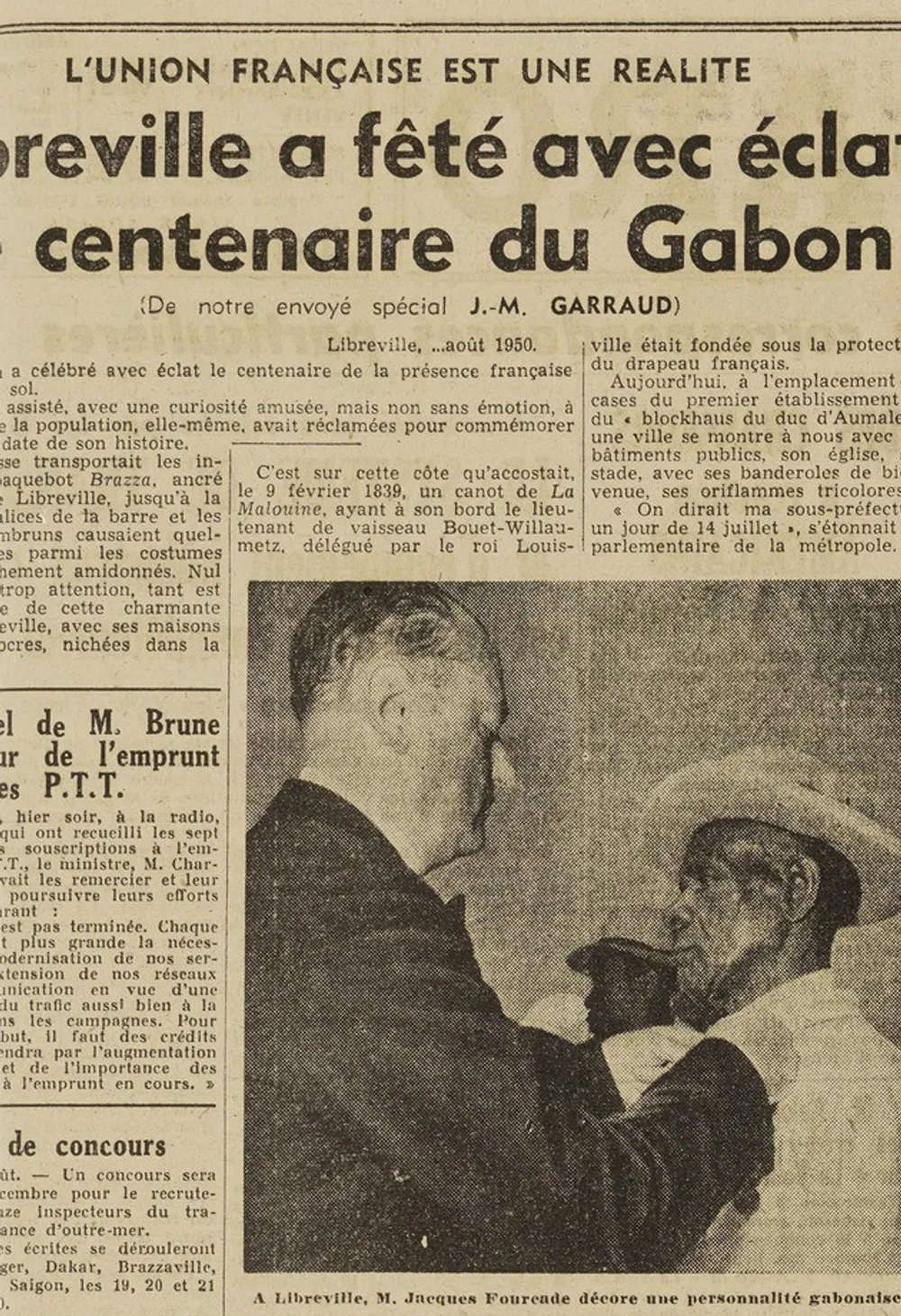
Jean-Marie Garraud did not merely write from Paris: he was in Libreville for the festival. In Le Figaro of 5-6 August 1950, under the headline « Libreville a fêté avec éclat le centenaire du Gabon » (Libreville celebrated the centenary of Gabon in style), he describes arriving on the liner Brazza, the ochre houses nestling in the greenery, the drums and the military band. And he returns to the starting point: “It was on this coast that, on 9 February 1839, a boat from La Malouine landed, carrying Lieutenant Bouet-Willaumetz, sent by King Louis-Philippe to sign a treaty of friendship with the local chief, King Denis. Ten years later, Libreville was founded under the protection of the French flag.”
The official ceremony brought together Jacques Fourcade, president of the Assembly of the French Union, and Bernard Cornut-Gentille, high commissioner in French Equatorial Africa and grandson of one of the last naval commanders of Gabon. There the député Aubame recalled that Gabon “does not intend to be forgotten by the mother country”, and the journalist notes that he said so “very freely, in a city whose very name is a symbol of freedom”.
During the festival, Jacques Fourcade presented a decoration to a “Gabonese personality” whom the paper does not name. The family recognises him: it is Prince Félix Adandé Rapontchombo, great-grandson of King Denis. A hundred and eleven years after the treaty signed by his ancestor, it was his descendant whom the Republic honoured in Libreville.
The crown shown to Le Figaro
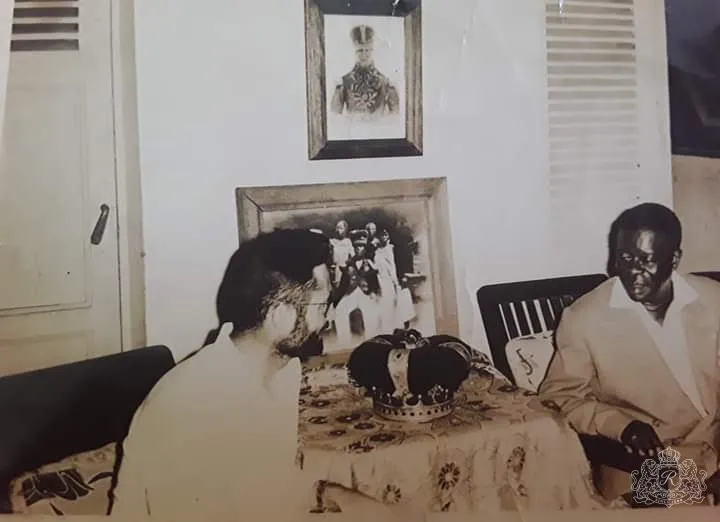
It was during those same days of August 1950 that a journalist from Le Figaro came to interview Prince Félix Adandé Rapontchombo, grandson of the second King Denis and great-grandson of the founder. In the photograph kept by the family, the crown sits on the table between the two men, beneath the portrait of King Denis in uniform. The paper’s special correspondent in Libreville was Jean-Marie Garraud, so it is very probably he who is seen from behind. At the centenary festival, King Denis’s crown was shown to the national press.
Sources
- Jean-Marie Garraud, « Le centenaire de la présence de la France au Gabon sera célébré demain à Libreville », Le Figaro, 31 July 1950, p. 6: Gallica.
- Le Figaro, 5 August 1950, p. 7, J.-M. Garraud, « Libreville a fêté avec éclat le centenaire du Gabon »: Gallica.
- Photographic archives of the Rapontchombo family.