

When European ships sailed up the Gabon estuary at the beginning of the 19th century, it was they whom they met: the Mpongwe, a people of the coast and of both banks of the Komo, navigators, traders and diplomats, organised in clans around chiefs whom the sailors called kings. It is from this people that King Denis Rapontchombo, chief of the left bank, came, and it is on their lands that Libreville would be born. This article brings together what the written sources, from the travel accounts of 1819 to the work of historians, say of the Mpongwe.
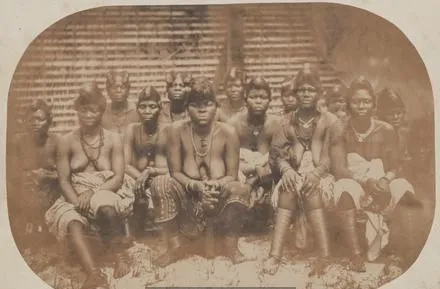
A Myene people of the estuary
The Mpongwe belong to the Myene (Omyene) group, which brings together the peoples speaking the dialects of that name along the Gabonese coast: the Mpongwe of the estuary, the Orungu of Cape Lopez, the Nkomi of the Fernan-Vaz, and the Galwa, Enenga and Adyumba of the lower Ogooué. The word “Myene” serves both as the name of a language and as the name of a cultural family: traditions, rites and art forms travel from one end of this coast to the other. Father André Raponda-Walker, the first Gabonese priest and the son of a Mpongwe princess, devoted his life to documenting these peoples: his Dictionnaire mpongwè-français and his Rites et croyances des peuples du Gabon (with Roger Sillans, 1962) remain the references.
Settled on both banks of the estuary and on the peninsula that closes it to the south, the Mpongwe live from fishing, trade and navigation. Their dugout canoes, of which the musée du quai Branly holds a scale model given by Victor Schoelcher before 1886, link the villages, the trading posts and the peoples of the interior.
1819: the first written descriptions
The first detailed description of the estuary published in Europe is found in an appendix to a book of 1819: the Mission from Cape Coast Castle to Ashantee by the English explorer T. Edward Bowdich, who devotes a chapter to the “Gaboon” and its inhabitants. In the decades that followed, the accounts multiplied: the American missionary John Leighton Wilson, settled at Baraka from 1842, describes Mpongwe society at length in Western Africa(1856), with its taste for trade and its language; the explorer Paul Du Chaillu, who set out from the estuary on his travels, opens his Explorations and Adventures in Equatorial Africa (1861) among the Mpongwe; and it is an explorer of the same period who notes that King “Rompochombo, or King Dennis” belongs to the “Ashiga family”: the oldest printed mention of the clan Assiga.
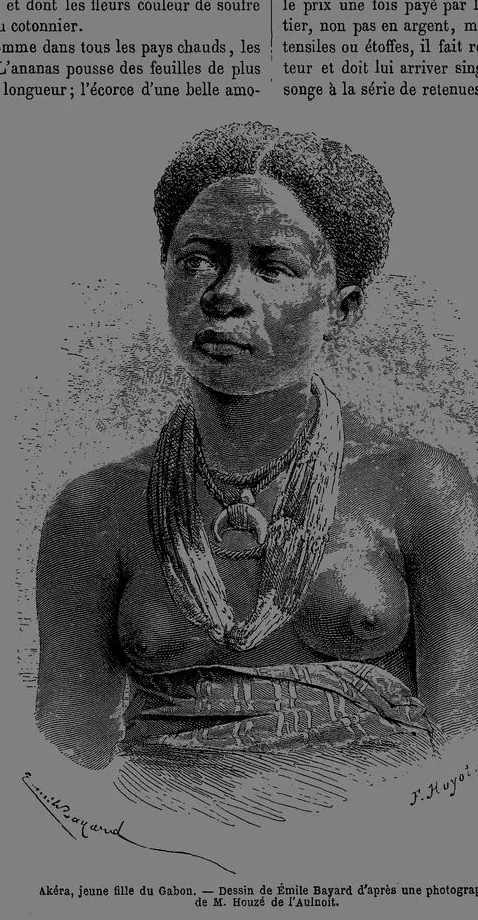
In 1865, the review Le Tour du Monde published the account of Dr Griffon du Bellay, a naval doctor in Gabon from 1861 to 1864, illustrated with engravings made after the photographs of Auguste Houzé de l'Aulnoit: King Denis is described there as “the most influential chief” (« le chef le plus influent ») of the estuary.
Clans and kings
Mpongwe society is organised in exogamous clans, led by lineage chiefs: Assiga, Agekaza, Agulamba and others. The Europeans gave the most powerful among them the names of kings: King Denis (Antchouwé Kowé Rapontchombo), chief of the left bank and of the clan Assiga; King Louis (Anguilè Ré-Dowé) and King Glass on the right bank (see The Oga of the estuary, with King George Rassondji). It was with King Denis that France signed, on 9 February 1839, its first treaty in Gabon; the chiefs of the right bank in turn ceded land in 1842 and 1843, and Fort d'Aumale rose facing the king’s lands. In 1849, the captives freed from the slave ship Elizia were settled on land granted by the Mpongwe chiefs: this was the founding of Libreville, told in another article on this site.
One of the first written languages of Gabon
Mpongwe is one of the first languages of Gabon to have been written down, and the documents can all be consulted online. As early as 1847, the American missionaries of Baraka published in New York A Grammar of the Mpongwe Language; the Gospel of Matthew appeared in Mpongwe in 1850, the four Gospels in 1879. On the French side, the Spiritans printed in 1873 a Grammaire de la langue pongouée. The tales, stories and proverbs collected by the missionary Robert H. Nassau (Where Animals Talk, 1912) and by Raponda-Walker (Contes gabonais) keep the memory of Myene oral literature.
Trade, the slave trade and the ordeal of the 19th century
All the sources agree: the Mpongwe were first and foremost intermediaries. Masters of the estuary, they held the trade between the European ships and the peoples of the interior, ivory, ebony, rubber, and drew power and prosperity from it. The historians who devoted their work to this period, K. David Patterson (The Northern Gabon Coast to 1875, Oxford, 1975) and Henry H. Bucher (The Mpongwe of the Gabon Estuary: a History to 1860, thesis, 1977), also describe the dark side of the century: the Atlantic slave trade that passed through the estuary, then the epidemics which, in the second half of the 19th century, dramatically reduced the Mpongwe population. It was this people, tried but still standing, that entered the 20th century, and whose elites, educated in the schools of Libreville, would play a leading role in the life of modern Gabon.
Arts and rites
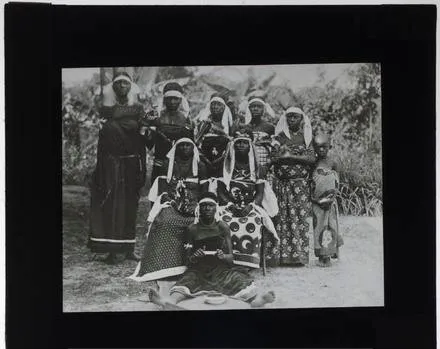
The museums of the world hold the witnesses of Mpongwe art: ivory spoons and combs in the British Museum, collected by R. B. N. Walker, the father of Raponda-Walker; musical instruments in the Metropolitan Museum in New York; kaolin-faced masks, funerary statuettes, ngombi harps and dugout canoes in the musée du quai Branly, where several pieces are catalogued “culture Mpongwe”; a mask in the Musée d'ethnographie de Genève. The Archives page of this site lists them one by one, with their inventory numbers. The rites, for their part, have not stayed in the display cases: the Ivenga dance, photographed at the beginning of the 20th century, the offerings to the sea and the Mpago rite are still celebrated at Pointe-Denis, under the authority of the Mpongwe chieftaincy and of the clan Assiga, guardian of the traditions since King Denis.
The Mpongwe today
Libreville was built on Mpongwe land, and the people of the estuary have remained at the heart of its history: the country’s first literate elites, first priests, first women deputies, among them Virginie Ambougou, granddaughter of the house of Rapontchombo. Every year still, the Mpongwe chieftaincy suspends activities at sea for the traditional ceremonies of Pointe-Denis, “in the name of the throne of King Denis Rapontchombo”; in April 2026, AFP devoted a report to the Mpago rite that protects the coastline. To be Mpongwe today is to carry this twofold memory: that of the masters of the estuary who dealt as equals with the European powers, and that of the guardians of the rites who, from generation to generation, maintain the bond between the sea, the land and the ancestors.
How many are they?
Gabon does not publish a census by ethnic group: the figures are therefore estimates. The Mpongwe are today put at 60,000 to 80,000 people. The Myene group as a whole, of which they are one of the six branches along with the Orungu, the Galwa, the Enenga, the Nkomi and the Adyumba, numbers some 40,000 to 50,000 speakers. The Mpongwe language proper is now spoken by only a few thousand people: a people small in number on the scale of the country, but whose imprint on the history of Gabon, from the estuary to Libreville, is out of all proportion to its demographic weight.
Sources
- T. Edward Bowdich, Mission from Cape Coast Castle to Ashantee, London, 1819, appendix on Gabon: archive.org.
- John Leighton Wilson, Western Africa: its History, Condition, and Prospects, New York, 1856: archive.org.
- Paul Du Chaillu, Explorations and Adventures in Equatorial Africa, 1861: archive.org.
- Dr Griffon du Bellay, « Le Gabon (1861-1864) », Le Tour du Monde, 1865: Gallica/BnF.
- A Grammar of the Mpongwe Language, with Vocabularies, American mission of Gabon, New York, 1847: archive.org; The Gospel of Matthew in the Mpongwe Language, 1850: archive.org; The Four Gospels in the Mpongwe Language, 1879: archive.org.
- Grammaire de la langue pongouée, Catholic mission, 1873: archive.org.
- Robert H. Nassau, Fetichism in West Africa, 1904: archive.org; Where Animals Talk: West African Folk Lore Tales, 1912: archive.org.
- André Raponda-Walker, Notes d'histoire du Gabon, Brazzaville, 1960; Dictionnaire mpongwè-français: archive.org; with Roger Sillans, Rites et croyances des peuples du Gabon, Paris, 1962: archive.org.
- K. David Patterson, The Northern Gabon Coast to 1875, Oxford, Clarendon Press, 1975; Henry H. Bucher, The Mpongwe of the Gabon Estuary: a History to 1860, thesis, University of Wisconsin, 1977.
- Convention of 9 February 1839 between King Denis and Lieutenant Bouët: Archives nationales d'outre-mer, FR ANOM 40 COL 436.
- On today’s rites: Africanews/AFP, 16 April 2026 (the Mpago rite); Gabon Review, 5 April 2026 (the Mpongwe chieftaincy); Gabon Review, 28 August 2026 (« Nchantonwin », on the former name of Pointe-Denis).
- On demography: « Mpongwè », Wikipédia (60,000 to 80,000 people); « Myènè (peuple) », Wikipédia; Sorosoro, « Le mpongwè » (on the state of the language).
- The Mpongwe objects held in museums, with their inventory numbers: the Archives page of this site; the genealogy of the house: Family tree.