

At Pointe-Denis, Maison Assiga keeps an initiatory tradition that it has handed down from generation to generation since King Denis Rapontchombo, and which it calls Omengo. The name belongs to the family’s oral transmission: it is not found in books, and that is in the nature of things, for the family branches of the Bwiti pass from guardian to guardian, in the temple, and not through writing. What the published sources do make it possible to establish is the framework within which this transmission takes place: the Bwiti of Gabon, its initiatory way, its rites and its instruments. This article keeps to both registers, always saying which one is speaking.
The Bwiti, the initiatory way of Gabon
The Bwiti is the great initiatory way of Gabon. Ethnographers place its birth among the Mitsogo, the Apindji and the Massango of the south of the country, from where it spread to the peoples of the coast, each of whom developed a form of its own. Through initiation, the songs and the music of the temple, it opens to the initiate the knowledge of self and the world of the ancestors. The published references are there: Father André Raponda-Walker and Roger Sillans devote whole pages to the Bwiti in their Rites et croyances des peuples du Gabon (1962), and the American anthropologist James W. Fernandez dedicated to it the major study Bwiti: An Ethnography of the Religious Imagination in Africa (Princeton, 1982).
The Bwiti is not a religion of the book: it is a school of life, entered through initiation, in which each community, each temple and each lineage of guardians carries its own branch, its songs, its prohibitions and its remedies. That is why the names of branches are countless, and why the oldest, those of the families, remain outside the bibliographies.
The temple of King Denis
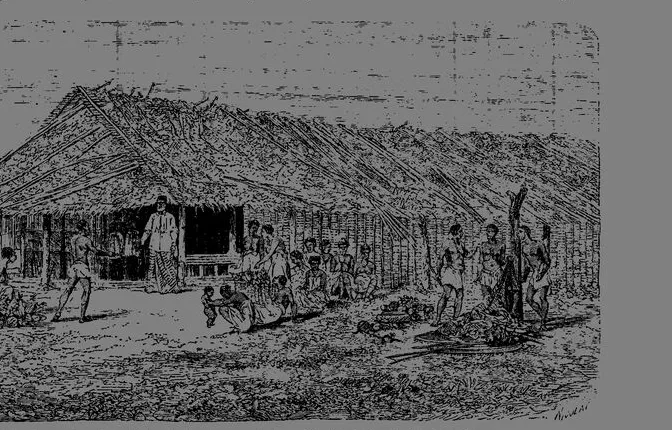
The family’s oldest photographed place of worship is the large building of woven leaves that Houzé de l'Aulnoit captured on the sand of Pointe-Denis as early as 1861, and that Le Tour du Monde engraved in 1865 under the name « case du roi Denis ». The French sources saw in it a dwelling; the tradition of the House recognises in it the king’s temple, the place where the sovereign of the Assiga clan held the rites of which his lineage has remained the guardian. Griffon du Bellay notes, moreover, that the old king refused to live in the comfortable houses built by his sons and remained “attached by an old habit” to this building: one does not move a temple. The full story of this photograph is told in the article devoted to it.
The ngombi harp and the instruments of the rite
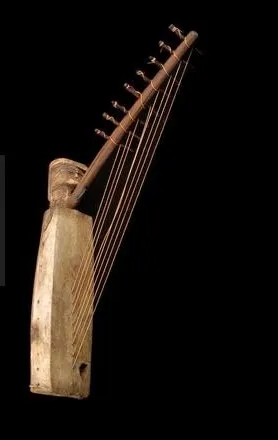
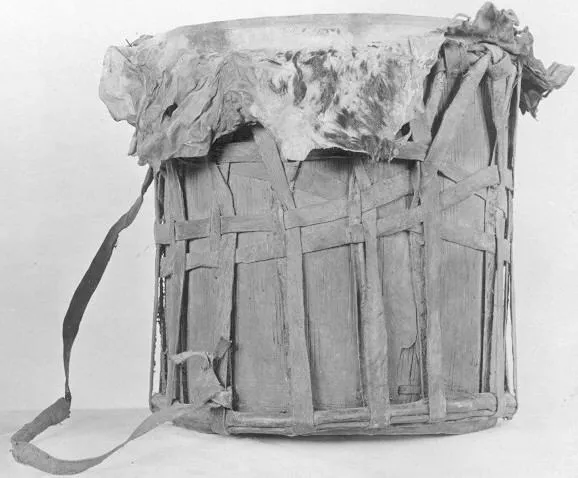
Throughout the Bwiti, the voice of the invisible world passes through the sacred ngombi harp: eight strings, an arched neck, often a carved head at the top of the pegbox. It is no coincidence that museums hold harps among the objects catalogued as “Mpongwe culture”: the one at the musée du quai Branly, which entered before 1937, with its nailed hide body and carved human head, and the eight-pegged ngombi neck given by Professor Jacques Millot. The Archives page presents them with their inventory numbers. To the harp are added the obaka, the drums and the musical bow that carry the songs of the vigils.
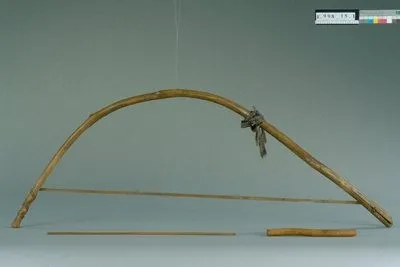
And there is the mongongo (or mougongo, mungongo), the mouth bow: a bent branch, a single string struck with a stick, the initiate’s mouth as the sounding box. It is the barest instrument of the Bwiti and one of the most profound: at the vigils, its voice murmurs what the ngombi proclaims. The great museums hold examples: the Musée de la musique of the Philharmonie de Paris has a mungongo musical bow brought back from Gabon, acquired by Jean Landré in 1968.
The Omengo branch, the transmission of the House
What follows belongs to the tradition of the House of Rapontchombo, which is its sole custodian. Since King Denis, the lineage of the Assiga clan has handed down at Pointe-Denis a branch of the Bwiti Disumba that it calls Omengo: the way of the king’s temple, that of the vigils on the sand of Nchantonwin, of offerings to the sea and of the spiritual protection of the throne. Its keeping falls to the king’s descendants: it is by virtue of this charge that Princess Marie-Anne Ankombie Rapontchombo watches over the royal regalia and that traditional ceremonies still set the rhythm of life on the peninsula today, to the point of closing the sea to canoes during the rites, as the Gabonese press reported in April 2026.
The tradition of the Assiga clan has always been to invite to the temple the greatest Bwitists of the country, drawn from the different branches: Missoko, Ngondet, the Apindji tradition and others besides. Pointe-Denis has thus remained a place where the ways of the Bwiti meet under the authority of the throne. It is not unusual, either, to meet there the high customary authorities of the continent: on 2 August 2015, more than fifty sovereigns, princes and traditional chiefs came to pay tribute to King Denis at Pointe-Denis, an event that now has its own article. Among them: Paramount Chief Songue Madiba, head of the Bakoko canton of Douala; the King of the Bell of Douala, Douala Manga Bell; the Sultan of Logone-Birni, Mahamat Bahar Marouf; and the dignitaries Diima Mfumu and Boketsu Ngele. The timeline of the House keeps its memory, and Gabonese television covered the tributes paid to the king that year (see the reports on the Archives page).
The House continues this transmission within the initiation it hosts on its lands: eleven days of immersion, vigils and rituals under the guidance of the guardians of the tradition, in keeping with the rules of the temple. The teachings proper to the Omengo, its songs and its founding stories will be published here as and when the guardians of the House choose to commit them to writing.
Sources
- André Raponda-Walker and Roger Sillans, Rites et croyances des peuples du Gabon, Paris, Présence africaine, 1962: archive.org; review in L'Homme, 1963: Persée.
- James W. Fernandez, Bwiti: An Ethnography of the Religious Imagination in Africa, Princeton University Press, 1982.
- Dr Griffon du Bellay, « Le Gabon (1861-1864) », Le Tour du Monde, 1865: la case du roi Denis, p. 288 (Gallica/BnF, public domain).
- Mpongwe harps and instruments: musée du quai Branly - Jacques Chirac, inv. 71.1937.0.179.1 and 71.1961.120.136; see the Archives page.
- On the present-day ceremonies at Pointe-Denis: Gabon Review, 5 April 2026; Africanews/AFP, 16 April 2026.
- The name Omengo, the reading of the 1861 building as a temple and the content of the branch belong to the oral tradition of the House of Rapontchombo, gathered from its guardians; they are presented as such. The place name itself is attested: when King Denis died in 1876, the Orungu chief Ré-Ntchengué “ordered a special mourning in his own town, Omèngo”, near Cape Lopez (Abbé André Raponda-Walker, quoted by Miboue).