

There are families one notices because they occupy the front of the stage. There are others one finds, generation after generation, simply present at the moments when the country decides its course. The House of Rapontchombo is one of these. Ever since King Denis treated with the crowns of Europe, every era of Gabon has crossed paths with his line: in Paris in 1960 for independence, on the benches of the first Assembly, in the town halls of Libreville, and as far as the king’s tomb, where presidents still come to pay their respects.
1839
A king who treats with crowns
King Denis I signs with the France of Louis-Philippe the first Franco-Gabonese agreement and receives the gifts of Queen Victoria; his son, King Denis II, Louis Denis Marie Félix Adandé Rapontchombo, receives the cross of the Legion of Honour.
1939
Prince Félix Adandé in Paris
A hundred years later, the French press hails the king’s heir as “the most considerable figure” of the delegation of great chiefs received in Paris.
1960
In the independence delegation
Alongside Léon M'ba, Prince Félix Adandé-Rapontchombo leaves for Paris to negotiate the independence of Gabon.
1961
In the National Assembly
Virginie Ambougou, Oga of the clan Assiga, born at Pointe-Denis, becomes one of the first two women deputies of Gabon.
The Bongo years
At the heart of the Republic
Prince Denis Marie Félix Adandé Rapuntchombo, mayor of the 4th arrondissement of Libreville, is photographed beside President Albert-Bernard Bongo.
2023
The peninsula of heads of State
Jeune Afrique describes Pointe-Denis as the “Gabonese paradise” of Mohammed VI and Ali Bongo Ondimba.
2025
A wreath on the king’s tomb
The President of the Republic of Gabon, Brice Clotaire Oligui Nguema, pays his respects at the tomb of King Denis and visits his museum.
1839: dealing as equals
The story begins before the Republic. On 9 February 1839, King Denis I signed with Lieutenant Bouët-Willaumez, in the name of Louis-Philippe, the first Franco-Gabonese agreement, drafted by his son, King Denis II, Louis Denis Marie Félix Adandé Rapontchombo. That same year, France made Denis II a Knight of the Legion of Honour, and the England of Queen Victoria sent King Denis I a gold chain and medal. The tone was set: the House did not petition the powers, it treated with them. And it was on lands he had granted that Libreville, the future capital, would be born.
1939 and 1960: Prince Félix, from Paris to independence
In July 1939, for the centenary of the treaty, the Parisian press singled out among the great chiefs of the Empire received in Paris Prince Félix Adandé Rapontchombo, the king’s great-grandson, “the most considerable figure” (« le personnage le plus considérable ») of the delegation: the episode is told in a dedicated article.
Twenty-one years later, the same name appeared on a far more decisive list. In July 1960, « la délégation gabonaise conduite par Léon Mba, assisté du Président de l'Assemblée Législative Paul Gondjout et d'hommes politiques et notables dont le Prince Félix Adande-Rapontchombo » (“the Gabonese delegation led by Léon Mba, assisted by the President of the Legislative Assembly Paul Gondjout and by politicians and notables including Prince Félix Adande-Rapontchombo”) left Libreville for Paris to negotiate independence with the government of Michel Debré. Gabon became independent on 17 August 1960. At the moment the country was born, the heir of King Denis was in the room.
Léon M'ba, the first President of the Republic, was himself, according to researchers, an initiate of the Bwiti, as was his successor: see Omar Bongo, the Bwitist president.
1961: a princess of the clan in the Assembly
The Republic barely born, the line entered Parliament. Virginie Ambougou, born on 27 August 1902 at Pointe-Denis, daughter of Princess Marie-Anne Rapontchombo and Oga of the clan Assiga, was elected in 1961: she was one of the first two women deputies in the history of Gabon, and sat until 1964.
The Bongo years: at the heart of the Republic
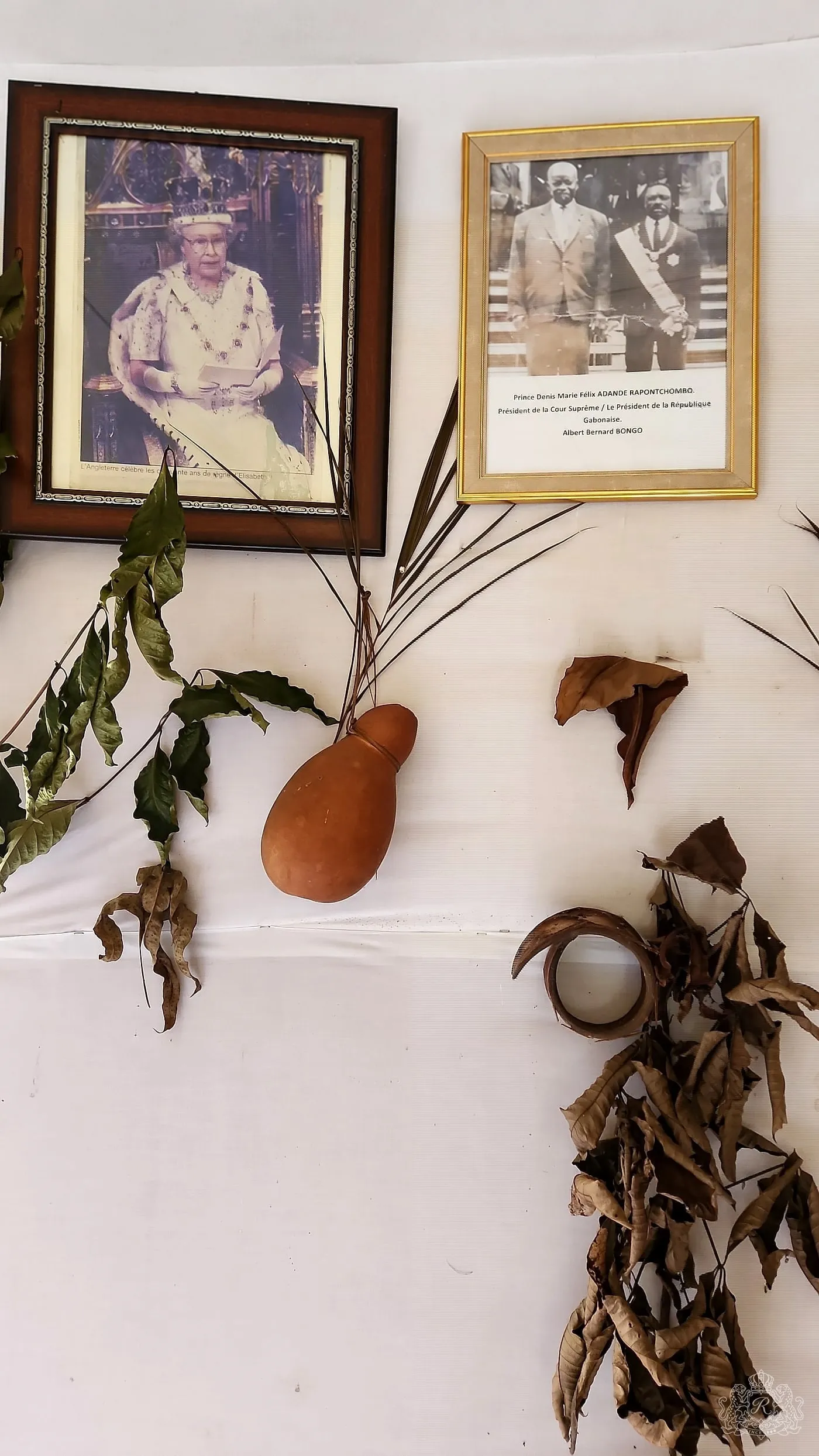
Son of Prince Félix, Denis Marie Félix Adandé Rapuntchombo made his career at the heart of Libreville’s public life: former mayor of the capital’s 4th arrondissement, communal secretary of the Gabonese Democratic Party, he was photographed beside President Albert-Bernard Bongo. The House keeps this portrait in its museum, between the calabash and the ritual leaves, as one keeps the memory of a president who was himself an initiate of the Bwiti.
2023: the peninsula of heads of State
Pointe-Denis is not only a place of memory. In 2023, Jeune Afrique described it as the “Gabonese paradise” of two heads of State, King Mohammed VI and President Ali Bongo Ondimba: the peninsula of King Denis had become the retreat of those who govern.
2025: a wreath on the king’s tomb
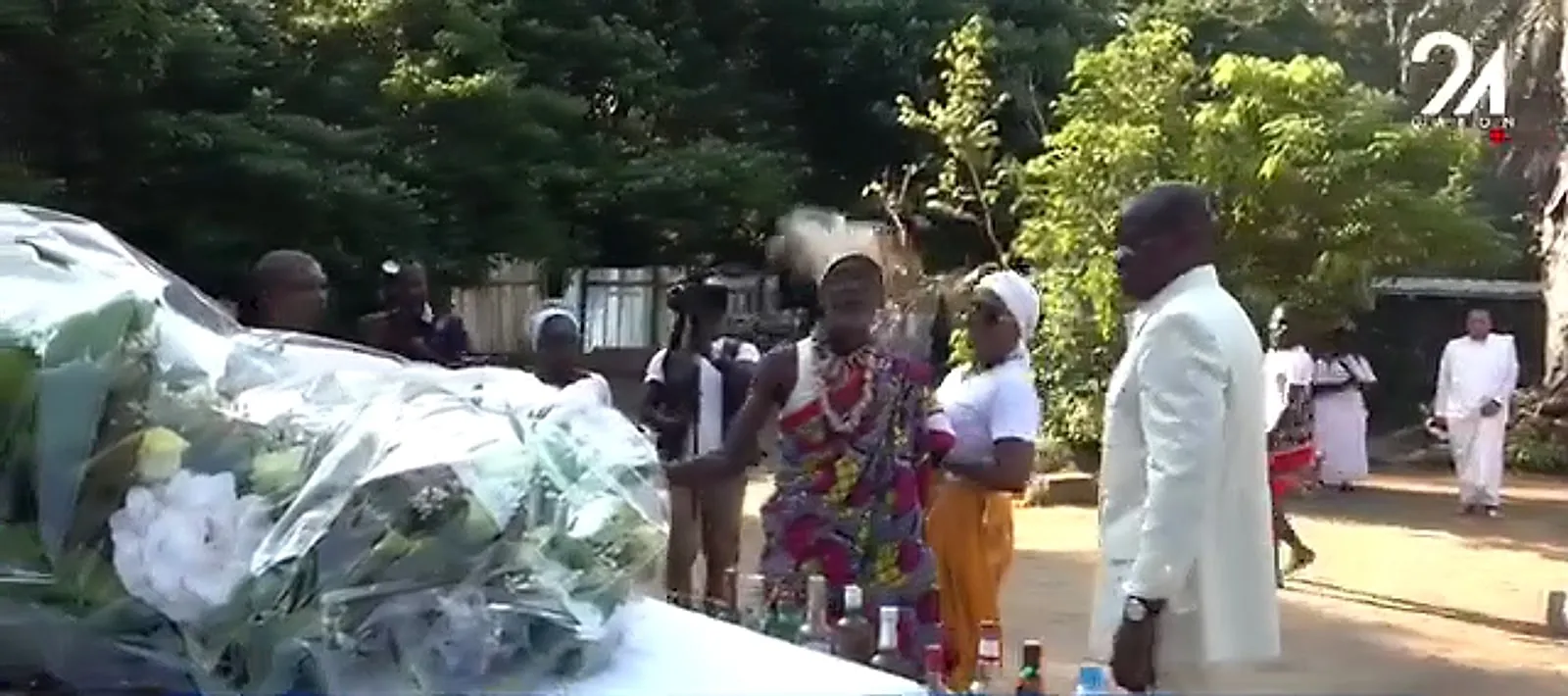
In March 2025, the President of the Republic of Gabon, Brice Clotaire Oligui Nguema, came to Pointe-Denis. He laid a wreath on the tomb of King Denis, then visited the museum of the royal family, where Gérard Michel Aimé Adande Avili received national television. The Gabon 24 report is kept in the Archives.
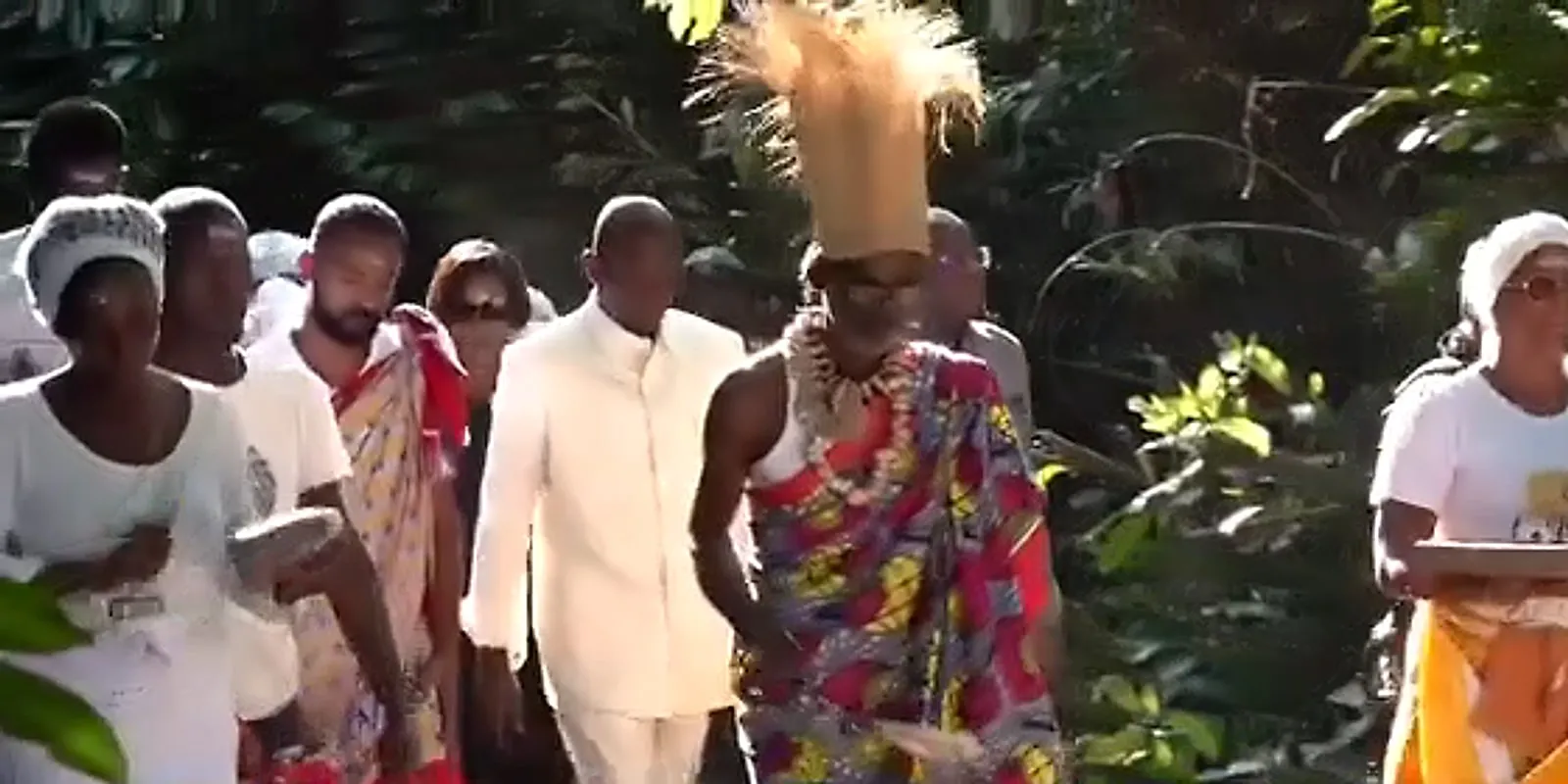
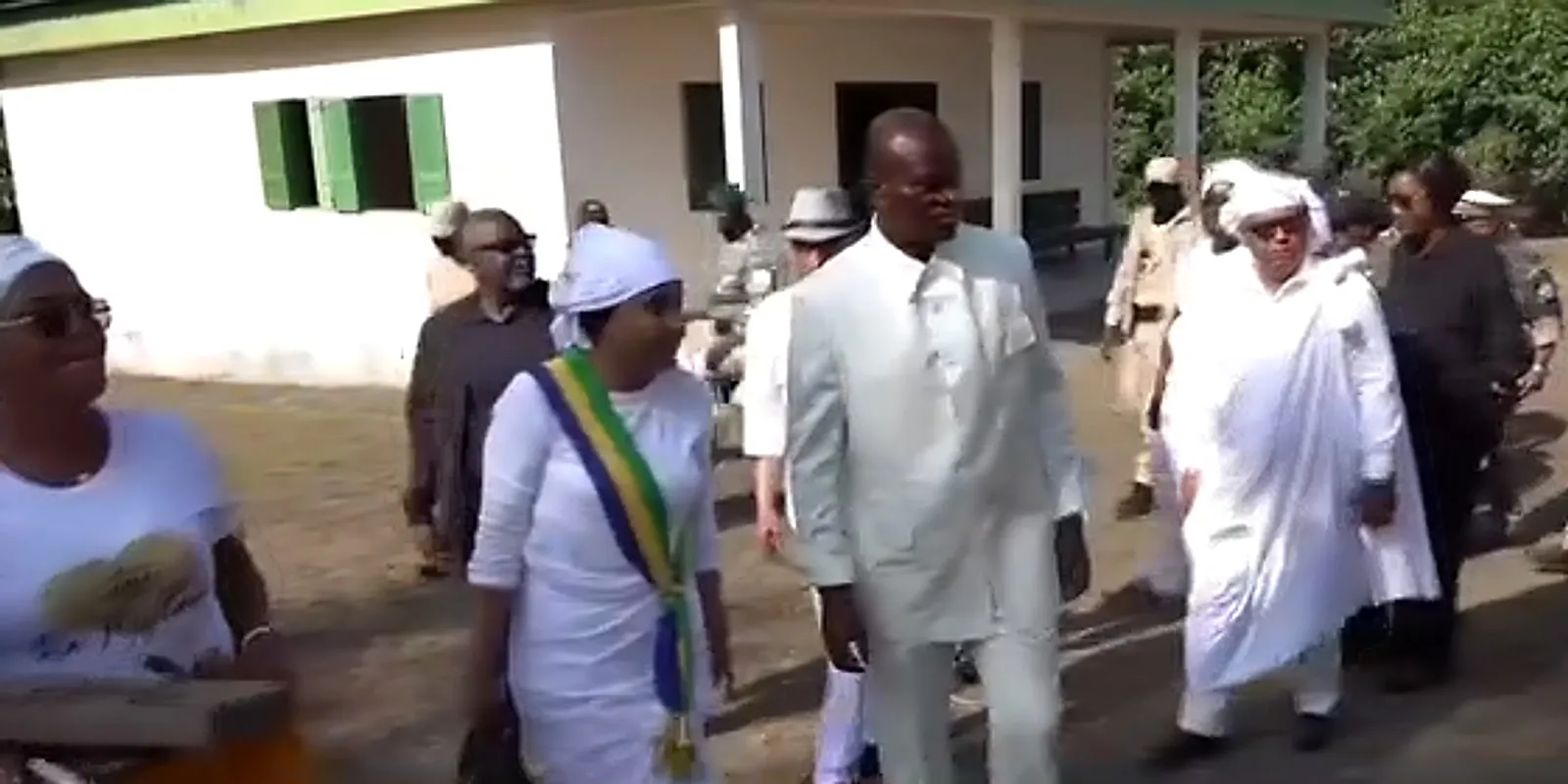
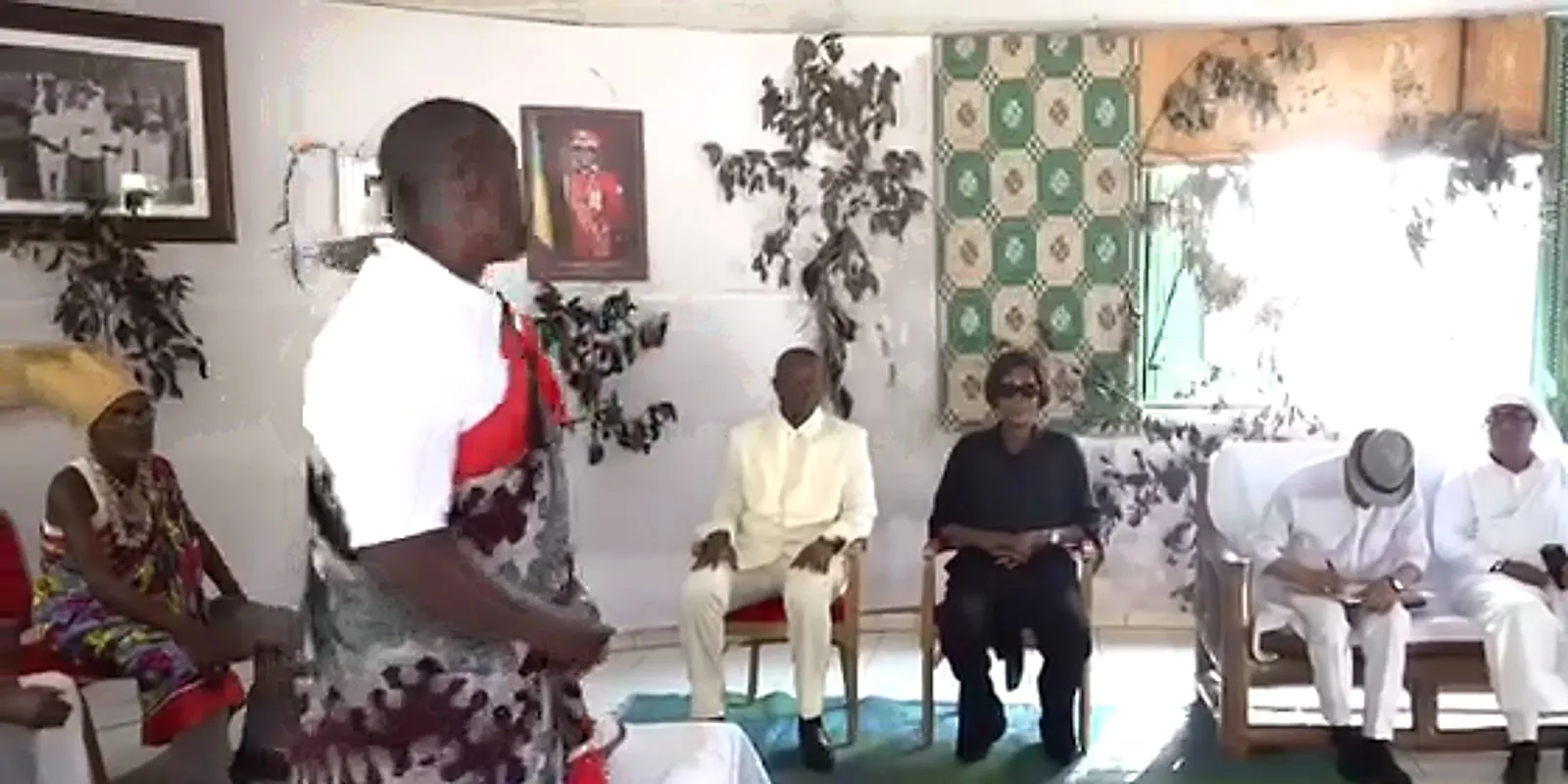
Stills from the report « Oligui Nguema salue la mémoire du roi Denis Rapontchombo », © Gabon 24, March 2025.
A House of the Bwiti
This political thread conceals another, older one. The House of Rapontchombo is not only a line of notables: it is a house of the Bwiti. In the building that the photographer Houzé de l'Aulnoit captured on the beach at Pointe-Denis in 1862, the tradition of the family sees the Bwiti temple of King Denis, where the king held the rites of which his clan was guardian. Since then, the House has passed on its own branch, the Omengo, attached to the Disumba, the trunk of the Bwiti; Jacques Makaya Zimamo, a descendant of the king and son of Princess Marie-Anne Ankombie Rapontchombo, is consecrated in it, and each year leads the ceremonial on the king’s tomb.
These rites are not hidden. When the House holds its ceremonies, Princess Marie-Anne, curator of the heritage and of the royal attributes, announces it by circular: in February 2020 and again in April 2026, activities at sea were suspended off Pointe-Denis, and the national press as well as AFP reported on it.
One then measures what the House and the country’s first two presidents share. Léon M'ba and Omar Bongo were, according to researchers, initiates of the Bwiti; the family of King Denis has, for two centuries, been one of its guardians. Between them there was politics; there was also the temple.
What this history says
None of these episodes makes a sound on its own. Placed end to end, they trace a constancy: regimes pass, presidents succeed one another, and the House of King Denis is always there, at their side or on their path. Today, Princess Marie-Anne Ankombie Rapontchombo, a senator, watches over the heritage and the royal attributes; and those who govern Gabon come, sooner or later, to bow at Pointe-Denis.
Sources
- July 1960 delegation: « La marche vers l'État gabonais », Infos Plus Gabon; « Libreville : les enfants du roi Denis », Jeune Afrique, 16 January 2014 (restricted access).
- Virginie Ambougou: « Virginie Ambougou, l'une des deux premières femmes députées du Gabon », Info241, 22 March 2021.
- Denis Marie-Félix Adandé Rapontchombo, « Ancien Maire du 4ème Arrondissement, Secrétaire Communal PDG Libreville »: death notice, L'Union, 17 January 2017, L'Union archives; portrait with President Bongo: museum of the royal family, Pointe-Denis.
- « La Pointe-Denis, paradis gabonais de Mohammed VI et Ali Bongo Ondimba », Jeune Afrique, 1 July 2023 (restricted access).
- 2025 visit: report « Oligui Nguema salue la mémoire du roi Denis Rapontchombo », Gabon 24, March 2025, kept in the Archives.
- The Bwiti of the House: the Bwiti temple of King Denis (photograph of 1862, musée du quai Branly; the reading of the building as a temple belongs to the tradition of the House), the Bwiti Omengo and the Bwiti Missoko; circulars of Princess Marie-Anne: 7joursinfo, February 2020, and Gabonactu, 5 April 2026; Africanews/AFP, 16 April 2026.
- 1839 and 1939: see the Legion of Honour of King Denis II, the gifts of Queen Victoria and Prince Félix Adandé in Paris, with their sources; Léon M'ba and Omar Bongo as initiates: Omar Bongo, the Bwitist president.