

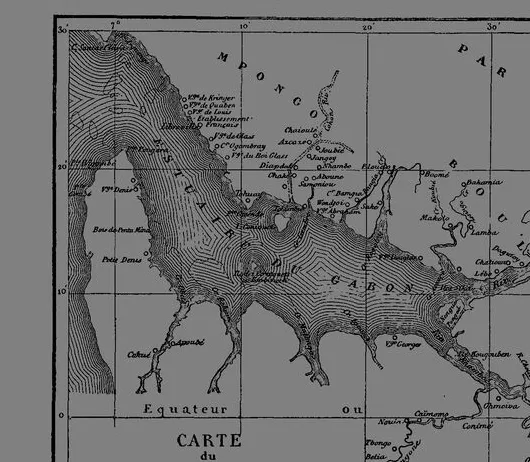
In the 19th century the Gabon estuary had not one king but several. Each Mpongwe clan obeyed its Oga, a word Europeans translated as “king”, giving each a trading-post name: Denis, George, Louis, Glass, Quaben. On the left bank, facing the ocean, two of them shared the coast: King Denis, of the Asiga clan, at Pointe-Denis, and further east, at the mouth of the Remboué, another highly influential landholding chief, Georges Rassondji, of the Agulamba clan.
What is an Oga?
In Mpongwe, oga means chief or king: the head of a clan, whereas the word “prince” rather designates the head of a lineage. The Oga was no absolute monarch: the historian Henry Bucher stresses that clan power remained largely oligarchic, shared with the elders. He was chosen by the elders from among the late king’s sons judged “serious”, and took office after rites of enthronement; he surrounded himself with the attributes of royalty, a seat, drums, and the kendo bell, the instrument of justice.
The rules of succession varied from clan to clan. With King Denis, the throne passed in the direct line, from father to son: Denis succeeded his father Ongouwu Ré-Mboko, then handed his gold ring to his son Félix Adandé. The family specifies: this son is King Denis II, Louis Denis Marie Félix Adandé Rapontchombo. With King Glass, it passed to brothers and nephews.
The great Oga of the estuary
In the 1840s the Mpongwe numbered some twenty clans, four of which dominated the trade of the estuary: the Asiga and the Agulamba on the left bank, the Agekaza-Glass and the Agekaza-Quaben on the right bank.
Antchouwé Kowé Rapontchombo, “King Denis”
Asiga (Assiga) · left bank, Pointe-Denis
Oga from about 1810, signatory of the first Franco-Gabonese agreement on 9 February 1839; died 9 May 1876.
Rassondji, “King George”
Agulamba · left bank, mouth of the Remboué
Received the English traveller Bowdich at Nghango in 1815; made a treaty with France in 1846.
Anguilè Ré-Dowé, “King Louis”
Agekaza (Quaben branch) · right bank
Signed on 18 March 1842 the treaty ceding his village of Okolo, where Fort d’Aumale was built in 1843; died about 1867.
R’Ogouarowe, “King Glass”
Agekaza (Glass branch) · right bank, Olamba
According to historians the most prestigious Mpongwe of his day; treaty of 28 March 1844; died 29 January 1848.
Kaka-Rapono, “King Quaben”
Agekaza · north of the right bank
Treaty with France on 27 April 1843.
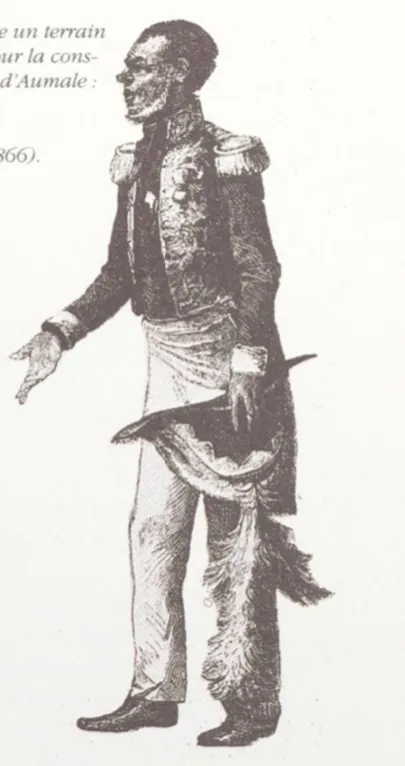
Georges Rassondji, Oga of the Remboué
The Agulamba clan held a position the whole estuary trade envied: its chief village, Nghango, stood on the left bank at the mouth of the Remboué, between the European ships and the trade routes running up towards the Ogooué and the interior. Through Lake Azingo the Agulamba were in touch with the peoples of the Ogooué, their Myene-speaking kin.
It was there that the English traveller Thomas Edward Bowdich spent a few weeks in 1815, as the guest of King Georges Rassondji, “King George” to the English captains: one of the earliest written accounts of the court of an Oga of the estuary. A contemporary of King Denis, Rassondji thus reigned on the same bank.
When France sought to establish itself in the estuary, Rassondji’s submission was indispensable to hold the whole left bank. In 1846 he signed a treaty with Bouët-Willaumez, the officer who had concluded King Denis’s in 1839; the same year an agreement made with the officer Mecquet ceded to France the creek that still bears his name, the “crique Georges”.
Left bank, right bank: treaties one by one
France did not treat with “Gabon” but with each Oga, one after another, playing on long-standing rivalries between the clans. King Denis opened the way on 9 February 1839 by ceding two leagues of land, while securing that the French would settle elsewhere than on his clan’s lands. King Louis signed on 18 March 1842 a treaty that this time mentioned the transfer of sovereignty; Fort d’Aumale rose the following year on the site of his village. King Quaben made his treaty on 27 April 1843, King Glass on 28 March 1844. On 1 April 1844 a general treaty brought together the chiefs of the estuary, except Glass, who submitted only after a bombardment in 1845. King George, lastly, made his treaty in 1846.
The sources do not always agree on dates: some place King Louis’s treaty in 1841, and King Denis’s death in 1875. We follow those of the historians and of the treaty texts cited below.
King Denis and the Agulamba clan
The two houses of the left bank were not merely neighbours. According to the family tree of the House of Rapontchombo, drawn from the work of Raponda-Walker, the mother of Félix Adandé, King Denis’s son and successor, was named Ngwembinda and belonged to the Agulamba clan, the clan of King George. The heir to the throne of Pointe-Denis was thus, through his mother, a child of the Agulamba: it was through such alliances that the Oga of the left bank held the coast together. The full genealogy is in the House’s family tree.
Two centuries later, the Mpongwe chieftaincy is still alive: when the House holds its ceremonies, the sea is still closed in the name of King Denis’s throne. On the people themselves, their history and rites, see Who are the Mpongwe?; on the treaty of 1839 and what followed, From King Denis’s lands to Libreville.
Sources
- Henry H. Bucher, « The Settlement of the Mpongwe clans in the Gabon estuary: an historical synthesis », Revue française d'histoire d'outre-mer, 1977, Persée; and The Mpongwe of the Gabon Estuary: A History to 1860, thesis, University of Wisconsin, 1977.
- André Raponda-Walker, Notes d'histoire du Gabon, 1960; on succession under Denis and under Glass and the rites of kingship: « Mpongwè », Miboue.
- Georges Rassondji at Nghango, Bowdich 1815, and the Agulamba of the lower Remboué: « Adyumba », Miboue; 1846 treaties with Bouët-Willaumez and Mecquet (“crique Georges”): « Grandes dates du Gabon », Miboue; “King Georges Rassondji, contemporary of King Denis”: « La royauté au Gabon », Encyclopédie de la mode gabonaise, 2013.
- Treaties of 1839, 1842, 1843, 1844: « Traités du Gabon », Miboue; signatory chiefs: « Mpongwe », Wikipédia; clans and Oga: « Mpongwe people », Wikipedia; « Anguilè Ré-Dowé », Wikipedia; « Roi Glass », Wikipédia.
- Map of 1865: Le Tour du Monde, see the Archives; Ngwembinda, of the Agulamba clan, mother of Félix Adandé: the House’s family tree, after Raponda-Walker.