

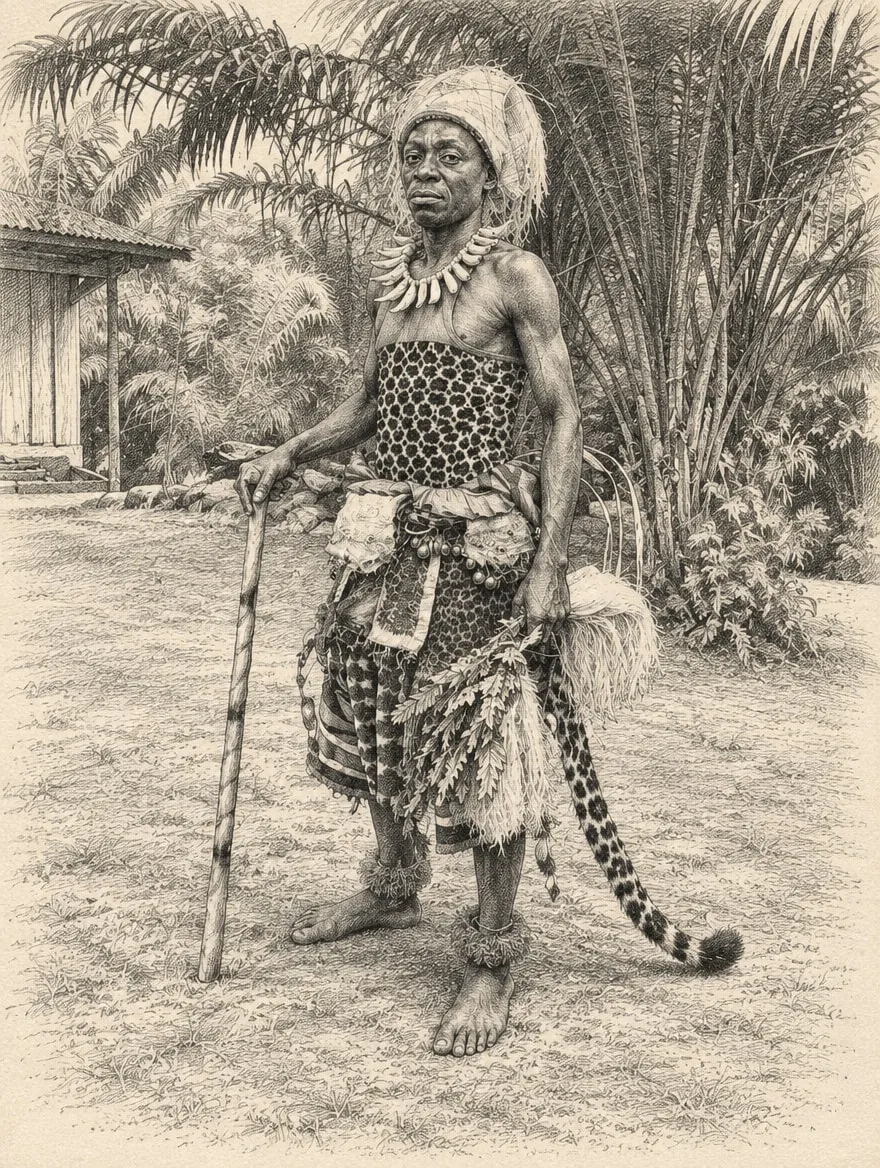
In the Bwiti, no one walks alone. Every initiate has received initiation from the hands of an elder, and every guardian of a temple leans on those who went before him on the path. For Maison Assiga, that elder has a name: Jérôme Mouele Niangou, spiritual father of the Bwiti Missoko, who accompanies Jacques Makaya Zimamo during the House’s night vigils at Pointe-Denis. This portrait is drawn from the testimony of the House of Rapontchombo, which wishes to honour publicly the man who watches over its nights.
What a spiritual father is in the Missoko
The Bwiti Missoko is the path of the ngangas: healers, seers, masters of diagnosis. No one becomes anything in it without a spiritual father: it is he who presents the novice to the temple, who leads the night of initiation, who reads the visions and who answers, before the temple and before the ancestors, for the path of the one he initiates. The bond between the initiate and his initiator does not end with the ceremony: it lasts a lifetime, made of reciprocal obligations, shared vigils and knowledge passed on by degrees. It is this journey that the anthropologist Julien Bonhomme described in Le miroir et le crâne (2006), the reference study on the Missoko initiation.
Alongside Maison Assiga
The tradition of the clan Assiga has always been to invite to the temple the greatest Bwitists of the country, of every branch. It is within this tradition that Jérôme Mouele Niangou is invited by the Rapontchombo royal family to attend the vigils of the Bwiti Missoko at Pointe-Denis. There he accompanies Jacques Makaya Zimamo, a descendant of King Denis and son of Princess Marie-Anne Ankombie Rapontchombo II, consecrated in the Bwiti Missoko and guardian of the tradition of the Royal Domain. There the spiritual father holds the role the Missoko assigns him: to watch over the night, to guide the songs, to keep the rule of the temple. Those who take part in the House’s initiation are welcomed within this same setting: a line of guardians, and the spiritual fathers who surround it.
His initiations, in his own words
Born in the south of Gabon, at Mouila, Jérôme Mouele Niangou descends from the Babongo, the people of the great forest whom Gabonese tradition holds to be the first keepers of the Bwiti. He entrusted the House with the account of his initiatory journey, published here with his consent. His first initiation, received at the age of 5, was the Djombi Tawo Tawo, among the Massango. He was then initiated into the Mwiri at the age of 7, during a biviva, the Mwiri initiation ceremony in the course of which young boys received circumcision, and whose female equivalent is the Niembe (or Njembe), the women’s initiatory society. He was next initiated into the Bwiti Ngondet at the age of 8, before receiving initiation into the Disumba.
His initiatory lineages
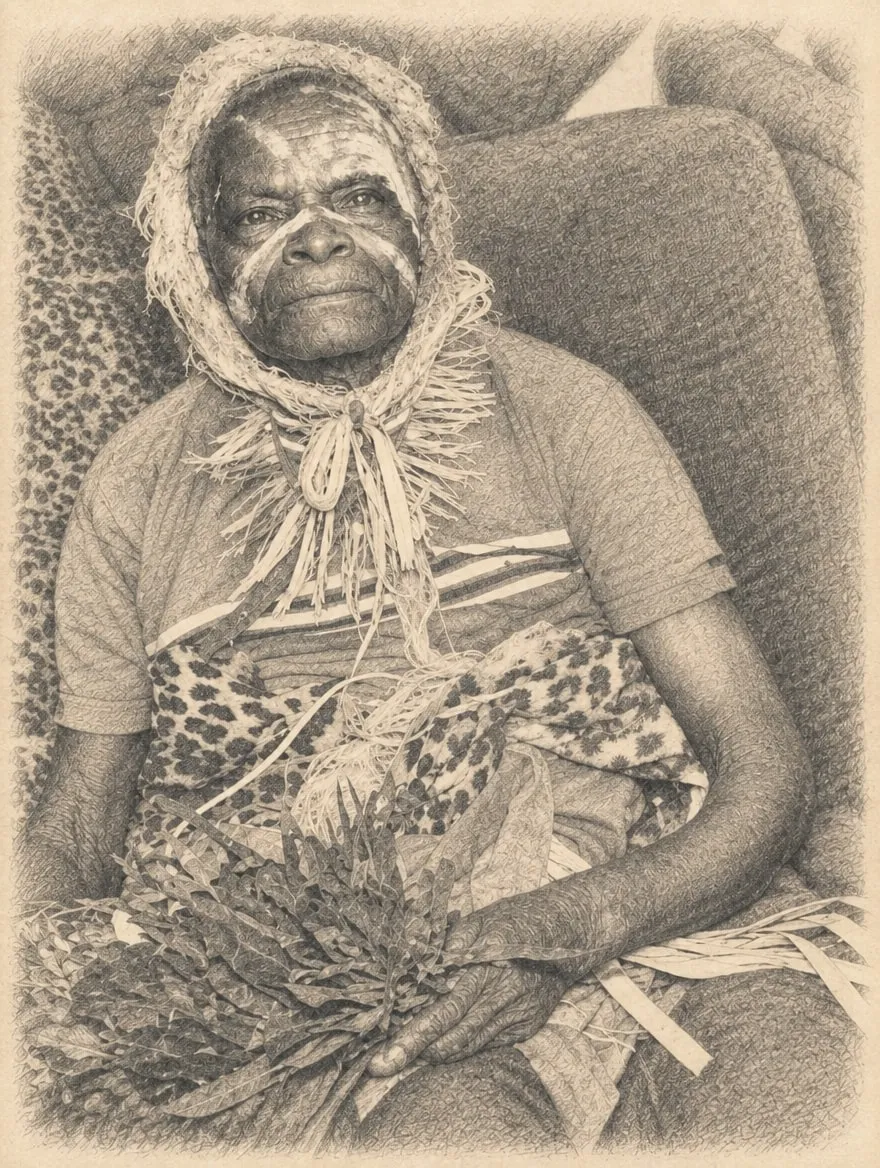
In the Bwiti, the line of initiation is what carries authority: each initiate holds his charge from the one who initiated him, who held it in turn from his own initiator. Here are the two lineages of Jérôme Mouele Niangou, as he has passed them on. Each initiate bears two names in them: his administrative name and his Kombo, the customary name.
Lineage of the Bwiti Ngondet
- Pascal Madouma (Kombo, customary name: Adoumaghana)
- Moussavou Mabounda Dessayo (Kombo: Doubila), initiated by Pascal Madouma
- Pierre Mbadingua (Kombo: Dibouba), initiated by Moussavou Mabounda Dessayo
- Jérôme Mouele Niangou (Kombo: Niangou), initiated into the Bwiti Ngondet by Pierre Mbadingua
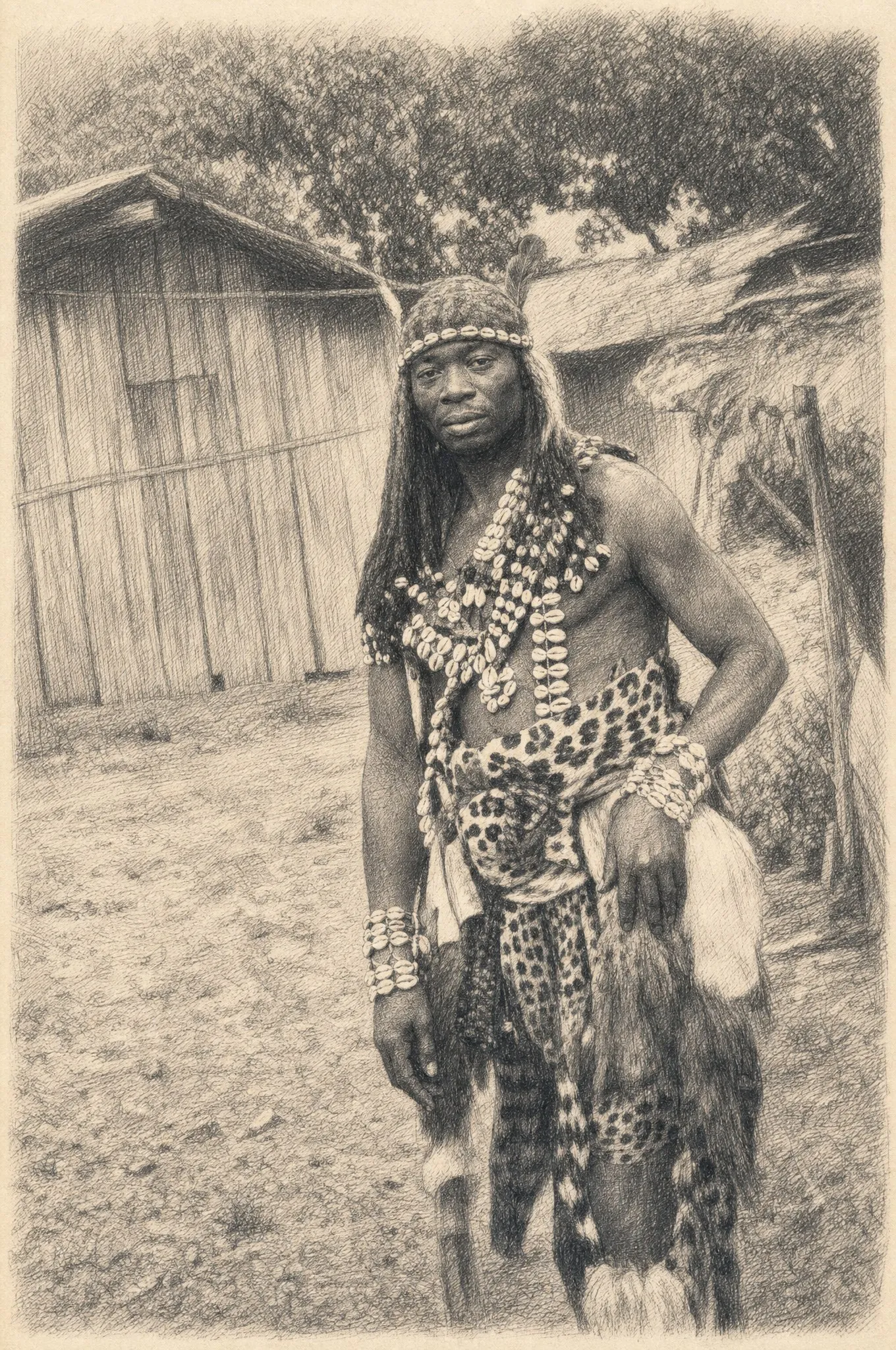
Lineage of the Disumba
- Guy Roger Mboumba Moussavou (Kombo: Ressassaguani)
- Yves Itsoukigha Koumba (Kombo: Mourô Nâ Mat), initiated by Guy Roger Mboumba Moussavou
- Jérôme Mouele Niangou (Kombo: Niangou), initiated into the Disumba by Yves Itsoukigha Koumba
Such is the lineage known to date; it will be completed as the memory of the temples allows. The teachings themselves belong to the temple: they will be set down in writing when their guardians so choose, as with the Omengo branch.
Sources
- Testimony of the House of Rapontchombo: the role of Jérôme Mouele Niangou alongside Jacques Makaya Zimamo belongs to the House’s own transmission, and is presented as such.
- The initiations (Djombi Tawo Tawo, Mwiri, Bwiti Ngondet, Disumba) and the initiatory lineages were communicated by Jérôme Mouele Niangou himself and are published with his consent.
- On the Missoko initiation and the bond with the initiator: Julien Bonhomme, Le miroir et le crâne. Parcours initiatique du Bwete Misoko (Gabon), Paris, CNRS Éditions / Éditions de la MSH, 2006.
- On Jacques Makaya Zimamo and the lineage: the Family tree page and the annual ceremonial on the king’s tomb (2024 report, Archives page).