

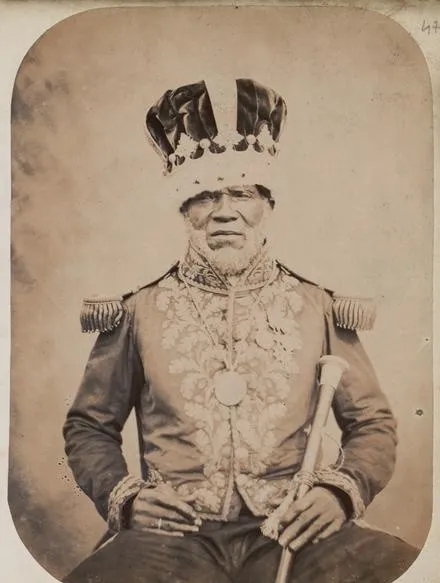
When asked his age, the king answered with an image: “When the King of France Louis XVI was on the throne, I could already handle a paddle and steer a canoe on the estuary by myself.” Antchouwé Kowé Rapontchombo, whom the Europeans called King Denis, was born on the left bank of the Gabon estuary around 1780. He died in 1876, almost a hundred years old, after reigning for nearly sixty-six years: a life that spans the end of the slave trade, the coming of France, the missions and the first explorers. The House calls him Denis I, for his son, King Denis II, Louis Denis Marie Félix Adandé Rapontchombo, bore the name after him, drafted the convention of 1839 and received the Legion of Honour.
A name that speaks of legitimacy
His father, Ongonwu Ré-Mboko, belonged to the Assiga clan: he was the son of Résakuélé, son of Ré-Ntori, son of R’Ombonwa, the first ancestor of the clan whose name is remembered. His mother, Ozugayilé, was of the Adoni clan. Tradition relates that the chief of the Aguempo, settled at Mina in the Iwengué-Nyama creek, disinherited on his deathbed the son who was to succeed him and named Ré-Mboko to occupy the éka, the seat, that is to say the throne. Ré-Mboko accepted, vowing to keep it for ever.
As a pledge, he added to his son Kowé’s name that of Rapontchombo, said to mean: “what was given to me was not lent, but given for good”. According to the family, the name comes from Ré-Mboko: Epamie Tchombo, which became Rapontchombo, “power is not lent”. On his father’s death, Kowé Rapontchombo succeeded him and found himself at the head of a large part of the left bank. In his youth he had served aboard a Spanish sailing ship; he would speak English, Spanish, Portuguese and French, which for decades made him the most skilful and respected broker of the estuary.
Each nation gave him its own name. The French called him Denis; the English,King William or “Denny”, a name he took up himself to deal with their traders, as the geologist Oskar Lenz noted in 1878, and the missionaries of his day. The family adds that the Scots called him Prince Guillaume.
The man the nations came to consult
His influence reached far beyond the village that bears his name. People came from afar to ask his advice or to have him settle their disputes, and his moral authority extended to the Orungu clans of Cape Lopez. On 1 March 1838 he received Captain de Péronne, commanding the corvette La Triomphante, and the schooner La Fine. The following year, despite the hostility of most of his counsellors, his authority prevailed: on 9 February 1839, aboard La Malouine, he signed with Édouard Bouët, in the presence of his son Petit Denis, who set his cross beside the king’s, the convention drafted by his son Denis II that opened the history of the French presence in Gabon, followed by several days of celebrations. In 1841 it was with his support that King Louis Ré-Dowé, on the opposite bank, accepted the treaty from which Fort d’Aumale and then Libreville would grow. In 1862 he again lent his help to the treaties made with the chiefs of Cape Lopez.
The travellers who met him kept the same memory of him. The Englishman Richard Burton described a man of medium height, powerfully built and very strong, his dark complexion set off by a snow-white beard; a gentle and expressive gaze, a pleasant and persuasive voice, courteous and dignified: “one of the most kingly-looking men I have ever met in Africa”. Paul du Chaillu in 1855-1856 and the Marquis de Compiègne around 1873 were also his guests; Dr Griffon du Bellay saw in him an “old man venerated by the local people and surrounded by the esteem of Europeans”. His eloquence won over the chiefs; his uniforms and decorations, received from London, Paris and Rome, were the wonder of the tribes.
A royal farm
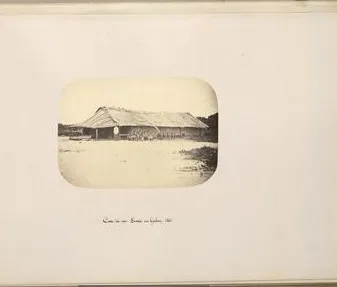
The kingdom did not end at the sandy point of Pongara. At the head of the Mbata creek, on the road to Cape Lopez, Paul du Chaillu came upon the king’s plantations in 1856, which he described under the title “A royal farm”:
“The plantations where I found myself belonged to them; they are the most flourishing I have seen on the coast. […] To the right and to the left, and for several miles in every direction, I saw fields of groundnuts, plantains, maize, sugar cane, ginger, yams, cassava and gourds.”
The king visited these lands only in the dry season; it was the queen, his first wife, who ran the work. Like the great men of the coast in his time, King Denis owned many slaves, three hundred according to tradition, and had himself taken part in their trade. Family memory also keeps the story of a solemn emancipation: before his assembled subjects, the king called forward his servant Rambourou-Akinda, who knelt; he raised him up, put his hat back on his head and declared: “From this day you are no longer a slave. You take rank as a notable counsellor and you shall eat at my table.”
“What is the good that God has done?”
When his favourite wife, Agnouré-Babé, died, the grieving king wished every subject to honour her memory by greeting him thus: “What is the evil that God has done?” – “Death,” the king would answer. Bishop Bessieux, founder of the Catholic Mission of Gabon, came to tell him that this greeting offended God. The king listened and changed the words: “What is the good that God has done?” – “Life!” – “Yes, may God give you life!” From then on he was always greeted in this way. Without ever giving up the customs of his fathers, he entrusted several of his children to the missionaries, and a mission was opened at his village in 1851.
“It is God’s moment”
In the spring of 1876 the old king felt the end approaching. With no missionary at hand, it was his son who baptised him, at his own request. When the healer came with his remedies, the king sent him away: “It is God’s moment. Do not blame my death on any sorcery or any poison; I forbid that slaves be sacrificed for me.” Then he drew his gold ring from his finger and placed it on that of his son Félix Adandé, thereby naming him, to the exclusion of all others, as his successor: “I am going to die, and I leave you, to be king in my place, to whom you all owe homage, obedience and respect according to the tradition of my fathers, my son Félix Adandé. Farewell!” The family specifies: this son is King Denis II, Louis Denis Marie Félix Adandé Rapontchombo.
Antchouwé Kowé Rapontchombo, King Denis I, died on 9 May 1876, aged about ninety-five, ten days after Bishop Bessieux.
A sovereign’s funeral
The Mpongwe chiefs of Libreville and its surroundings, the Fang chiefs of the left bank and even a chief from the Fernan-Vaz came in person to the funeral. At Cape Lopez the Orungu chief Ré-Ntchengué, son of Rogombè, ordered a special mourning in his own town, Omèngo. In Libreville, Rear-Admiral Ribourt, commander-in-chief of the French establishments on the west coast of Africa, had the flags lowered to half-mast and the guns fired, and sent gifts.
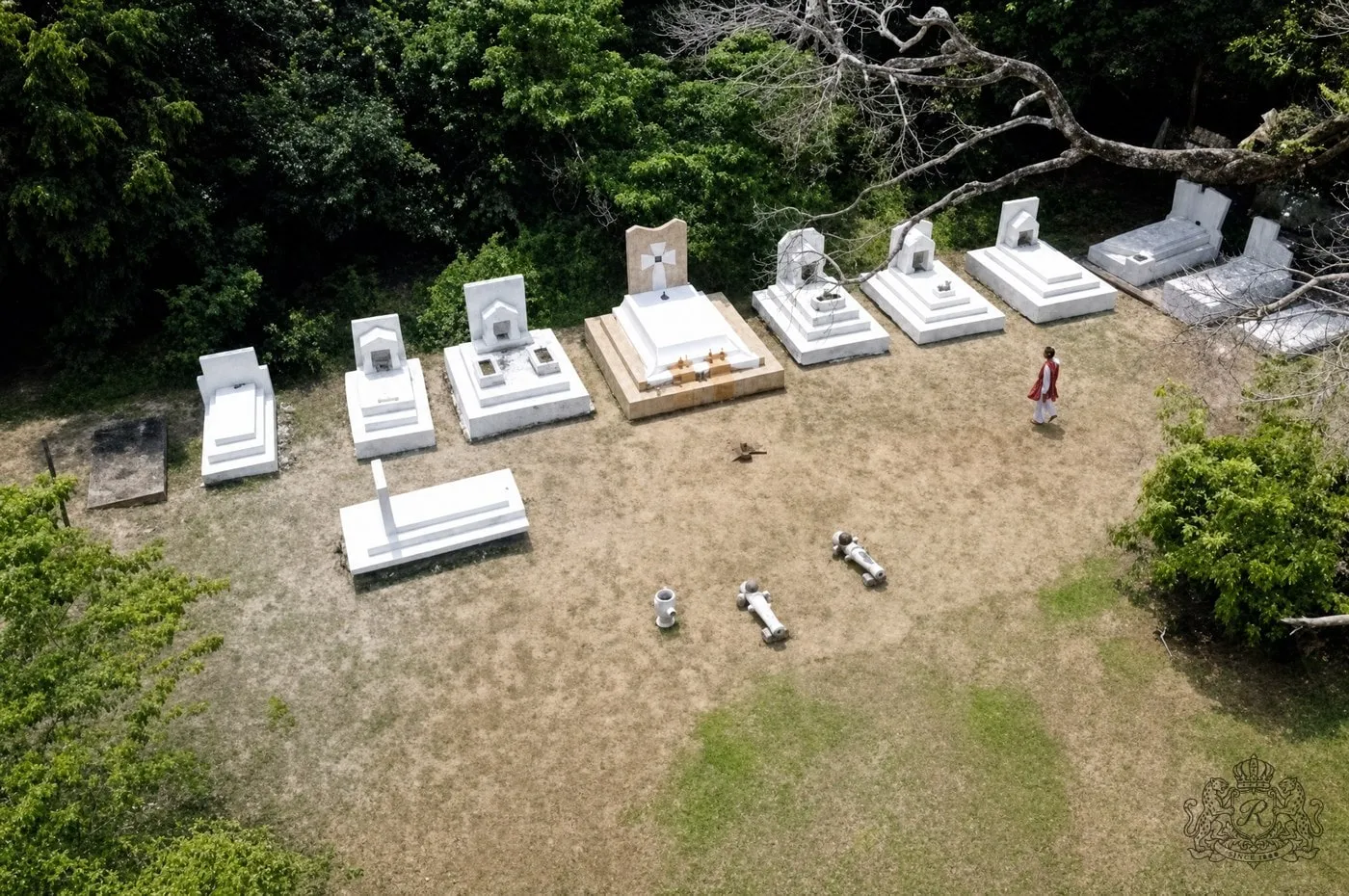
Dressed in his full uniform of an English general, an echo of the gifts of Queen Victoria, King Denis I, Antchouwé Kowé Rapontchombo, was buried in the old cemetery of Iwounwé, between Pongara Point and Nghomboué Point, facing the ocean that had brought him the Europeans. His descendants rest beside him, and the House still watches over his grave.
Sources
- “Denis Rapontchombo”, biography published by miboue.com, after the archives of the Denis family and the sources below.
- Bulletin des Pères du Saint-Esprit, 1876 (death and baptism of the king).
- Paul Belloni du Chaillu, Voyages et aventures dans l’Afrique équatoriale, Paris, Michel Lévy, 1863 (“A royal farm”).
- Richard F. Burton, account of his visit to King Denis (portrait of the king).
- Marquis de Compiègne and Alfred Marche, L’Afrique équatoriale, Paris, Plon, 1876.
- Dr Griffon du Bellay, “Le Gabon”, Le Tour du Monde, 1865, pp. 273-320.
- Rev. Fr. Gautier, Étude historique sur les Mpongwès et tribus avoisinantes, Brazzaville, Institut d’études centrafricaines, 1950.
- Vice-Admiral Fleuriot de Langle, “Croisières à la côte d’Afrique”, Le Tour du Monde, 1872-1876.