

1839 is the year the world came to the estuary. In February, King Denis signed with France the convention that would open the history of Libreville. That same year, on the river, a slave ship was captured after a fight: five English sailors lost their lives, and four others, wounded, were taken prisoner. It was King Denis who negotiated their release and returned them to their homeland. This act, performed with no calculation other than honour, would earn him the gratitude of the most powerful sovereign of his century.
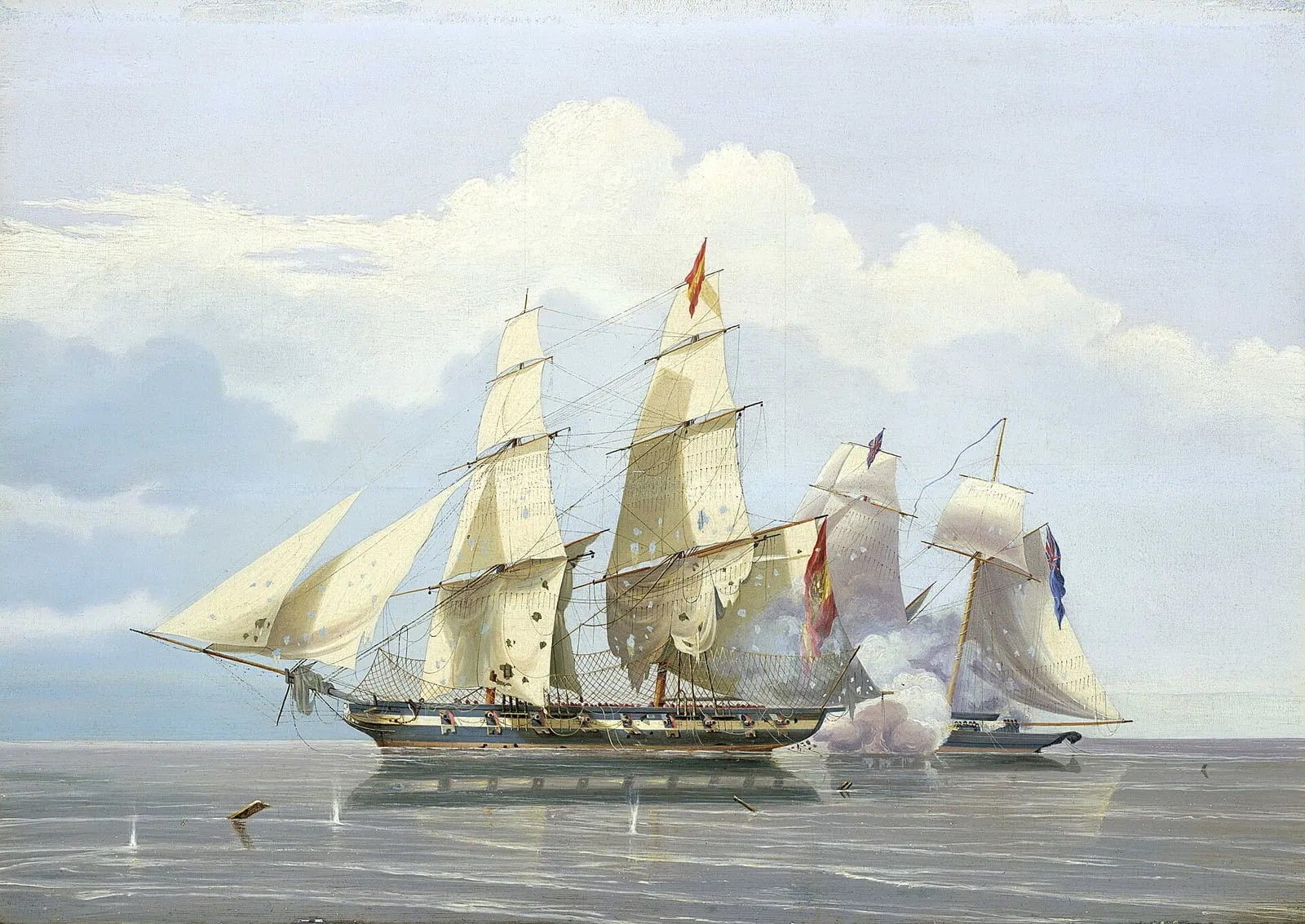
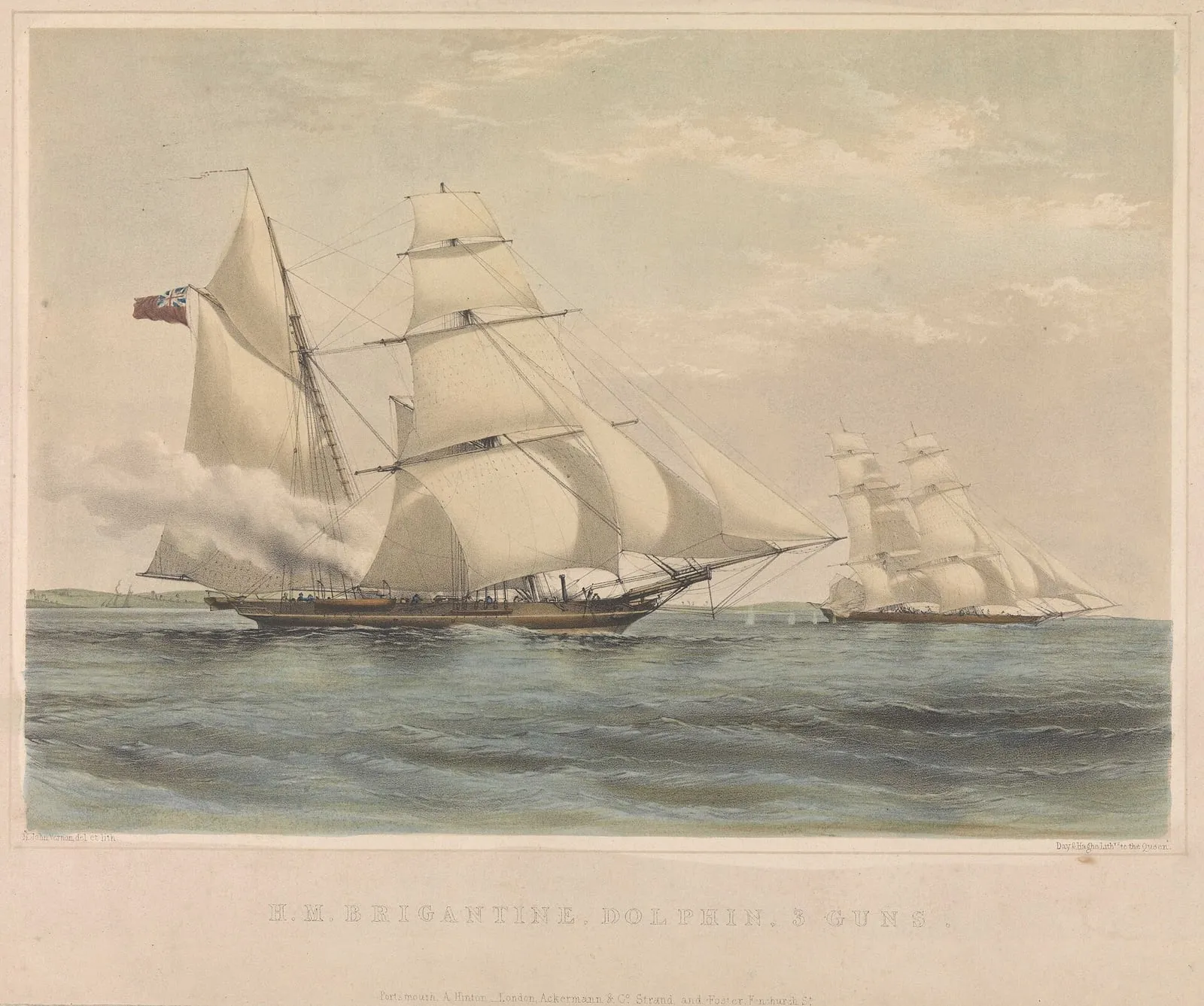
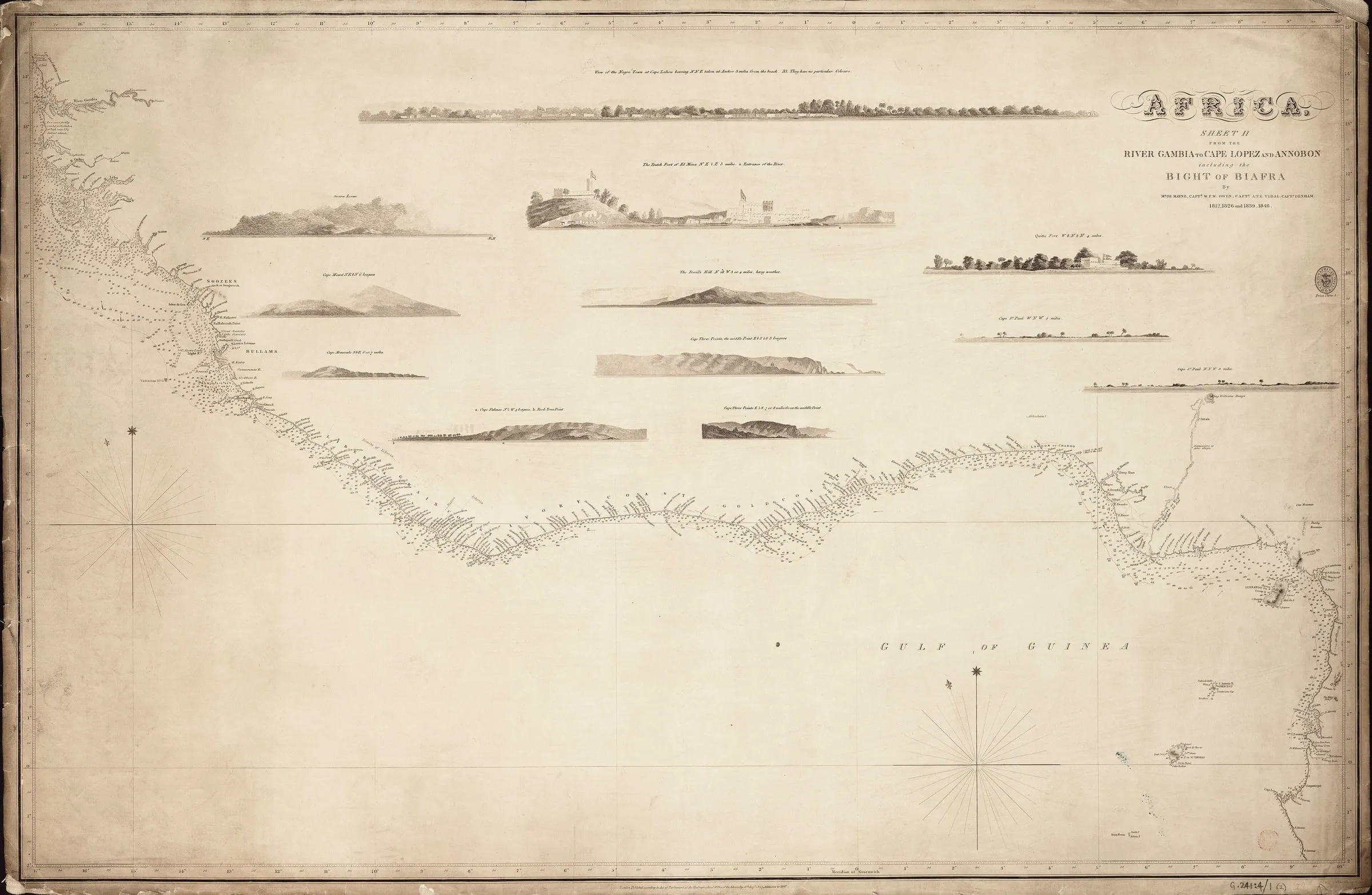
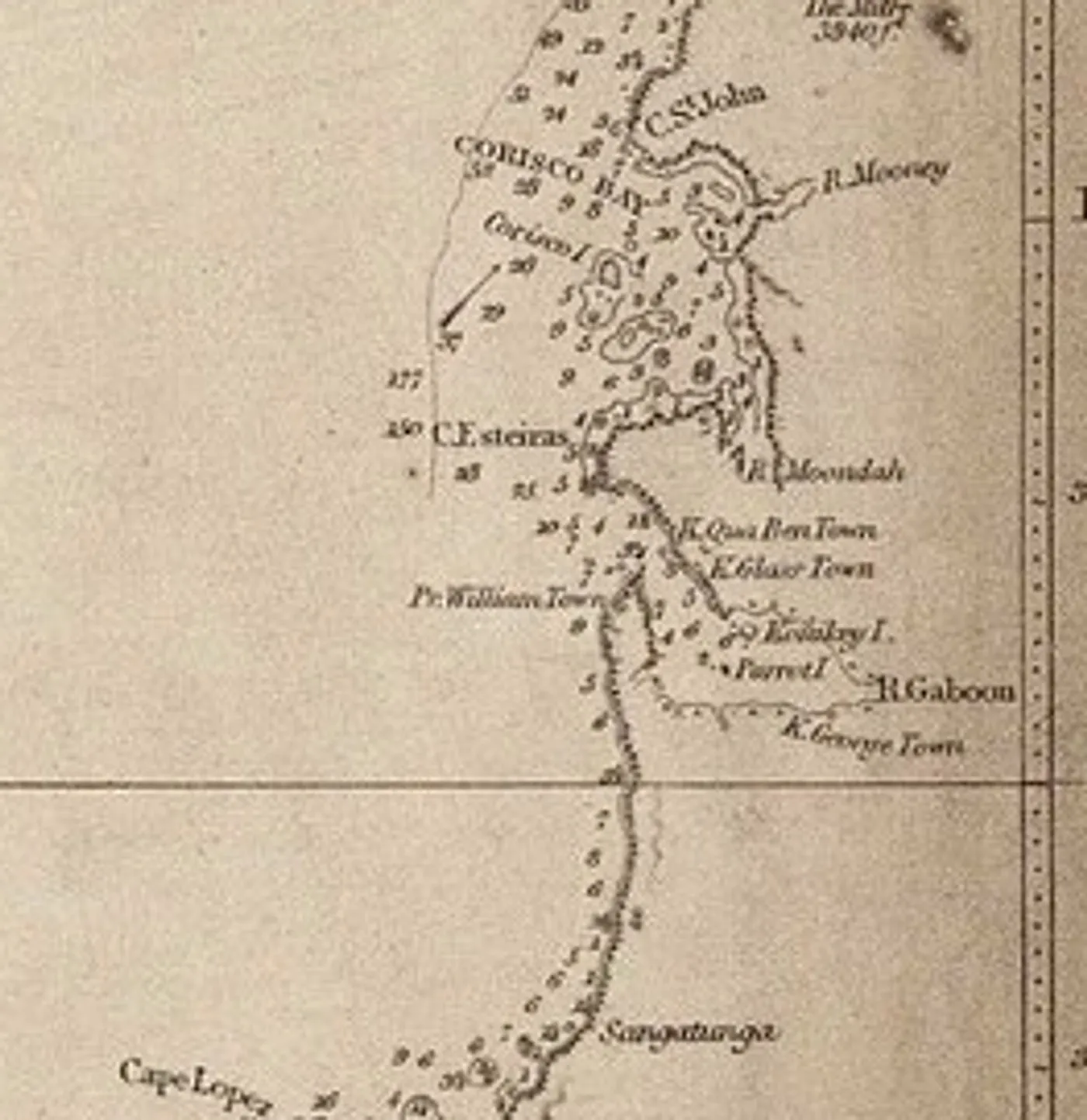
Why was the whole world crowding into these waters? Because the Gabon estuary is one of the finest natural harbours on the coast of equatorial Africa: a deep, safe anchorage where ocean-going ships came to rest their crews and take on water. Because the Mpongwe, King Denis’s people, were the indispensable brokers of trade between the interior and the ocean: ivory, ebony and dyewood changed hands under their authority. Because the English and French squadrons cruised there to suppress the slave trade, now outlawed, and France was seeking a foothold on this coast for its navy, while American and French missions were preparing to plant their schools there. At the centre of this converging world, one man held the left bank: King Denis, who spoke to the captains in their own language.
The foremost power in the world
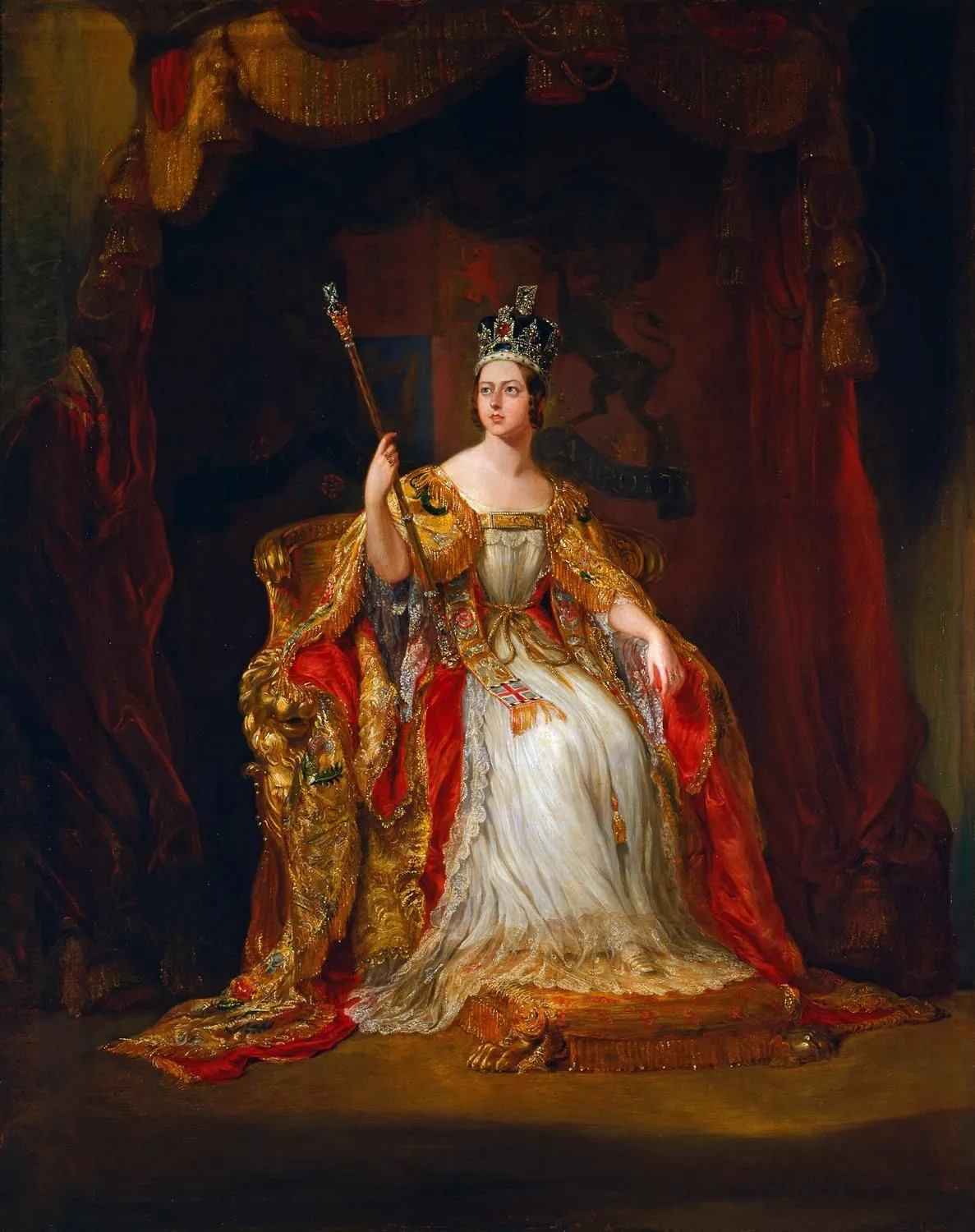
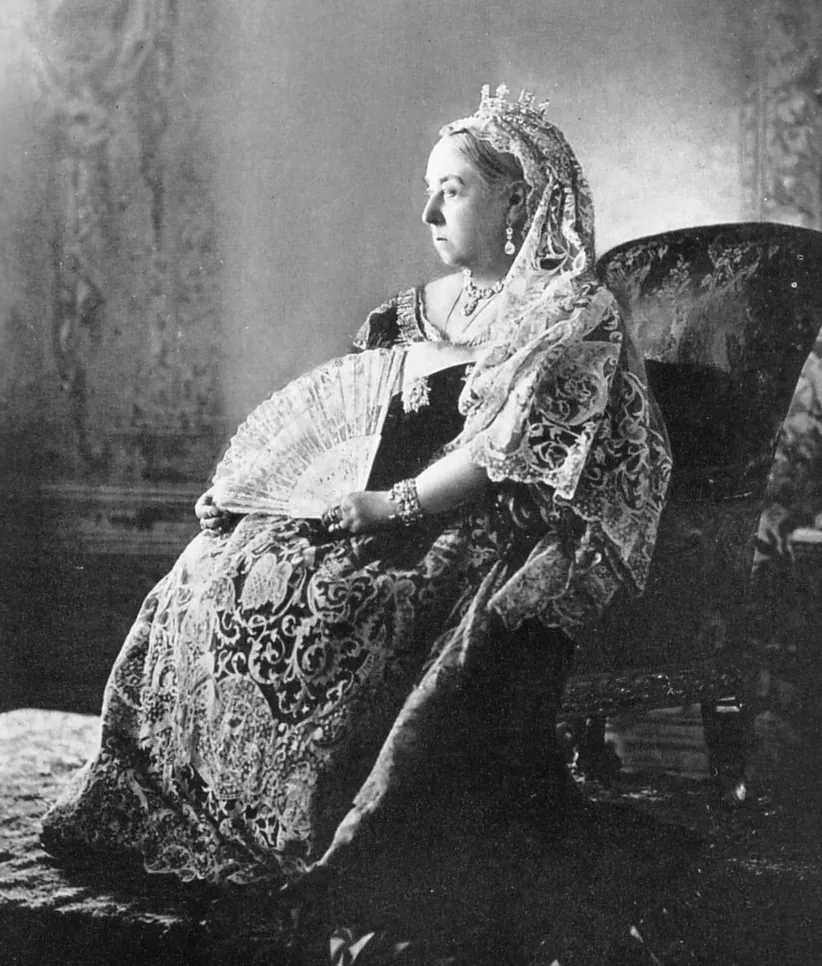
One must measure who was paying tribute to a king of the estuary. In 1839, Victoria’s United Kingdom was the foremost power on the planet. The workshop of the world: its mills, forges and railways had no equal, and the industrial revolution was born on its soil. The mistress of the seas: since Trafalgar, the Royal Navy had reigned unchallenged over the oceans, and no flag crossed the Atlantic without reckoning with it. An empire already immense: India, Canada, Australia, the Cape; by the end of Victoria’s reign it would cover nearly a quarter of the world’s land, and it would be said of it that “the sun never sets” upon it. London, finally, was the financial capital of the world: it was from the City that the canals, ports and railway lines of five continents were financed.
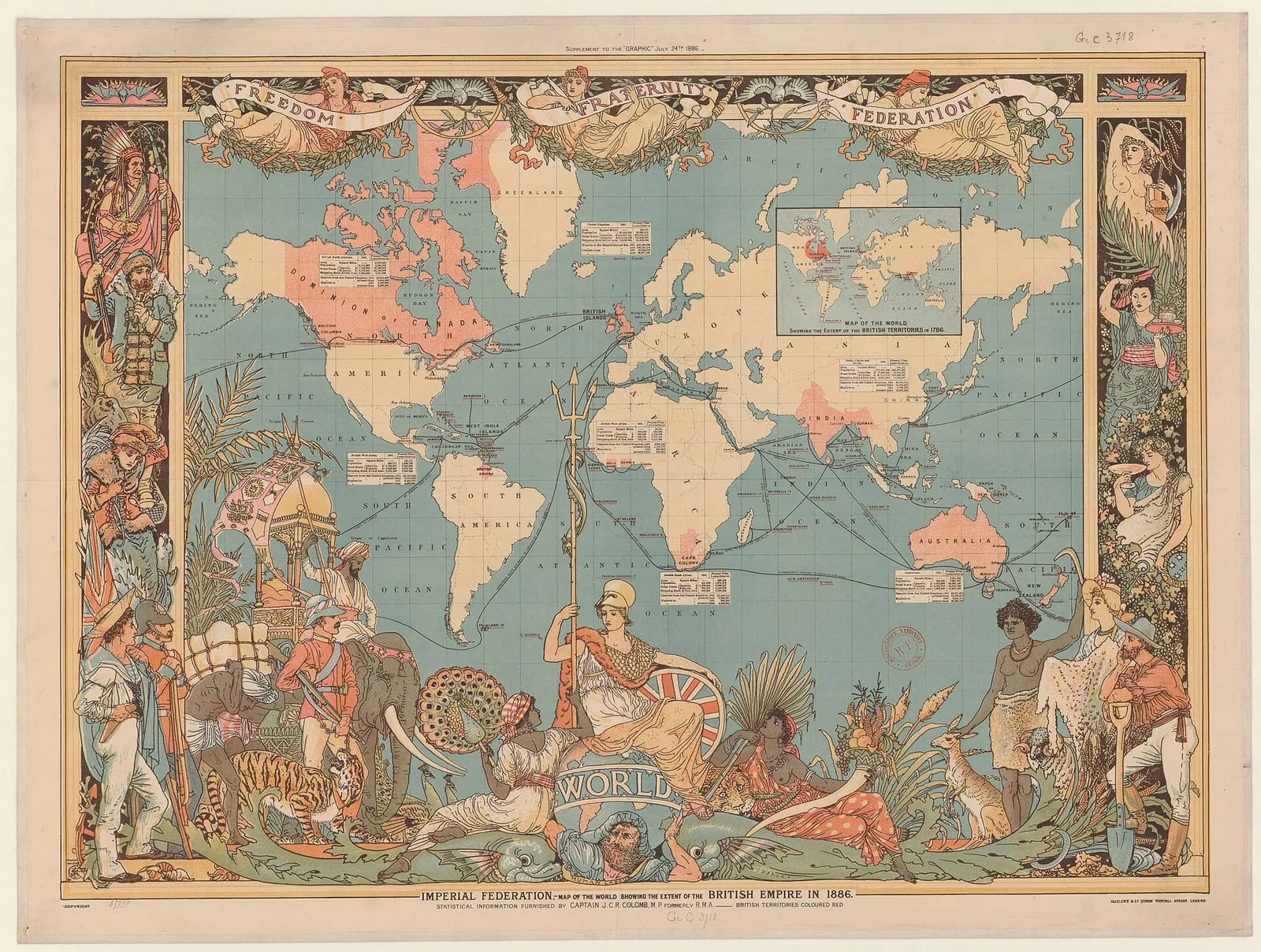
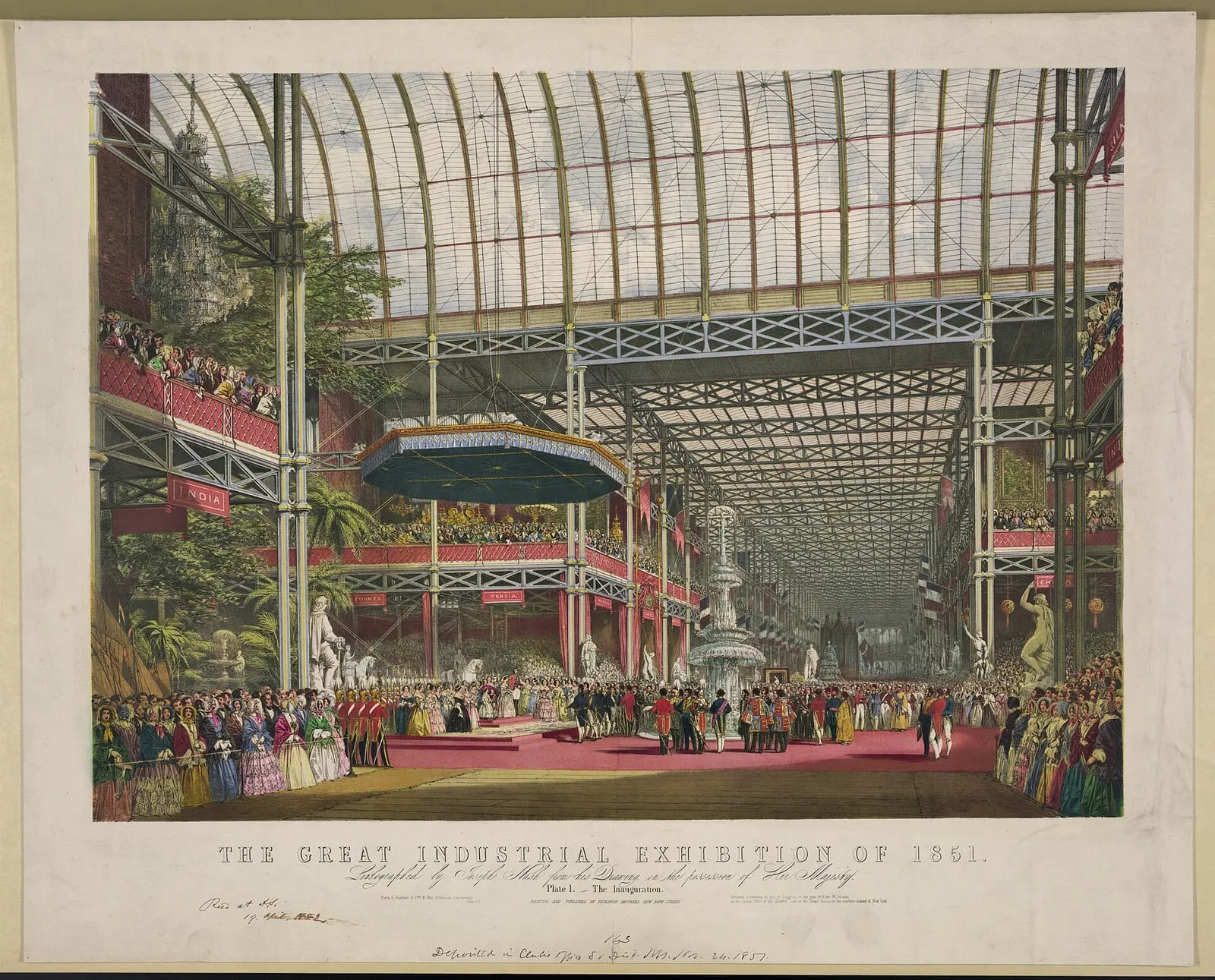
It was this power, which dealt with empires as an equal, that would write to a Mpongwe sovereign on the coast of equatorial Africa to thank him. The gesture was no empty protocol: the queen of the seas recognised in the king of the estuary an authority and a sense of honour that spoke the same language as her own.
English sailors on the river
In 1839 a boat from HMS Lynx, a ship of the anti-slavery squadron, went up the Gabon estuary in search of a slave ship thought to be hidden in its waters. It was attacked and captured after a hard fight, according to the chronicles by Séké or Bakèlè, peoples of the interior: five British sailors lost their lives, and the four survivors, wounded, were taken prisoner. King Denis, sovereign of the left bank, then pledged his word and his authority: he secured their release and had them brought back safe and sound. Victoria’s England, which had made the fight against the slave trade one of the causes of its empire, learned that an African king had staked his standing for sailors who were not his own.
The king himself spoke of it to the Queen in his letter of 16 May 1840: he had been “too much glad to save Queen’s men belong Lynx”, which cost him one hundred and twenty dollars, which he had been glad to give for her.
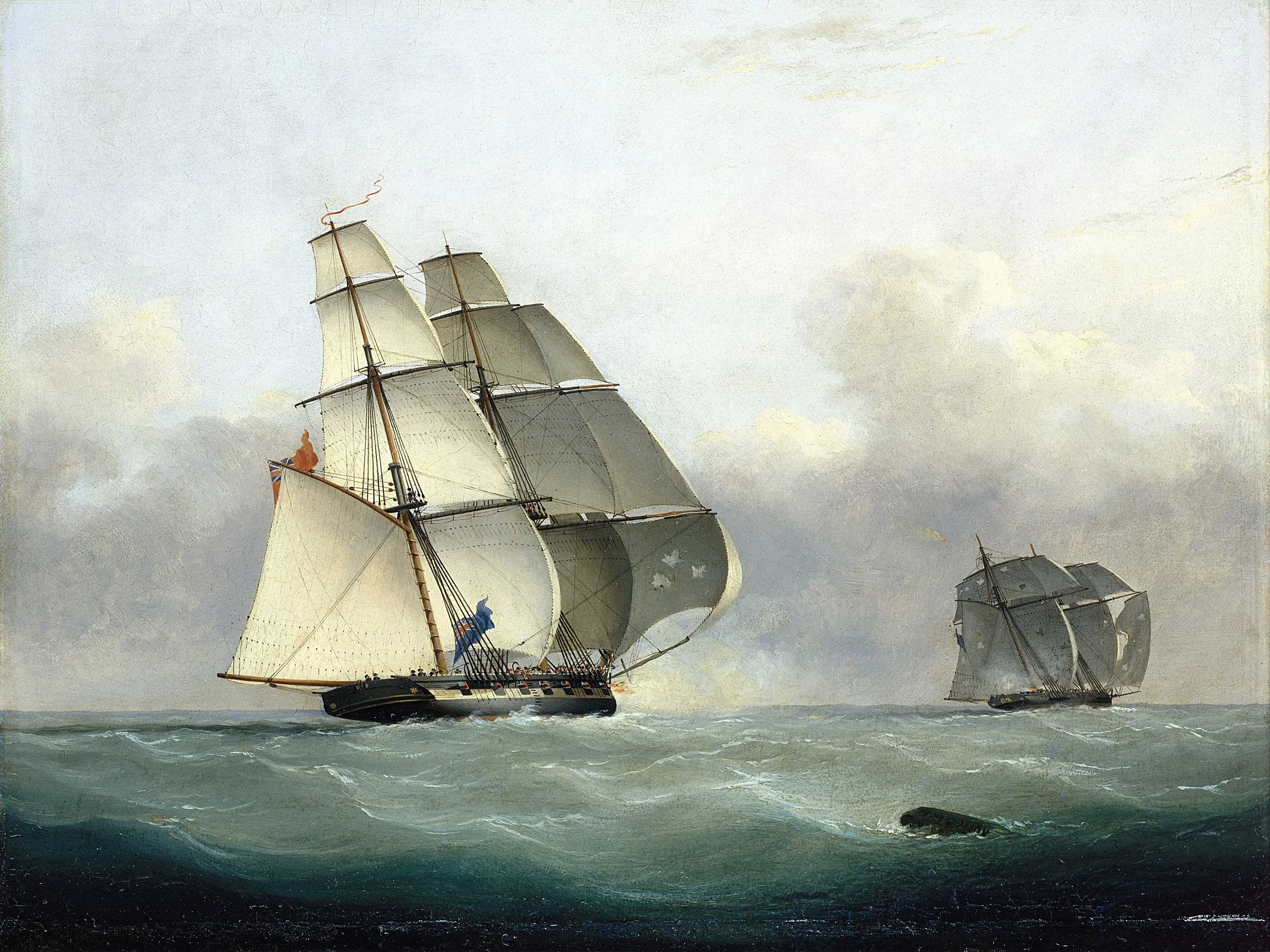
The king did not stop there. According to the biography kept by the family, he also sent the Queen of England a live panther, a gift from one sovereign to another; the British archives consulted so far have kept no record of it.
The Queen’s gift
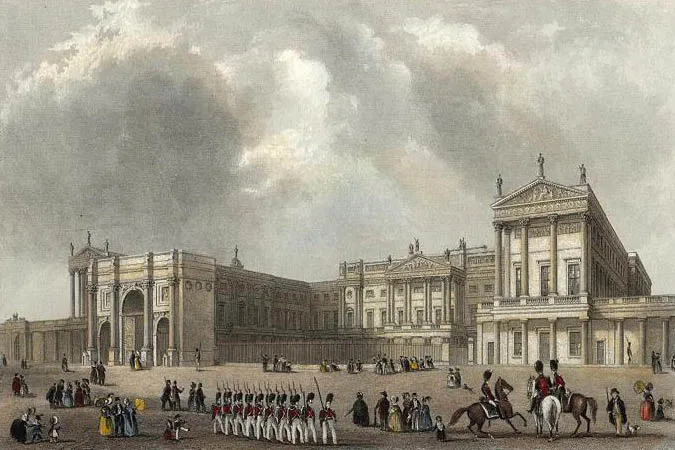
As a token of gratitude, Queen Victoria sent King Denis a gold chain and a gold medal bearing her effigy, engraved with a dedication that the sources have preserved word for word:
“Victoria, Queen of Great Britain and Ireland, to King Denny, in testimony of Her Majesty’s deep sense of his human and generous conduct in rescuing from captivity four wounded British seamen, in the river Gaboon, 1839.”
The English familiarly called the sovereign “Denny”: it is by this name that the Queen addresses him, as an equal, as one writes to a peer.
May 1840: the presentation
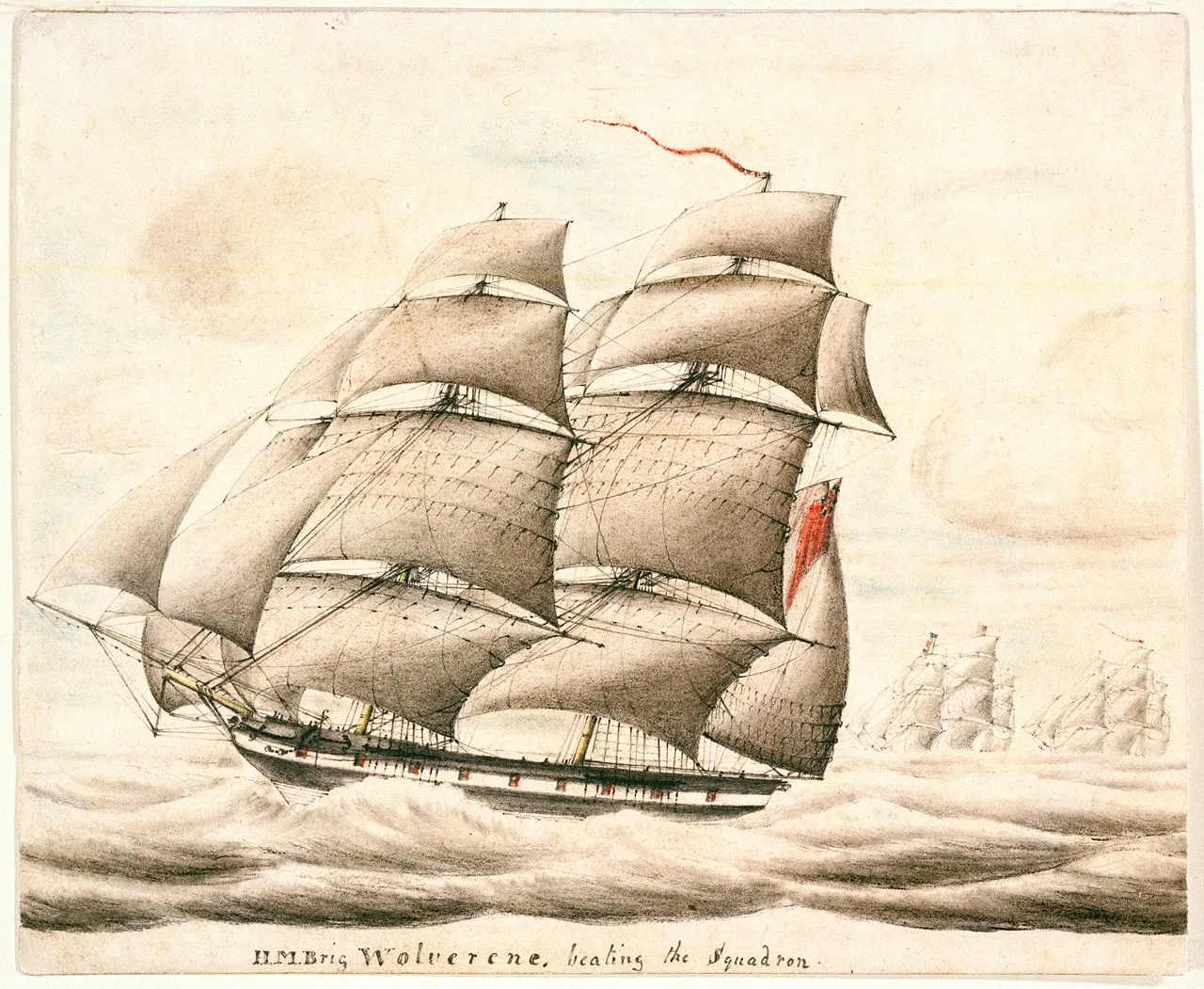
The gift crossed the Atlantic the following spring. Commander William Tucker, of the sloop HMS Wolverene, went up the Gabon river and arrived on 15 May 1840 “to present King Denis with the gold medal and chain”, as he wrote in his report dated Fernando Po, 31 May. A sailor of the crew, Cornelius Noddall, described the scene in a letter to his mother, now held at Royal Museums Greenwich. The next day the ship saluted the king, and ashore the commander hung the medal round his neck himself.
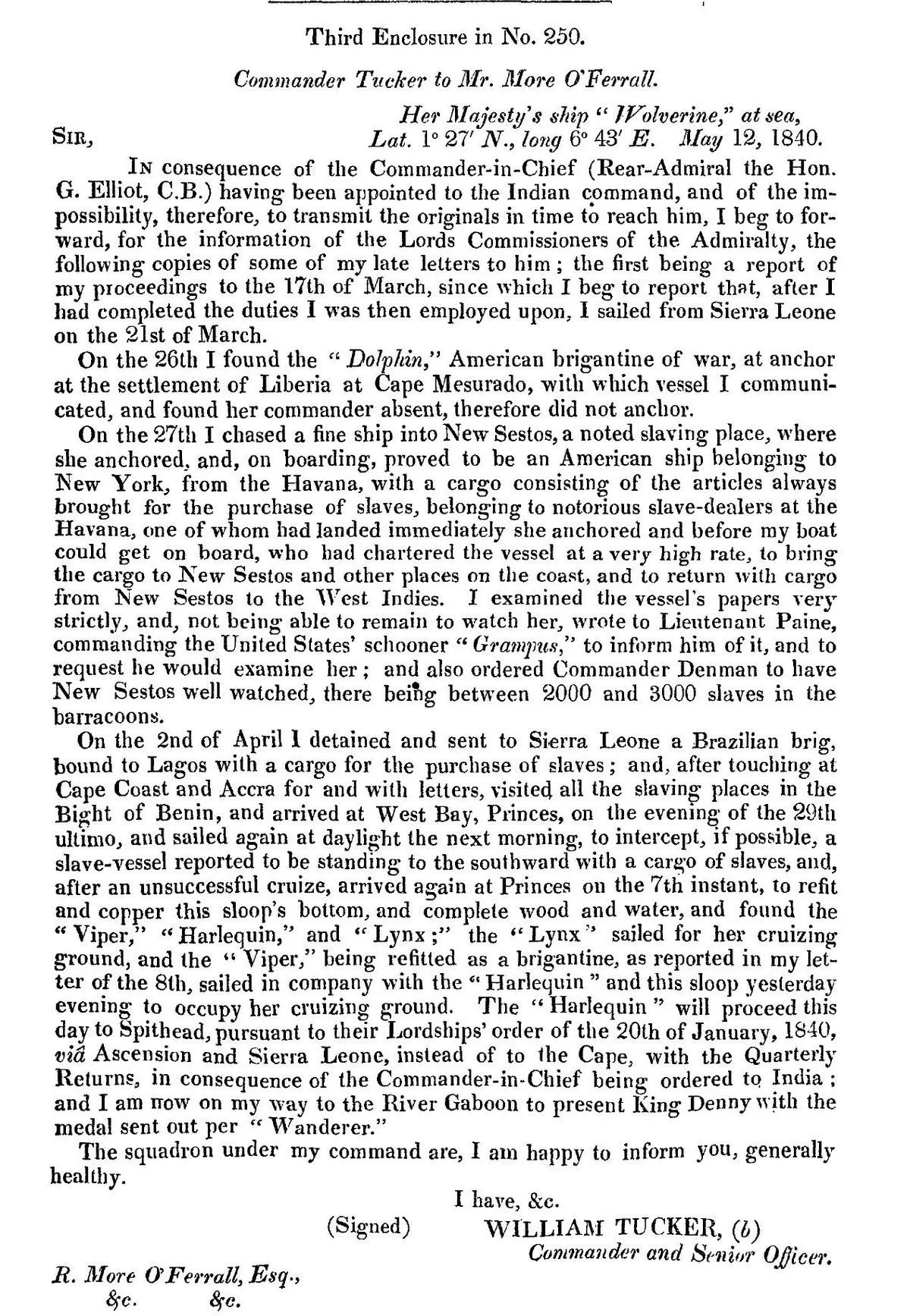
The records of the British Parliament allow the medal to be traced step by step. It came from England aboard HMS Wanderer, under Commander Joseph Denman, which anchored at Sierra Leone on 1 March 1840. On 12 May, at sea, Tucker wrote to the Admiralty: “I am now on my way to the River Gaboon to present King Denny with the medal sent out per Wanderer.” The letter was printed the following year among the papers presented to both Houses of Parliament.
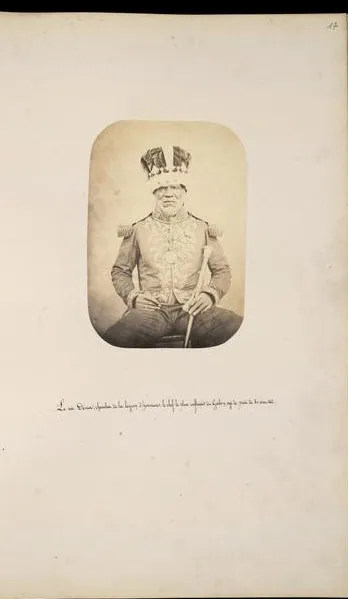
That same day, 16 May 1840, the king dictated his reply to the Queen. He did not merely give thanks: he said what one sovereign expects of another. He asked for a great coat with epaulettes, a waistcoat and trousers “plenty gold in them”, a cocked hat with gold and feather, a sword and belt, and two easy chairs. In London, Lord John Russell authorised on 30 January 1841 the sending of these gifts, on condition that the king undertook to abolish the slave trade. It is this officer’s dress that can be seen, twenty years later, in the photographs of the king.
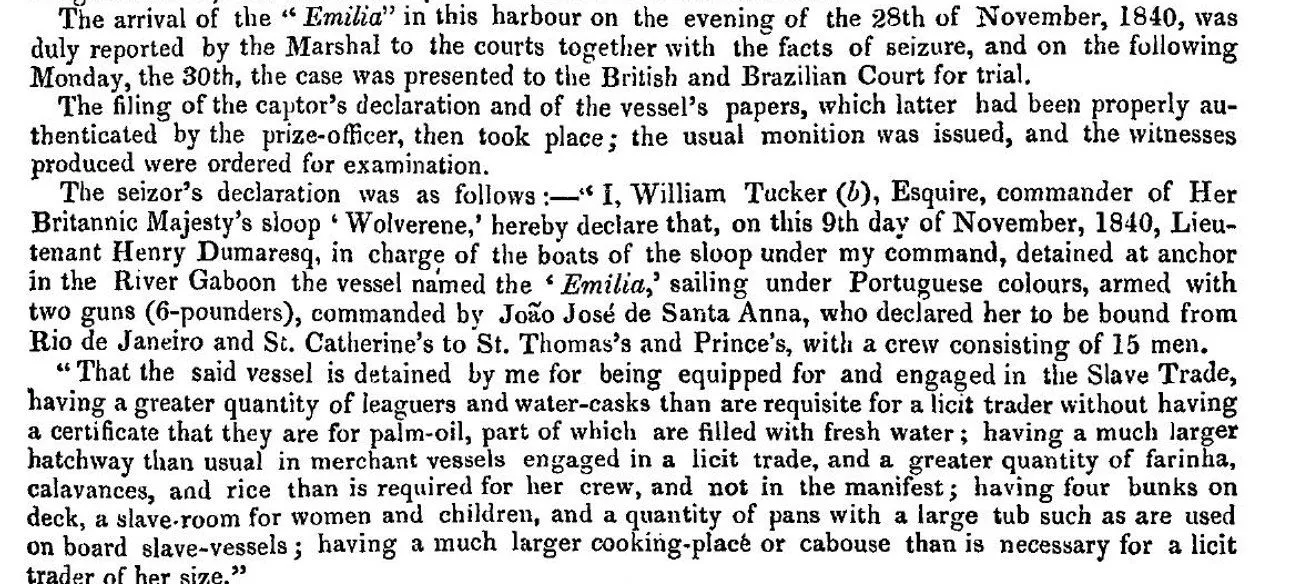
The river remained under the watch of the Wolverene. On 1 October 1840 the brigantine Emilia, alias Flor de Rio, out of Rio de Janeiro under Portuguese colours, anchored in the Gabon estuary. On 9 November the boats of the Wolverene, led by Lieutenant Henry Dumaresq, seized her at anchor. On board were far more water casks than any honest trader needed, provisions missing from the manifest, bunks on deck and “a slave-room for women and children”: the full equipment of a slaver. Taken to Sierra Leone, the ship was condemned on 9 December 1840 by the Anglo-Brazilian Mixed Commission. It was in the same spirit that London, a month later, made the dispatch of the uniform the king had asked for conditional on his abolishing the slave trade.
The crown and the sceptre
The memory of the House of Rapontchombo goes further: according to family tradition, it was also from Queen Victoria that King Denis received the crown, the sceptre and the crown jewels seen in the photographs of 1862, where the sovereign poses in majesty. Published documents have kept a written record only of the chain and the medal; but the crown and the sceptre are there, in Houzé de l’Aulnoit’s pictures, borne by a king who held them from no conquest: they were given to him. The oral tradition of the lineage, guardian of what the archives do not write down, attributes the gift to the British sovereign.
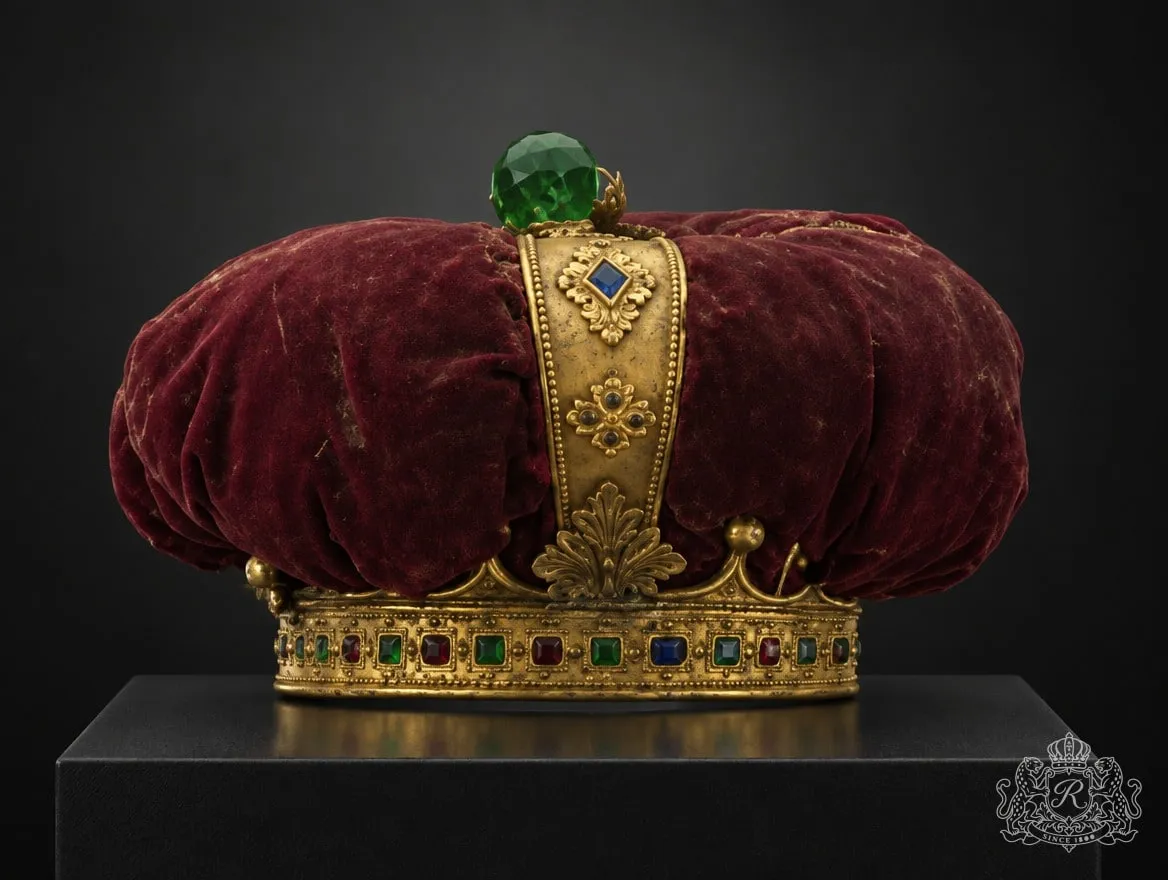
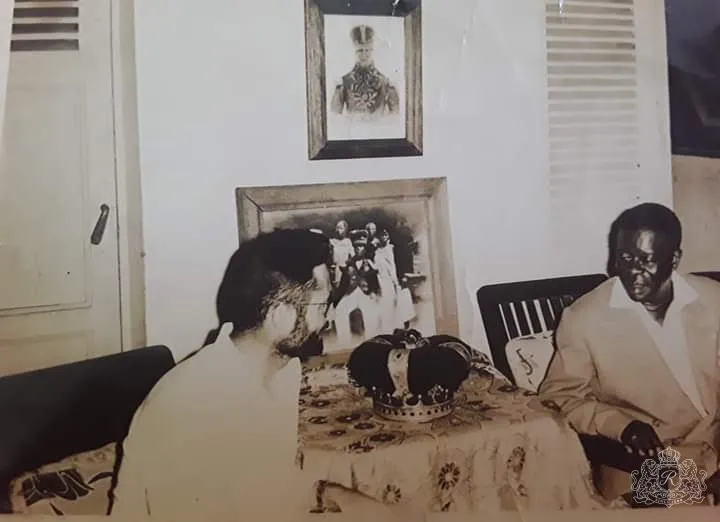
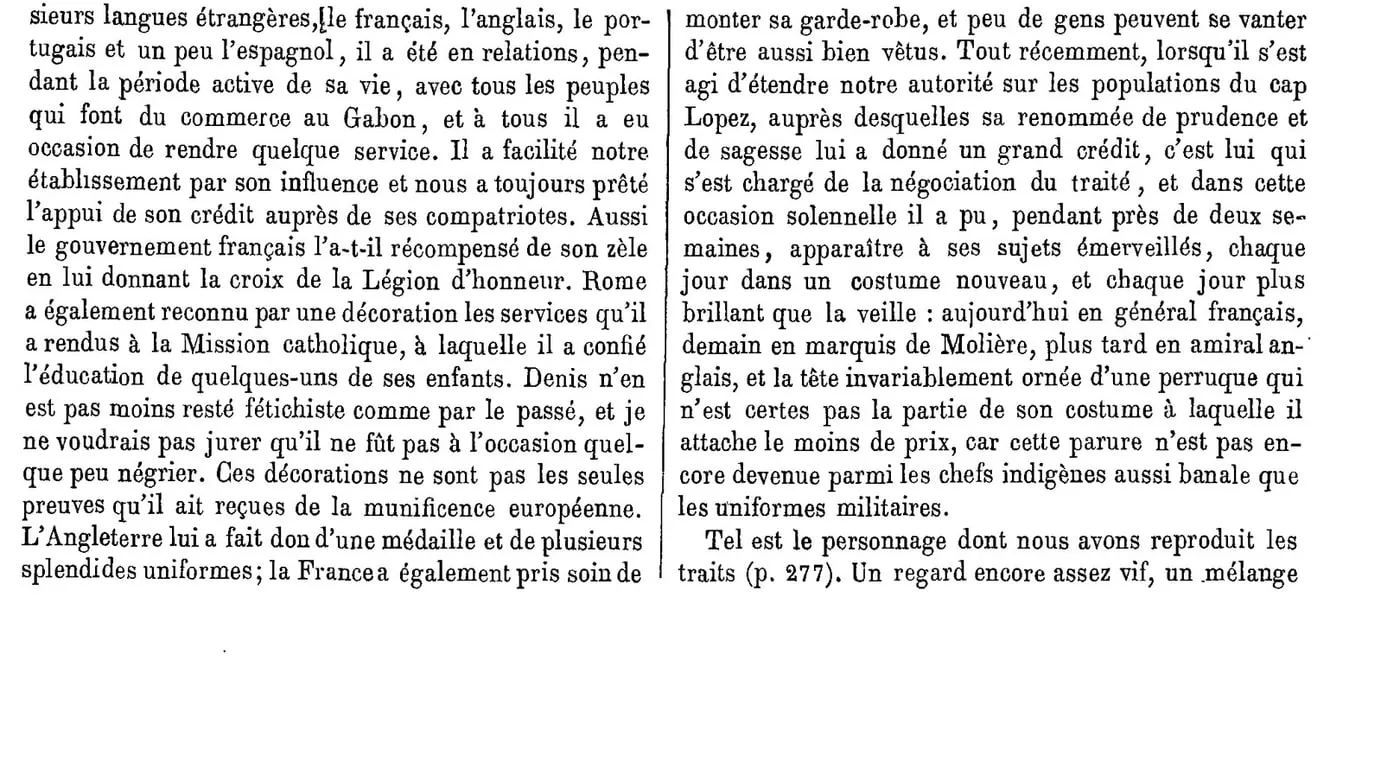
What do the sources say? Dr Griffon du Bellay, who met the king in the early 1860s, wrote in 1865: “England gave him a medal and several splendid uniforms; France likewise took care to furnish his wardrobe” (« L’Angleterre lui a fait don d’une médaille et de plusieurs splendides uniformes »). The uniforms requested in 1840 did arrive; of a crown, however, he says nothing. The anthropologist Mélanie Soiron, in her University of Lille thesis (2009), reports that in 1848 the Queen sent the king, “in reward for good relations, sixty pieces of luxurious cloth, a senior officer’s dress and a king’s crown”, and that he chose to be buried in the full dress of an English general; she does not name the original document, and the day and month remain unknown. Family tradition adds that the Queen sent two crowns, one for the king and one for his consort. The Admiralty and Foreign Office archives of 1847-1849 may one day tell us more.
The line of the Crown
The Crown that honoured King Denis has never been broken: from Victoria to Charles III, six sovereigns have handed down the throne of Great Britain, just as the lineage of the Assiga clan has handed down the guardianship of the Royal Domain, documented over eleven generations. Two houses, two memories, bound by a gesture of 1839.
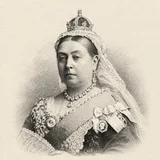 Victoriaqueen from 1837 to 1901 · who honoured King Denis
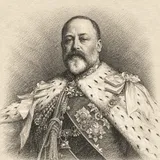 Edward VIIson of Victoria · king from 1901 to 1910
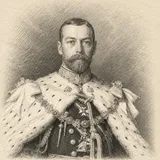 George Vson of Edward VII · king from 1910 to 1936
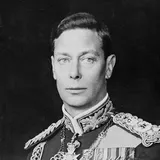 George VIson of George V · king from 1936 to 1952
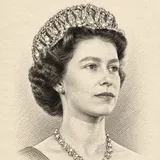 Elizabeth IIdaughter of George VI, great-great-granddaughter of Victoria · queen from 1952 to 2022
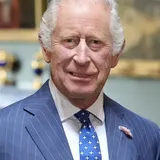 Charles IIIson of Elizabeth II · king since 2022
Portraits: engravings after Bassano, Fildes and the official photographs; Charles III after the official photograph · Wikimedia Commons, public domain.
Discover the family tree of the Assiga clan chieftaincy
The lineage from which King Denis descends, respected by the highest authorities of his time.
The year the powers paid tribute
Victoria’s gift did not come alone. In that same year of 1839, by royal ordinance of 16 September, King Louis-Philippe appointed the king’s son, King Denis II, Louis Denis Marie Félix Adandé Rapontchombo, knight of the Legion of Honour “for exceptional services rendered”: he was the first man from sub-Saharan Africa to receive this distinction. The King of the French added a silver-gilt medal in the name of the Ministry of the Navy; Pope Gregory XVI sent King Denis I a “Bene merenti” medal; and the Prince de Joinville saw to it that the cannon saluted the king’s pirogue when it came alongside French ships. In a single year, London, Paris and Rome had honoured the master of the estuary and his House.
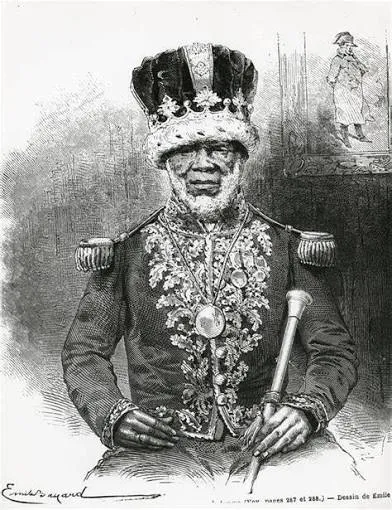
The memory of the House calls these tributes the crown jewels: they tell that even before the founding of Libreville, a king of the estuary dealt with London and Paris as a sovereign. This memory is not closed: the royal attributes are today in the keeping of HRH Princess Marie-Anne Ankombie Rapontchombo, guardian of the lineage’s cultural heritage, and the King Denis museum at Pointe-Denis preserves their memory, where it all began. The honours from Paris and Rome have their own stories: the cross of Franceand the Pope’s medal.
Sources
- On the rescue of the four English sailors and Queen Victoria’s gifts (gold chain, gold medal and its dedication): « Denis Rapontchombo », Miboue.
- Parliamentary Papers, 1841 (Niger expedition): report of Commander Tucker, HMS Wolverene, Fernando Po, 31 May 1840; the king’s letter to the Queen of 16 May 1840 (the Lynx sailors, the one hundred and twenty dollars, the gifts requested); Lord John Russell’s despatch of 30 January 1841; transcription: “The 1841 Niger expedition”, pdavis.nl.
- Correspondence with the British Commissioners … relating to the Slave Trade, Class A, C and D, presented to both Houses of Parliament, 1841: Commander Tucker’s letters of 17 March 1840 (arrival of the Wanderer at Sierra Leone) and 12 May 1840 (“to present King Denny with the medal sent out per ‘Wanderer’”), pp. 187-188; seizure of the Emilia in the Gabon river, 9 November 1840, pp. 118-120: Internet Archive.
- Royal Museums Greenwich, letters of Cornelius Thomas Augustus Noddall, 1840, with “a description of a medal presentation to King Denny, an African chief”, reference AGC/N/33: rmg.co.uk.
- Mélanie Soiron, La longévité politique. Ou les fondements symboliques du pouvoir politique au Gabon, doctoral thesis, Université Lille 1, 2009, vol. 1, pp. 82-83, note 207: theses.fr; Dr Griffon du Bellay, « Le Gabon », Le Tour du Monde, 1865, p. 287: Wikisource; the capture of the Lynx boat: Miboue; the two crowns: family tradition.
- On the Legion of Honour of 16 September 1839, the first distinction of its kind awarded to a man from sub-Saharan Africa: « Denis Rapontchombo », Wikipédia, which attributes it to King Denis; the family corrects this: it belongs to King Denis II, Louis Denis Marie Félix Adandé Rapontchombo.
- The crown and sceptre given by Queen Victoria: family tradition of the House of Rapontchombo, supported by the photographs of 1862.
- Images: portrait of Queen Victoria by Winterhalter (1843), Royal Collection; Buckingham Palace, engraving of 1837; photographs of 1862, musée du quai Branly - Jacques Chirac (inv. 70.2008.16.2.17); engraving by Émile Bayard. All in the public domain; see the Archives page of this site.
- Ships and chart: “H.M. Brig Wolverene, beating the Squadron” (PU6064); Nicholas Matthews Condy, The Capture of the slaver Gabriel by HMS Acorn, 6 July 1841 (BHC0628); Admiralty Chart No. 594, Africa Sheet II (F0133), Royal Museums Greenwich, via Wikimedia Commons, public domain.
- On the reign of King Denis: Elikia M'Bokolo and Bernard Rouzet, Le Roi Denis : la première tentative de modernisation du Gabon, ABC, 1977.