

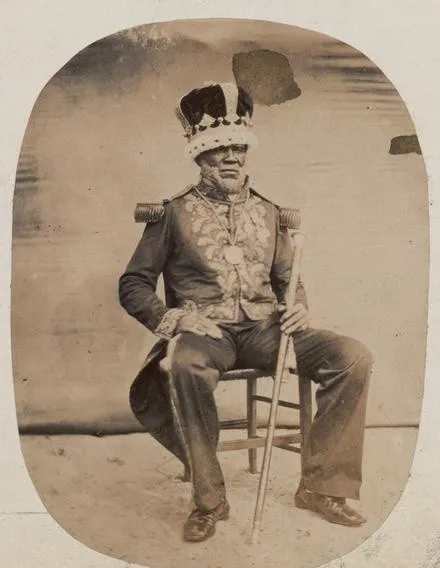
King Denis was not the king of a country, but the chief of a clan. Among the Mpongwe of the Gabon estuary, each clan had its own chief, its own seat and its own ancestors, and King Denis’s clan was called the Assiga, which books also spell Asiga, and which the explorer Paul Du Chaillu wrote down in 1861 as “Ashiga”. This article brings together what the published sources say about the clan, from its first ancestors to the present day. When a piece of information comes only from the family’s memory, we say so; when the sources disagree, we point it out.
Origins: from R’Ombonwa to Ongonwu Ré-Mboko
The clan’s genealogy has come down to us through Abbé André Raponda-Walker, who published it in 1960 from the archives of the Denis family. The king’s father, Ongonwu Ré-Mboko, “of the Assiga clan”, was the son of Résakuélé, son of Ré-Ntori, son of R’Ombonwa, “the first ancestor of the clan whose name is remembered”. No date is known for these first three generations; Ré-Mboko’s can only be inferred from his son’s succession, around 1810.
Where did the Assiga come from? In his list of the Mpongwe clans, Raponda-Walker writes that this clan “broke away in the course of time from that of the Agwénkowa”; the ethnologist Michel Jouin notes in 1973 that the Agwènkowa, “formerly at Denis”, later moved to Donguila. Raponda-Walker also relates how the seat came to the Assiga. The chief of the Aguempo clan (Agwémpono), settled at Mina in the Iwengué-Nyama creek, disinherited on his deathbed the son who was to succeed him, and named Ré-Mboko to occupy the éka, the seat, that is to say the throne; the list of clans sums it up in a single line: the “kingship” of the Agwémpono “passed to the Asiga”. Ré-Mboko is thus, according to Raponda-Walker, “the first of the Assiga to ascend the éka”. To mark that the seat was his for good, he added to his son Kowé’s name that of Rapontchombo, which is said to mean, “according to some”: “what was given to me was not lent to me, but given for good”.
One clan among the Mpongwe clans
The Mpongwe form, Raponda-Walker writes, a tribe (inongo) divided into clans (imbuwe), which “do not seem to have exceeded twenty or so” at the outset; his list has twenty-five entries, several of them extinct or split clans. Of the Asiga he says that they are “still relatively numerous” in 1960, and that they are the “clan of Kowé Rapontchombo, or King Denis”. Members of the same clan claim common male ancestors, do not marry one another, and owe one another close solidarity: pursuing together the killer of one of their own, ransoming prisoners, contributing to bride prices and fines. Below the clan, Jouin describes the lineage (nago, the “house”) and the line (inu, the “hearth”).
Nineteenth-century travellers saw the estuary through these clans. In 1856 the American missionary John Leighton Wilson counts four main Mpongwe communities: on the north bank, the people of King Glass and King Quaben; on the south bank, those of “King William”, that is King Denis, near the mouth of the river, and those of King George, some thirty miles further up. In 1861 Paul Du Chaillu specifies that the king “belongs to the Ashiga family” and considers him “the most intelligent of all the kings”. It is the earliest printed mention of the clan that we know of.
Since the clans were exogamous, alliances were made from one clan to another, and the genealogy keeps their trace. King Denis’s mother, Ozugayilé, was of the Adoni clan; conversely, King François, chief of the Adoni of Dambè island (Coniquet), had for mother Ngwé-Nanga, “born of the Assiga clan”. The mother of Félix Adandé, Ngwembinda, belonged to the Agulamba, the clan of King George Rassondji, the other great chief of the left bank (see The Oga of the estuary).
The éka and the succession
The word éka means the throne, and Raponda-Walker describes its form: “a small round seat (mbata) covered with a white cloth (ivéla)”, placed in the chief’s great house, which was built at right angles to the street. The oga, the chief, bore as insignia the iron bell nkéndo, the great ebony cane nkogu, a spear, a fly-whisk and a fan. Before him a small special drum was beaten, the épona; and Raponda-Walker adds: “Among the Asiga King Denis alone could play this sacred drum.” Jouin adds that the palaver house held the chief’s throne and the relics of the clan’s ancestors, beside a fire kept burning at all times by an old woman, “the woman of the throne”.
On the rule of succession, the sources disagree. For Raponda-Walker, among the Mpongwe in general, the succession “usually fell to the brother of the chief”, the elders being able to set aside the natural heir and announcing their choice, kept secret, on the seventh day of mourning. For Jouin, the chieftaincy traditionally passed to the eldest son, to whom the oldest of the elders handed the insignia at the end of the funeral. Both insist on the role of the elders: the Mpongwe chieftaincy, Jouin writes, “looks more like a gerontocracy than a kingship”, and the word “king” given by the Europeans “should not mislead”.
In the Assiga line, Raponda-Walker describes a usage of its own. On his deathbed, Ré-Mboko drew his ring from his finger and placed it on that of the son he had chosen, Denis, “then very young”; sixty-six years later, Denis made the same gesture for his younger son, Félix Adandé, “for such was the mode of transmission of power in the family”. The choice was not uncontested: an elder brother of Félix, who believed himself called to the throne, “grumbled about it a great deal”.
The left bank and Pointe-Denis
The Assiga are the clan of the left bank, the south bank of the estuary, facing present-day Libreville. Raponda-Walker calls the peninsula “Denis or Nchantoné”; Jouin reports that the south bank bore in Mpongwe a name taken from the Portuguese São Tomé; today it is written Nchantonwin. At the beginning of the nineteenth century this bank was shared among many clans, among them the Asiga, the Agulamba, the Aninwo, the Abandja and the Agwémpono.
Between the Assiga and the Agulamba the border was clear. It followed the Igombiné river, and to pass from one territory to the other “a special authorisation from the chief of the neighbouring clan was needed”. When the two chiefs poured their offerings on the sea, each one followed the shore from his village as far as a rocky islet, Edo-z’Ombwiri, held to be the dwelling of the most fearsome spirit of the estuary; neither had the right to pour his offerings beyond his own limits, in the “common sea”.
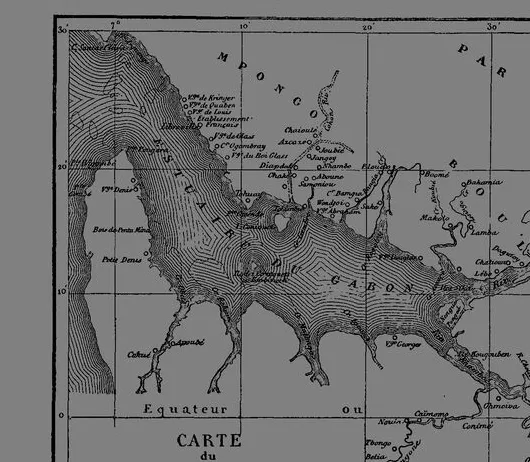
The king’s village was a large one. According to figures from Wilson taken up by the historian K. David Patterson and quoted by Jouin, in 1842 the main village of Denis had a hundred and fifty houses and seven to eight hundred inhabitants, plus some four hundred slaves. The clan’s lands reached beyond the sandy point: at the head of the Mbata creek, on the road to Cape Lopez, Du Chaillu visited in 1856 plantations he judged “the most flourishing” on the coast, and wrote that the king’s subjects “are the most well-to-do of the Mpongwe”. A group of Pygmies of the left bank had also placed itself, according to Raponda-Walker, “under the protection of the chiefs of the Asiga family”. The clan had its own dead: Raponda-Walker cites “the old cemeteries of Ozogolo, of the Assiga of Pointe Denis”, family cemeteries where only free people were received; the king himself lies in the old cemetery of Iwounwé, between Pongara point and Nghomboué point.
King Denis and the treaties
Kowé Rapontchombo succeeded his father around 1810 and reigned for nearly sixty-six years (his life is told in King Denis, a life). Father Gautier, quoted by Raponda-Walker, ranks him among the most influential oga in Mpongwe history, a chief “whose renown and influence reached beyond Cape Lopez; people came from afar to ask for his mediation”. Wilson, who met him, describes a man of about sixty with a snow-white beard, “one of the most king-like looking men I have ever met in Africa”. Raponda-Walker quotes this portrait under the name of the Englishman Richard Burton, but it appears word for word in Wilson’s book as early as 1856.
On 9 February 1839, aboard La Malouine, the king signed with Édouard Bouët (later Bouët-Willaumez) the treaty that opened the French presence in Gabon, despite the hostility of most of his counsellors. According to Raponda-Walker, it allowed the French to settle on two leagues of coast; the Navy put up a few buildings there, including a coal depot, then moved to the other bank. For, Jouin stresses, clan chiefs did not recognise treaties signed by other clans: France had to treat with each of them, one after another. It was “with the support of King Denis” that King Louis Dowé, of the Aguékaza, signed the treaty from which Fort d’Aumale would come. The sources hesitate over the date: Raponda-Walker writes “18 March 1841” in his chapter on Denis, but quotes a text dated “18 March 1842” in the one he devotes to King Louis; Jouin gives 1841.
On 1 August 1846, aboard the Aube, a new act brought together the signatories of the treaty of 1 April 1844 and recognised France’s right to settle on any land that seemed useful to it; the text, which Raponda-Walker reproduces from the copy kept by the descendants of King François, opens its list of signatures with those of « Roi Denis » and « Roi Georges ». As early as 1839, France had made his son, King Denis II, Louis Denis Marie Félix Adandé Rapontchombo, a Knight of the Legion of Honour, and Queen Victoria had sent King Denis a crown, a sceptre, a gold chain and a gold medal. For what followed, see From the lands of King Denis to Libreville.
King Denis II and the gold ring
In the spring of 1876, the old king drew off his gold ring and placed it on the finger of his son Félix Adandé, thereby naming him to succeed him “to the exclusion of any other”, before his subjects and the neighbouring chiefs: “I am going to die, and I leave you, to be king in my place, to whom you all owe homage, obedience and respect, according to the tradition of my fathers, my son Félix Adandé.” The king died on 9 May 1876. The historian Jeremy Rich sums it up: on his father’s death, Félix Adandé became “the chief of the influential Asiga clan”. The family specifies: this son is King Denis II, Louis Denis Marie Félix Adandé Rapontchombo.
The two main sources do not tell quite the same story. Raponda-Walker, writing from the family archives and the missionary bulletins, dates Félix’s birth to around 1847 and describes a Christian and lettered chief, a former employee of the Navy offices, founder of a school at Denis, loyal to France, who for a time had to take refuge in the village of Arévoma, “the village that must be shown to no one”, before winning his case. Rich, who draws on colonial and missionary archives, gives 1844 as his birth year and describes a more troubled career: arrested in 1884 and threatened with deportation, Félix escaped and remained for years out of the administration’s reach; around 1903 he collected taxes on the south bank for the government, before being stripped of his title in 1905. Both agree on the essential: Félix Adandé remained, until his death on 24 September 1911, the chief of the south bank of the estuary. In 1950 the government had a mausoleum raised over his tomb.
Raponda-Walker names his children: Jean-Félix Rapontchombo (1872-1903), the first Gabonese to obtain a university degree; Jean Rémy Onanga Adandé Rapuntchombo dit « Ajax », father of Prince Félix Adandé (the family corrects this: he was the son of Prince Félix Adandé); and Marie-Anne Ankombié (1875-1951), widow of Joseph Ongouwou-Tito, “long the guardian of the ancestral land”, who died in Libreville and was buried at Denis, beside her father.
Transmission through women and the customary rule
Mpongwe descent is patrilineal, but it is the bride price that sets it in motion. Michel Jouin explains in 1973: “The children of a legitimate union belong to the lineage and the clan of their father”, and a legitimate child is “a child whose mother has been given a bride price by the husband”. When the mother has received no bride price, or when the father does not acknowledge the child, the child belongs to its mother’s clan; and “children of mixed race, of a Mpongwe mother and a European father, are also adopted by the mother’s clan”. Raponda-Walker had said the same in 1960: the child belongs to the father “if he had paid the bride price in full”; “otherwise, the child returned to the mother’s clan”. He gives an example: according to one version, King Louis Dowé was born of an Aguékaza woman taken back by her family, and “according to custom the child became an Aguékaza by right”.
It is through this mechanism that the House understands how its heritage was handed down in the last generations, where the line passes through women. Virginie Ambougou, born on 27 August 1902 at Pointe-Denis, daughter of Marie-Anne Rapontchombo and Tito Ongonwou, is described by the published sources as Oga of the Assiga clan; in 1961 she was one of the first two women elected to Gabon’s National Assembly. The published sources do not say how the rule applied in her case; the rest of the line, down to Princess Marie-Anne Ankombie Rapontchombo II and her son Jacques Makaya Zimamo, is established according to the tradition of the House. The whole can be read in the family tree.
The clan, its ancestors and the Bwiti
The clan is also a community of worship. All its members, Raponda-Walker writes, “made sacrifices to the spirits of the clan’s ancestors: Agombè-nèro”; and we have seen that the chief of the Assiga himself went to pour offerings on the sea as far as the limits of his territory. These rites have not disappeared: in April 2026 the AFP filmed, off Pointe-Denis, the Mpago, the offerings to the spirits of the sea, and Gérard-Aimé Adande, grandson of Prince Félix Adande Rapontchombo, spoke there of the Assiga clan as a relationship between the sea spirits, “our ancestors the Agombés”, and the deity.
What follows belongs to the tradition of the House. According to it, the great building that Houzé de l’Aulnoit photographed in 1861-1862 at Pointe-Denis was the Bwiti temple of King Denis, where the chief of the clan held the rites of which his line has remained the guardian; and since King Denis the line has handed down a branch of the Bwiti Disumba that it calls Omengo. The early written sources, for their part, do not speak of the Bwiti in connection with the Assiga: they describe the cult of the ancestors, the sacred drum and the offerings to the sea.
The clan today
In the twentieth century the Mpongwe clans gradually left the left bank for Libreville. According to Raponda-Walker, the last Mpongwe of Denis only abandoned the villages of their ancestors in the first years of the century; Jouin specifies that the Asiga spread throughout the Glass quarter “while keeping a village” at Denis. He also considers, in 1973, that this move disorganised the chieftaincy and the cult of the ancestors across all the clans. The line, for its part, remained present: in 1960 Raponda-Walker presents Prince Félix Adandé, the king’s great-grandson, as “the present chief of the Mpongwe community of Glass”; he is found in Paris in 1939 and in the independence delegation of 1960 (see The House of Rapontchombo and the heads of state).
Today, Princess Marie-Anne Ankombie Rapontchombo is the keeper of the heritage and the royal regalia of Pointe-Denis, and Jacques Makaya Zimamo leads every year, in traditional dress, the ceremony at the king’s tomb. On 2 August 2015, sovereigns and traditional chiefs from several countries came there to pay tribute to the king (see 2 August 2015: the kings of Africa at Pointe-Denis). The clan’s name also lives on in that of Maison Assiga Domaine Royal Rapontchombo, whose history is told on the Royal House page.
Sources
- André Raponda-Walker, Notes d’histoire du Gabon, Brazzaville, Mémoires de l’Institut d’études centrafricaines no. 9, 1960, full text on the IRD portal (in French): the king’s ancestry, the éka and the name Rapontchombo (p. 24); the treaty of 1839 and King Louis’s treaty “on 18 March 1841” (pp. 25-26); the gold ring, death and burial of the king (p. 29); Ré-Mboko “the first of the Assiga to ascend the éka”, Félix Adandé and his children (pp. 30-33); King Louis’s treaty dated “18 March 1842” and the birth of Ré-Dowé (p. 35); the border and offerings of the Assiga and the Agulamba (p. 39); King François and his mother Ngwé-Nanga, the act of 1 August 1846 (pp. 42-43); list of clans, Agwémpono and Asiga (pp. 51-52); bride price and descent (p. 53); insignia, éka, the drum épona, succession (pp. 53-54); the cemeteries of Ozogolo (p. 89); the Pygmies of the left bank (p. 148).
- Michel Jouin, La terminologie de parenté mpongwè, Libreville, ORSTOM, 1973, full text on the IRD portal (in French): the clans of the south bank and the Agwènkowa (p. 3); the 1842 figures after Wilson and Patterson (p. 4); the Asiga’s settlement in Glass (p. 5); lineage, clan, bride price and descent (pp. 6-9); chieftaincy, palaver house and treaties clan by clan (pp. 14-15); succession by the eldest son (p. 165).
- Jeremy Rich, “King or Knave? Félix Adende Rapontchombo and Political Survival in the Gabon Estuary”, African Studies Quarterly, vol. 6, no. 3, 2002, open access: Félix Adandé (1844-1911), chief of the Asiga clan in 1876 (pp. 1, 3); arrest and escape in 1884 (p. 6); tax collection around 1903 and loss of title in 1905 (p. 9); chief of the south bank until his death (pp. 9-10).
- John Leighton Wilson, Western Africa: its History, Condition, and Prospects, New York, 1856, pp. 292-294, archive.org: the four Mpongwe communities and the portrait of “King William”, King Denis.
- Paul B. Du Chaillu, Explorations and Adventures in Equatorial Africa, London, 1861, pp. 17-18, archive.org: the king “belongs to the Ashiga family”; the Mbata plantations, quoted from the 1863 French translation reproduced by Raponda-Walker (p. 27).
- K. David Patterson, The Northern Gabon Coast to 1875, Oxford, Clarendon Press, 1975 (quoted by Jouin for the 1842 figures); Elikia M’Bokolo, Le roi Denis. La première tentative de modernisation du Gabon, Paris-Dakar, ABC-NEA, 1976 (the reference biography, not consulted for this article).
- Convention of 9 February 1839: Archives nationales d’outre-mer, FR ANOM 40 COL 436; map of 1865: Dr Griffon du Bellay, « Le Gabon (1861-1864) », Le Tour du Monde, 1865, Gallica/BnF.
- Virginie Ambougou, Oga of the Assiga clan: “Virginie Ambougou”, Wikipedia; Info241, 2021.
- The Mpago of April 2026: Africanews/AFP, 16 April 2026; Princess Marie-Anne Ankombie Rapontchombo: 7joursinfo, 2020; the ceremony at the king’s tomb: Gabon Télévisions, 4 November 2024.
- Tradition of the House: the Bwiti temple and the Omengo, the descent of the last generations (family testimony of Jacques Makaya Zimamo); see the family tree and the Sources page.