

Of all the branches of the Bwiti, the Disumba (also written Dissoumba or Dissumba) is the oldest: the trunk from which every branch grows. Born among the Mitsogo and the Apindji of the Ngounié region, in central Gabon, it is the initiatory society of men, the school in which the knowledge of origins is handed down. Whoever wishes to understand the Missoko, the Ngondet or family branches such as the Omengo must begin here.
The temple, the post and the fire
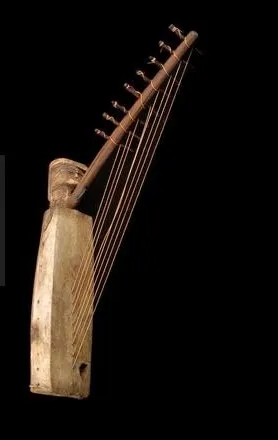
The Disumba is lived in the ebandza, the temple: a large open meeting house in which every element carries meaning. The central post links earth to sky; the fire keeps watch all night; the ngombi harp carries the voice of the invisible world. The initiate enters through initiation, receives the founding vision, then advances from grade to grade in knowledge: each stage must be earned, learned and kept. The ethnographers Otto Gollnhofer and Roger Sillans, who devoted their careers to the Mitsogo, described this ritual architecture in La mémoire d'un peuple (1997); André Raponda-Walker and Roger Sillans had already drawn its outline in Rites et croyances des peuples du Gabon(1962).
From central Gabon to the coast
Along the trade routes and through alliances between peoples, knowledge of the Disumba travelled in the 19th century towards the Ogooué and the coast, home of the Mpongwe and the other Myene peoples. From this trunk came the great refoundings: the healing way of the Missoko and the lineage branches such as the Ngondet. The lines of initiation, for their part, remember: Jérôme Mouele Niangou, the spiritual father who accompanies Maison Assiga, received his initiation into the Disumba from Yves Itsoukigha Koumba (Kombo: Mourô Nâ Mat), himself initiated by Guy Roger Mboumba Moussavou (Kombo: Ressassaguani); his lineage is published on this site.
Placing the Disumba in the tree
Sources
- Otto Gollnhofer and Roger Sillans, La mémoire d'un peuple. Ethno-histoire des Mitsogho, ethnie du Gabon central, Paris, Présence africaine, 1997.
- André Raponda-Walker and Roger Sillans, Rites et croyances des peuples du Gabon, Paris, Présence africaine, 1962: archive.org.
- James W. Fernandez, Bwiti: An Ethnography of the Religious Imagination in Africa, Princeton University Press, 1982.
- The Disumba lineage of Jérôme Mouele Niangou, as given by himself: his portrait on this site.
- The other branches: Missoko, Ngondet, Omengo; the overview: What is the Bwiti?.